Zhou Hang, Zhu Junmeng, Mei Yi, Chen Aoxing, Liu Rui, Wang Xiaonan, Wu Xiangyu, Chen Xiaotong, Liu Baorui
The Comprehensive Cancer Centre, Nanjing Drum Tower Hospital, Affiliated Hospital of Medical School, Nanjing University, Nanjing 210008, China.
The Comprehensive Cancer Centre of Nanjing Drum Tower Hospital, Clinical College of Traditional Chinese and Western Medicine, Nanjing University of Chinese Medicine, Nanjing 210008, China.
Biomater Res. 2024 Jan 7;29:0130. doi: 10.34133/bmr.0130. eCollection 2025.
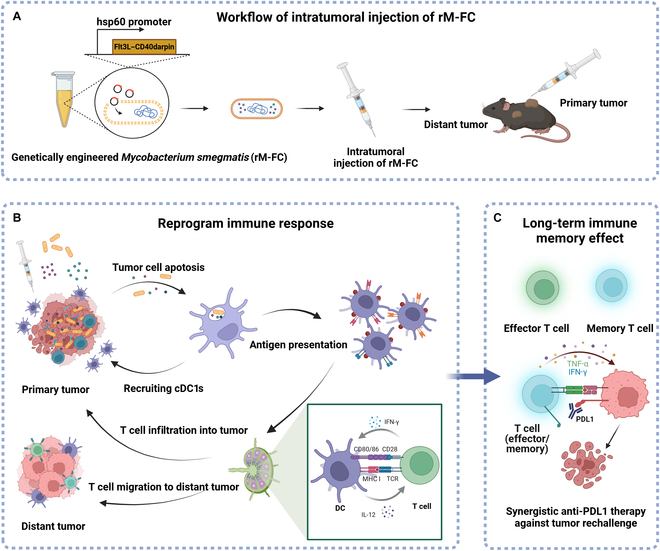
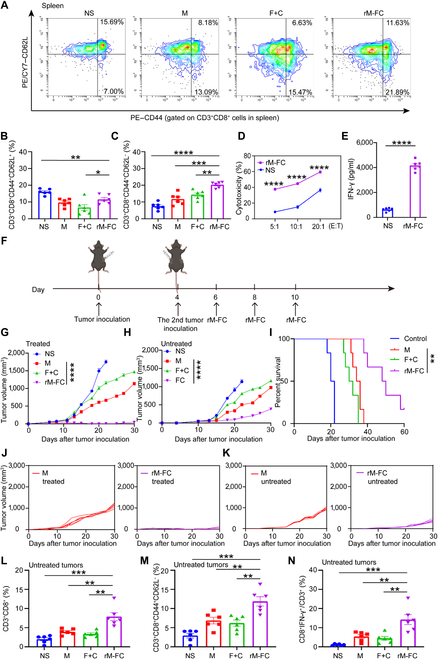
Conventional type 1 dendritic cells are essential for antigen presentation and successful initiation of antitumor CD8 T cells. However, their abundance and function within tumors tend to be limited. , a fast-growing, nonpathogenic mycobacterium, proves to be easily modified with synthetic biology. Herein, we construct an engineered expressing a fusion protein of Fms-like tyrosine kinase 3 ligand and costimulator CD40darpin (rM-FC) since the 2 drugs are reported to have a good synergistic effect. Intratumoral delivery of rM-FC effectively recruits and activates dendritic cells (DCs), especially CD103 DCs and CD80CD86 DCs, further inducing sufficient migration of effector memory T cells into the tumor microenvironment. This successfully converts the so-called immune-desert tumors to the "hot" phenotype. In B16F10 mouse melanoma tumor models, local injection of rM-FC into the primary tumor triggers a robust T cell immune response to restrain the growth of both the treated tumors and the distant untreated ones. The population of PDL1 tumor cells increased after the in situ vaccination, and murine tumors became more responsive to programmed death ligand 1 (PDL1) blockade, prompting the combination therapy. Overall, our findings demonstrate that rM-FC acts as a strong DC agonist and remarkably enhances antitumor immunity.
传统的1型树突状细胞对于抗原呈递和抗肿瘤CD8 T细胞的成功启动至关重要。然而,它们在肿瘤中的丰度和功能往往受到限制。耻垢分枝杆菌是一种快速生长的非致病性分枝杆菌,事实证明它很容易通过合成生物学进行改造。在此,我们构建了一种工程化的耻垢分枝杆菌,表达Fms样酪氨酸激酶3配体和共刺激分子CD40darpin的融合蛋白(rM-FC),因为据报道这两种药物具有良好的协同作用。瘤内递送rM-FC可有效募集和激活树突状细胞(DCs),尤其是CD103 DCs和CD80CD86 DCs,进而诱导效应记忆T细胞充分迁移至肿瘤微环境中。这成功地将所谓的免疫“冷”肿瘤转变为“热”表型。在B16F10小鼠黑色素瘤肿瘤模型中,将rM-FC局部注射到原发性肿瘤中可引发强烈的T细胞免疫反应,从而抑制已治疗肿瘤和远处未治疗肿瘤的生长。原位接种后,PDL1肿瘤细胞数量增加,并且小鼠肿瘤对程序性死亡配体1(PDL1)阻断治疗变得更敏感,从而促使联合治疗。总体而言,我们的研究结果表明,rM-FC作为一种强大的DC激动剂,可显著增强抗肿瘤免疫力。