Johnson Abigail J, Alvear Alison, Knights Dan, Chow Lisa S, Bantle Anne E
Division of Epidemiology and Community Health, School of Public Health, University of Minnesota, Minneapolis, MN 55455, USA.
Division of Diabetes, Endocrinology and Metabolism, Department of Medicine, University of Minnesota, Minneapolis, MN 55455, USA.
Nutrients. 2025 Jan 4;17(1):185. doi: 10.3390/nu17010185.
TRE is an emerging approach in obesity treatment, yet there is limited data on how it influences gut microbiome composition in humans. Our objective was to characterize the gut microbiome of human participants before and after a TRE intervention. This is a secondary analysis of a previously published clinical trial examining the effects of time-restricted eating (TRE).
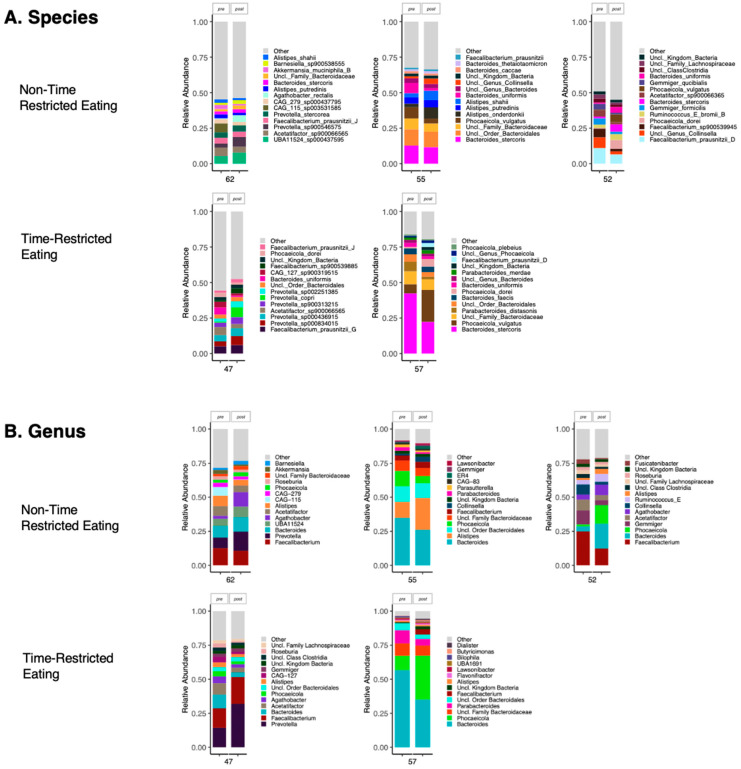
In a previously published, 12-week randomized controlled trial, Chow et al. evaluated the effects of an 8-h TRE intervention on body composition in human participants. Chow et al. demonstrated significant reductions in weight, lean mass, and visceral fat in the TRE group compared to those following time-unrestricted eating (non-TRE). Stool samples were collected by a subset of those participants using home kits at both baseline and post-intervention for shotgun metagenomic sequencing for this secondary analysis. Microbiome community composition was compared before and after intervention as alpha and beta diversity.
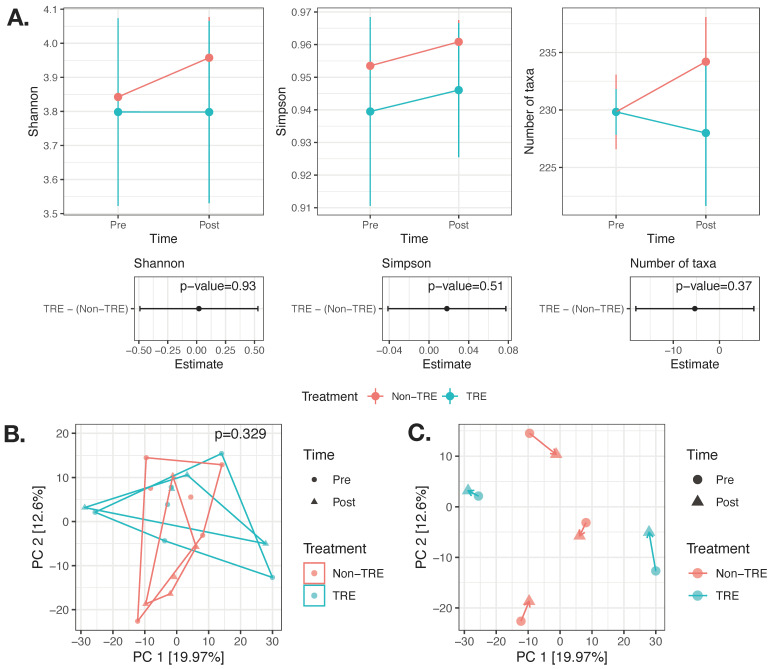
Sixteen participants provided stool samples (eight in the TRE group and eight in the non-TRE group). Stool samples were collected from all participants at at least one time point, but both pre- and post-treatment samples were available from only five participants who completed both baseline and post-treatment collections. In alignment with the findings of Chow et al., the participants in the TRE group of the secondary analysis who collected microbiome sample(s) successfully reduced their eating window from an average of 15.3 ± 0.8 h at baseline to 9.3 ± 1.7 h during the intervention (mean ± SD, < 0.001) and the non-TRE group's eating window remained unchanged. While the TRE group lost weight and visceral fat mass, no effect of the TRE intervention was observed on alpha diversity (Shannon index, Simpson index, and number of taxa, linear mixed models), beta diversity (Bray-Curtis, PERMANOVA), even after controlling for weight and visceral fat changes.
Our analysis did not detect any significant differences in gut microbiome composition or diversity indices between participants undergoing a TRE intervention and those in the control group. The study's findings are limited by a small sample size, short duration, and the collection of stool samples at only two time points. Future studies with larger sample sizes, longer durations, and more frequent sampling, and collection of detailed dietary data are needed to better understand the relationship between TRE and gut microbiome dynamics.
限时进食(TRE)是一种新兴的肥胖治疗方法,但关于其如何影响人类肠道微生物群组成的数据有限。我们的目的是描述TRE干预前后人类参与者的肠道微生物群特征。这是对先前发表的一项研究限时进食(TRE)效果的临床试验的二次分析。
在先前发表的一项为期12周的随机对照试验中,Chow等人评估了8小时TRE干预对人类参与者身体成分的影响。Chow等人证明,与不限时进食(非TRE)的参与者相比,TRE组的体重、瘦体重和内脏脂肪显著降低。该二次分析的一部分参与者在基线和干预后使用家用试剂盒收集粪便样本,用于鸟枪法宏基因组测序。将干预前后的微生物群群落组成作为α和β多样性进行比较。
16名参与者提供了粪便样本(TRE组8名,非TRE组8名)。所有参与者至少在一个时间点收集了粪便样本,但只有5名完成基线和治疗后收集的参与者同时提供了治疗前和治疗后的样本。与Chow等人的研究结果一致,二次分析中成功收集微生物组样本的TRE组参与者将进食窗口从基线时的平均15.3±0.8小时成功缩短至干预期间的9.3±1.7小时(平均值±标准差,P<0.001),而非TRE组的进食窗口保持不变。虽然TRE组体重和内脏脂肪量有所下降,但即使在控制体重和内脏脂肪变化后,也未观察到TRE干预对α多样性(香农指数、辛普森指数和分类单元数量,线性混合模型)、β多样性(布雷-柯蒂斯距离、PERMANOVA)有任何影响。
我们的分析未发现接受TRE干预的参与者与对照组之间在肠道微生物群组成或多样性指数上存在任何显著差异。该研究的结果受到样本量小、持续时间短以及仅在两个时间点收集粪便样本的限制。未来需要进行样本量更大、持续时间更长、采样更频繁以及收集详细饮食数据的研究,以更好地了解TRE与肠道微生物群动态之间的关系。