Zhou Liqian, Peng Xinhuai, Chen Min, He Xianzhi, Tian Geng, Yang Jialiang, Peng Lihong
School of Computer Science, Hunan University of Technology, Zhuzhou 412007, Hunan, China.
School of Computer Science, Hunan Institute of Technology, Hengyang 421002, Hunan, China.
Gigascience. 2025 Jan 6;14. doi: 10.1093/gigascience/giae103.
The accurate deciphering of spatial domains, along with the identification of differentially expressed genes and the inference of cellular trajectory based on spatial transcriptomic (ST) data, holds significant potential for enhancing our understanding of tissue organization and biological functions. However, most of spatial clustering methods can neither decipher complex structures in ST data nor entirely employ features embedded in different layers.
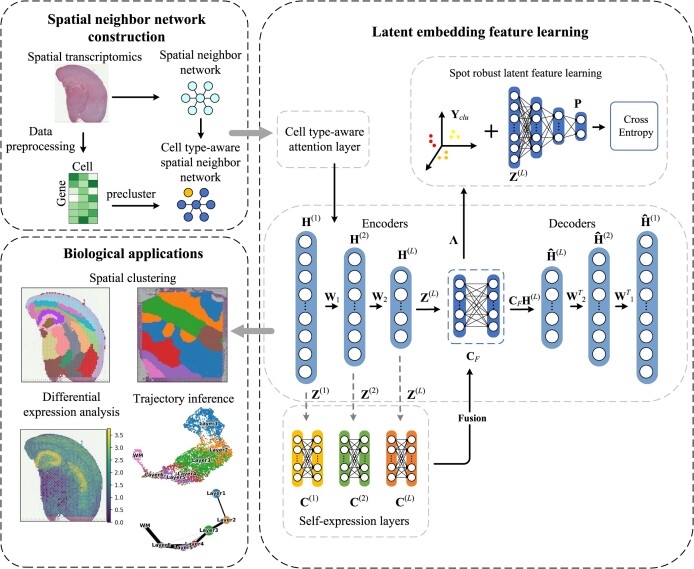
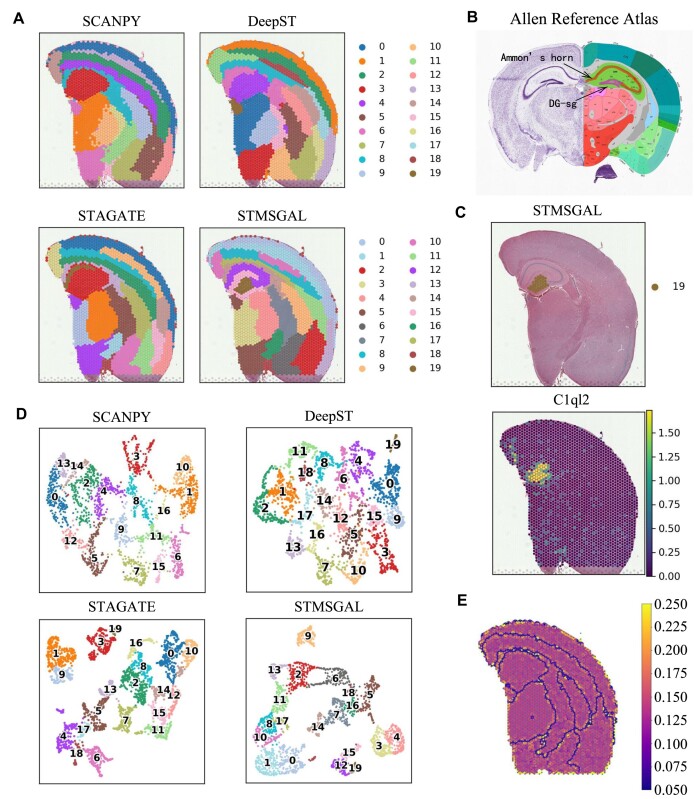
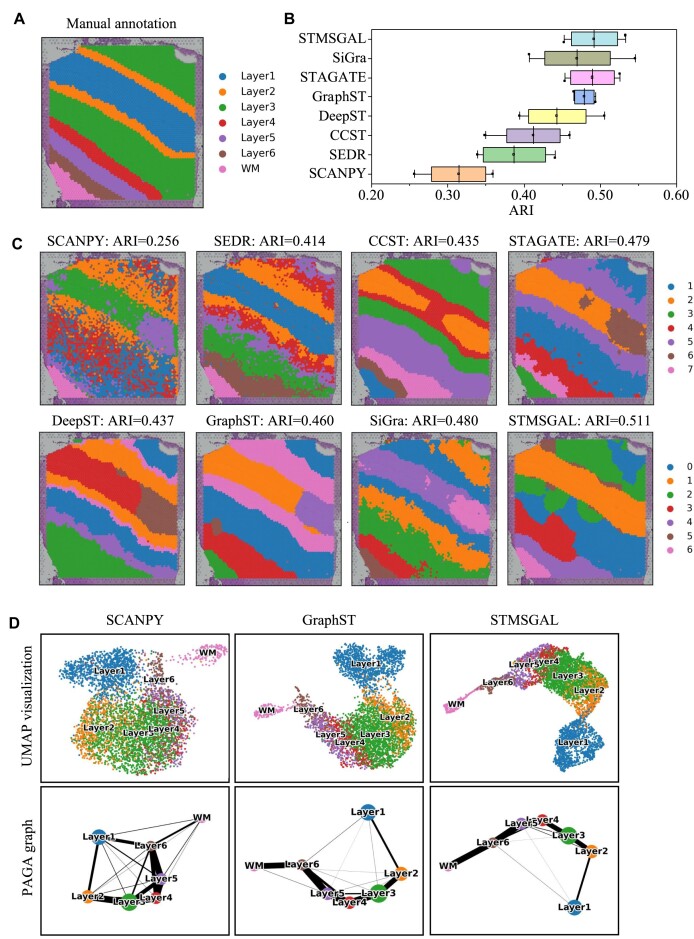
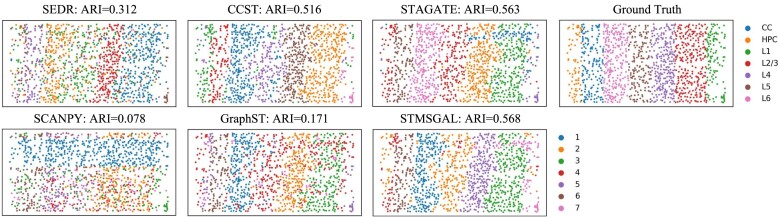
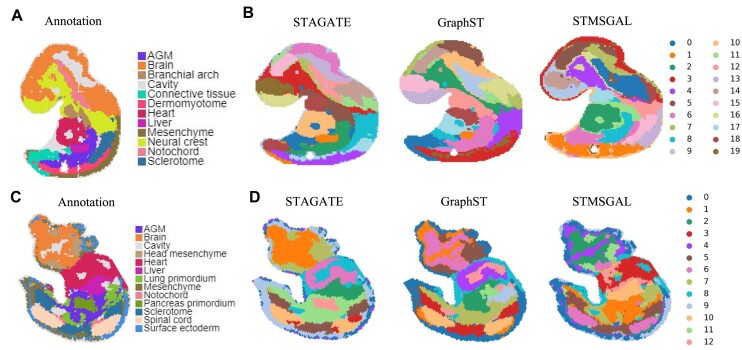
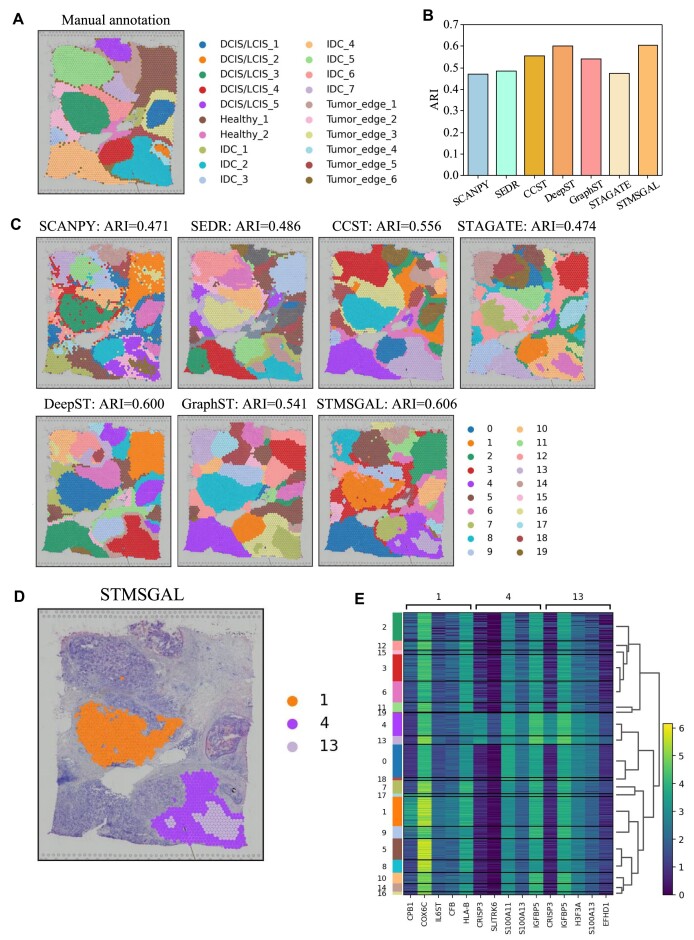
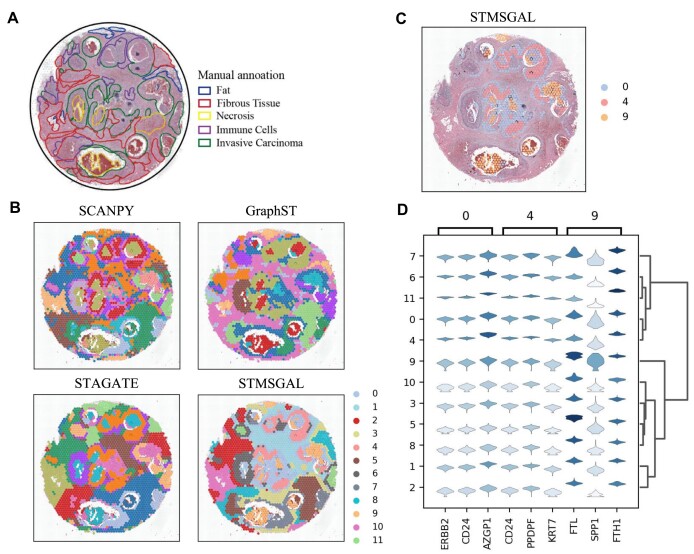
This article introduces STMSGAL, a novel framework for analyzing ST data by incorporating graph attention autoencoder and multiscale deep subspace clustering. First, STMSGAL constructs ctaSNN, a cell type-aware shared nearest neighbor graph, using Louvian clustering exclusively based on gene expression profiles. Subsequently, it integrates expression profiles and ctaSNN to generate spot latent representations using a graph attention autoencoder and multiscale deep subspace clustering. Lastly, STMSGAL implements spatial clustering, differential expression analysis, and trajectory inference, providing comprehensive capabilities for thorough data exploration and interpretation. STMSGAL was evaluated against 7 methods, including SCANPY, SEDR, CCST, DeepST, GraphST, STAGATE, and SiGra, using four 10x Genomics Visium datasets, 1 mouse visual cortex STARmap dataset, and 2 Stereo-seq mouse embryo datasets. The comparison showcased STMSGAL's remarkable performance across Davies-Bouldin, Calinski-Harabasz, S_Dbw, and ARI values. STMSGAL significantly enhanced the identification of layer structures across ST data with different spatial resolutions and accurately delineated spatial domains in 2 breast cancer tissues, adult mouse brain (FFPE), and mouse embryos.
STMSGAL can serve as an essential tool for bridging the analysis of cellular spatial organization and disease pathology, offering valuable insights for researchers in the field.
准确解析空间域,以及识别差异表达基因和基于空间转录组(ST)数据推断细胞轨迹,对于增进我们对组织组织和生物学功能的理解具有巨大潜力。然而,大多数空间聚类方法既无法解析ST数据中的复杂结构,也不能完全利用不同层中嵌入的特征。
本文介绍了STMSGAL,这是一种通过结合图注意力自动编码器和多尺度深度子空间聚类来分析ST数据的新框架。首先,STMSGAL使用仅基于基因表达谱的Louvian聚类构建ctaSNN,即细胞类型感知共享最近邻图。随后,它将表达谱和ctaSNN整合起来,使用图注意力自动编码器和多尺度深度子空间聚类生成点潜在表示。最后,STMSGAL实现空间聚类、差异表达分析和轨迹推断,为全面的数据探索和解释提供综合能力。使用四个10x Genomics Visium数据集、一个小鼠视觉皮层STARmap数据集和两个Stereo-seq小鼠胚胎数据集,将STMSGAL与7种方法进行了比较,包括SCANPY、SEDR、CCST、DeepST、GraphST、STAGATE和SiGra。比较结果显示,STMSGAL在戴维斯-布尔丁、卡林斯基-哈拉巴斯、S_Dbw和ARI值方面表现出色。STMSGAL显著增强了对具有不同空间分辨率的ST数据中层结构的识别,并准确描绘了2个乳腺癌组织、成年小鼠脑(FFPE)和小鼠胚胎中的空间域。
STMSGAL可以作为连接细胞空间组织分析和疾病病理学的重要工具,为该领域的研究人员提供有价值的见解。