Conen Robin, Mueller Steffen, Tibubos Ana Nanette
Department of Nursing Science, Diagnostics in Healthcare and eHealth, Trier University, Trier, Germany.
Department of Computer Science/Therapeutic Science, Trier University of Applied Sciences, Trier, Germany.
Interact J Med Res. 2025 Jan 20;14:e59611. doi: 10.2196/59611.
Psychoeducation positively influences the psychological components of chronic low back pain (CLBP) in conventional treatments. The digitalization of health care has led to the discussion of virtual reality (VR) interventions. However, CLBP treatments in VR have some limitations due to full immersion. In comparison, augmented reality (AR) supplements the real world with virtual elements involving one's own body sensory perception and can combine conventional and VR approaches.
The aim of this study was to review the state of research on the treatment of CLBP through psychoeducation, including immersive technologies, and to formulate suggestions for psychoeducation in AR for CLBP.
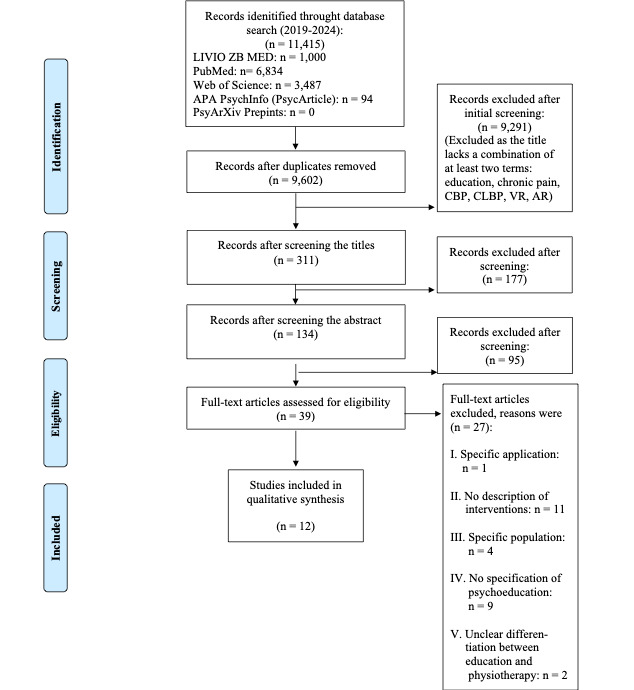
A scoping review following PRISMA (Preferred Reporting Items for Systematic Reviews and Meta-Analyses) guidelines was performed in August 2024 by using Livivo ZB MED, PubMed, Web of Science, American Psychological Association PsycINFO (PsycArticle), and PsyArXiv Preprints databases. A qualitative content analysis of the included studies was conducted based on 4 deductively extracted categories.
We included 12 studies published between 2019 and 2024 referring to conventional and VR-based psychoeducation for CLBP treatment, but no study referred to AR. In these studies, educational programs were combined with physiotherapy, encompassing content on pain biology, psychological education, coping strategies, and relaxation techniques. The key outcomes were pain intensity, kinesiophobia, pain catastrophizing, degree of disability, quality of life, well-being, self-efficacy, depression, attrition rate, and user experience. Passive, active, and gamified strategies were used to promote intrinsic motivation from a psychological point of view. Regarding user experience from a software development perspective, user friendliness, operational support, and application challenges were recommended.
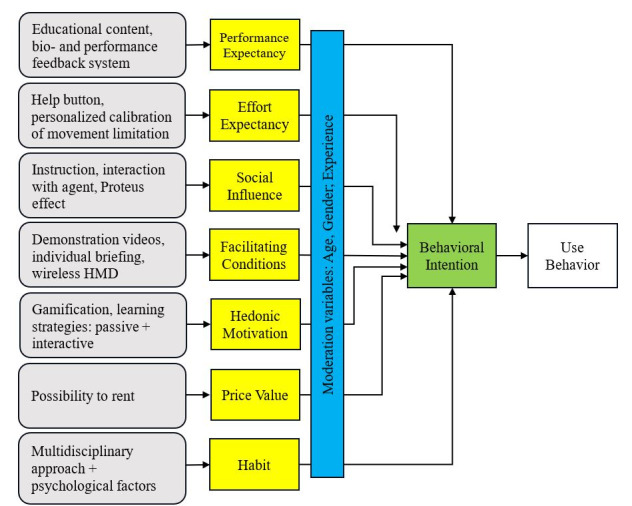
For the development of a framework for an AR-based psychoeducational intervention for CLBP, the combination of theories of acceptance and use of technologies with insights from health psychological behavior change theories appears to be of great importance. An example of a theory-based design of a psychoeducation intervention in AR for CLBP is proposed and discussed.
在传统治疗中,心理教育对慢性下腰痛(CLBP)的心理成分有积极影响。医疗保健的数字化引发了对虚拟现实(VR)干预措施的讨论。然而,由于完全沉浸感,VR中的CLBP治疗存在一些局限性。相比之下,增强现实(AR)通过涉及自身身体感官感知的虚拟元素来补充现实世界,并且可以将传统方法与VR方法相结合。
本研究旨在回顾通过心理教育(包括沉浸式技术)治疗CLBP的研究现状,并为CLBP的AR心理教育提出建议。
2024年8月,按照PRISMA(系统评价和Meta分析的首选报告项目)指南,使用Livivo ZB MED、PubMed、科学网、美国心理学会PsycINFO(PsycArticle)和PsyArXiv预印本数据库进行了一项范围综述。基于4个演绎提取的类别对纳入研究进行了定性内容分析。
我们纳入了2019年至2024年间发表的12项关于CLBP治疗的传统和基于VR的心理教育的研究,但没有研究涉及AR。在这些研究中,教育项目与物理治疗相结合,涵盖疼痛生物学、心理教育、应对策略和放松技巧等内容。关键结果包括疼痛强度、运动恐惧、疼痛灾难化、残疾程度、生活质量、幸福感、自我效能感、抑郁、损耗率和用户体验。从心理学角度使用被动、主动和游戏化策略来促进内在动机。从软件开发角度来看,关于用户体验,推荐了用户友好性、操作支持和应用挑战。
对于基于AR的CLBP心理教育干预框架的开发,技术接受和使用理论与健康心理行为改变理论的见解相结合似乎非常重要。提出并讨论了一个基于理论设计的AR中CLBP心理教育干预示例。