Jameson Kelly G, Kazmi Sabeen A, Ohara Takahiro E, Son Celine, Yu Kristie B, Mazdeyasnan Donya, Leshan Emma, Vuong Helen E, Paramo Jorge, Lopez-Romero Arlene, Yang Long, Schweizer Felix E, Hsiao Elaine Y
Department of Integrative Biology & Physiology, University of California, Los Angeles, Los Angeles, CA 90095, USA.
UCLA Goodman-Luskin Microbiome Center, Department of Medicine, Division of Digestive Diseases, David Geffen School of Medicine, Los Angeles, CA 90095, USA.
iScience. 2024 Dec 27;28(2):111699. doi: 10.1016/j.isci.2024.111699. eCollection 2025 Feb 21.
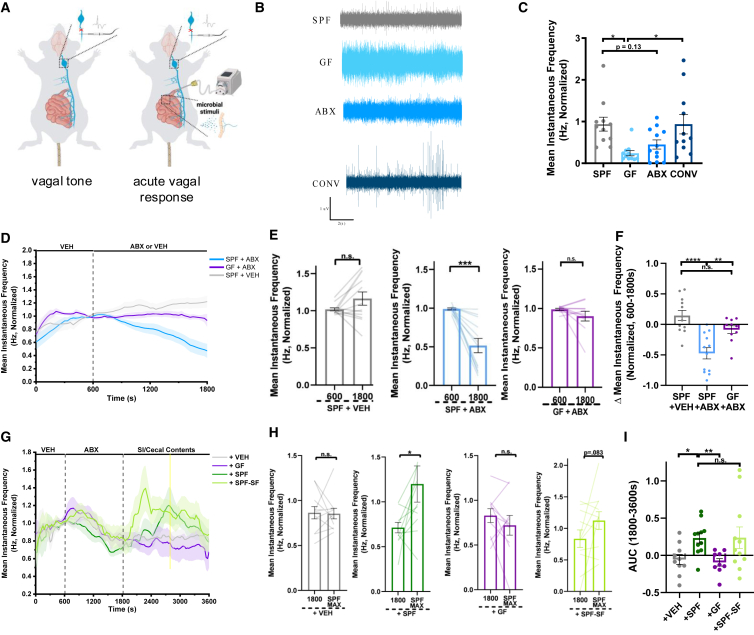
The vagus nerve is proposed to enable communication between the gut microbiome and the brain, but activity-based evidence is lacking. We find that mice reared germ-free exhibit decreased vagal tone relative to colonized controls, which is reversed via microbiota restoration. Perfusing antibiotics into the small intestines of conventional mice, but not germ-free mice, acutely decreases vagal activity which is restored upon re-perfusion with intestinal filtrates from conventional, but not germ-free, mice. Microbiome-dependent short-chain fatty acids, bile acids, and 3-indoxyl sulfate indirectly stimulate vagal activity in a receptor-dependent manner. Serial perfusion of each metabolite class activates both shared and distinct neuronal subsets with varied response kinetics. Metabolite-induced and receptor-dependent increases in vagal activity correspond with the activation of brainstem neurons. Results from this study reveal that the gut microbiome regulates select metabolites in the intestinal lumen that differentially activate vagal afferent neurons, thereby enabling the microbial modulation of chemosensory signals for gut-brain communication.
迷走神经被认为能够实现肠道微生物群与大脑之间的通讯,但缺乏基于活动的证据。我们发现,与定殖的对照小鼠相比,无菌饲养的小鼠迷走神经张力降低,而微生物群恢复后这种情况会逆转。向常规小鼠而非无菌小鼠的小肠灌注抗生素,会急性降低迷走神经活动,而用常规小鼠而非无菌小鼠的肠道滤液重新灌注后,迷走神经活动会恢复。微生物群依赖的短链脂肪酸、胆汁酸和硫酸吲哚酚以受体依赖的方式间接刺激迷走神经活动。对每一类代谢物进行连续灌注会激活具有不同反应动力学的共享和不同的神经元亚群。代谢物诱导的和受体依赖的迷走神经活动增加与脑干神经元的激活相对应。这项研究的结果表明,肠道微生物群调节肠腔内的特定代谢物,这些代谢物以不同方式激活迷走神经传入神经元,从而实现微生物对用于肠-脑通讯的化学感觉信号的调节。