Liao Wenjun, Luo Xiangde, Li Lu, Xu Jinfeng, He Yuan, Huang Hui, Zhang Shichuan
Department of Radiation Oncology, Sichuan Cancer Hospital and Institute, Sichuan Cancer Center, Cancer Hospital Affiliate to School of Medicine, University of Electronic Science and Technology of China, Chengdu, 610041, China.
School of Mechanical and Electrical Engineering, University of Electronic Science and Technology of China, Chengdu, 611731, China.
Sci Rep. 2025 Feb 4;15(1):4250. doi: 10.1038/s41598-024-84804-3.
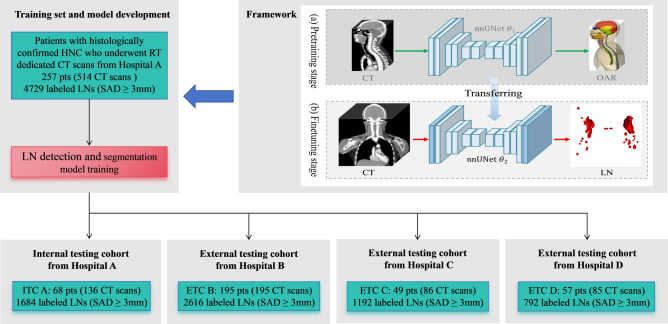
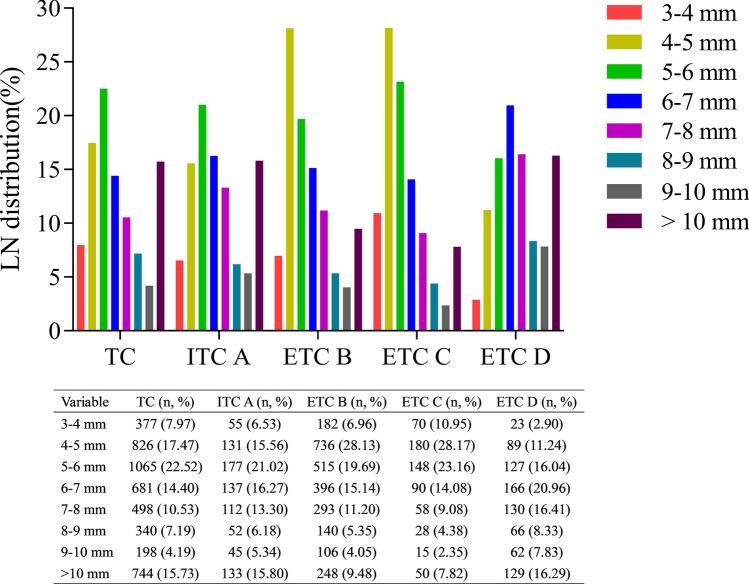
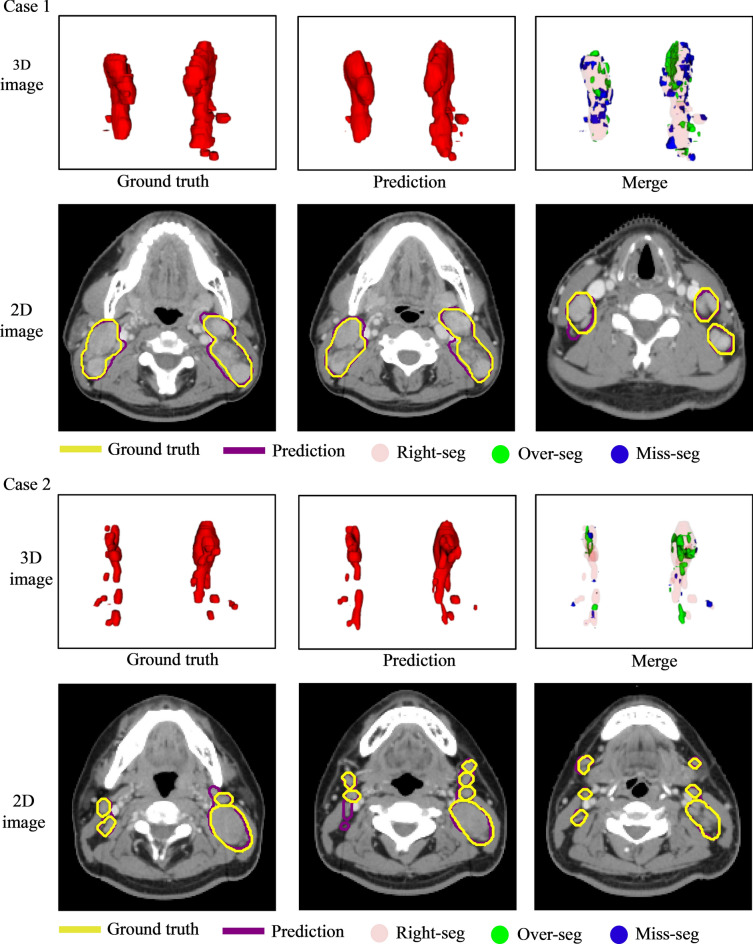
To develop a deep learning model using transfer learning for automatic detection and segmentation of neck lymph nodes (LNs) in computed tomography (CT) images, the study included 11,013 annotated LNs with a short-axis diameter ≥ 3 mm from 626 head and neck cancer patients across four hospitals. The nnUNet model was used as a baseline, pre-trained on a large-scale head and neck dataset, and then fine-tuned with 4,729 LNs from hospital A for detection and segmentation. Validation was conducted on an internal testing cohort (ITC A) and three external testing cohorts (ETCs B, C, and D), with 1684 and 4600 LNs, respectively. Detection was evaluated via sensitivity, positive predictive value (PPV), and false positive rate per case (FP/vol), while segmentation was assessed using the Dice similarity coefficient (DSC) and Hausdorff distance (HD95). For detection, the sensitivity, PPV, and FP/vol in ITC A were 54.6%, 69.0%, and 3.4, respectively. In ETCs, the sensitivity ranged from 45.7% at 3.9 FP/vol to 63.5% at 5.8 FP/vol. Segmentation achieved a mean DSC of 0.72 in ITC A and 0.72 to 0.74 in ETCs, as well as a mean HD95 of 3.78 mm in ITC A and 2.73 mm to 2.85 mm in ETCs. No significant sensitivity difference was found between contrast-enhanced and unenhanced CT images (p = 0.502) or repeated CT images (p = 0.815) during adaptive radiotherapy. The model's segmentation accuracy was comparable to that of experienced oncologists. The model shows promise in automatically detecting and segmenting neck LNs in CT images, potentially reducing oncologists' segmentation workload.
为了开发一种使用迁移学习的深度学习模型,用于在计算机断层扫描(CT)图像中自动检测和分割颈部淋巴结(LN),该研究纳入了来自四家医院的626例头颈癌患者的11,013个短轴直径≥3mm的标注淋巴结。nnUNet模型被用作基线,在大规模头颈数据集上进行预训练,然后使用医院A的4,729个淋巴结进行微调以进行检测和分割。在内部测试队列(ITC A)和三个外部测试队列(ETC B、C和D)上进行验证,分别有1684个和4600个淋巴结。通过灵敏度、阳性预测值(PPV)和每例假阳性率(FP/vol)评估检测,而使用Dice相似系数(DSC)和豪斯多夫距离(HD95)评估分割。对于检测,ITC A中的灵敏度、PPV和FP/vol分别为54.6%、69.0%和3.4。在ETC中,灵敏度范围从FP/vol为3.9时的45.7%到FP/vol为5.8时的63.5%。分割在ITC A中平均DSC为0.72,在ETC中为0.72至0.74,ITC A中的平均HD95为3.78mm,ETC中为2.73mm至2.85mm。在自适应放疗期间,对比增强CT图像和未增强CT图像之间(p = 0.502)或重复CT图像之间(p = 0.815)未发现显著的灵敏度差异。该模型的分割准确性与经验丰富的肿瘤学家相当。该模型在自动检测和分割CT图像中的颈部淋巴结方面显示出前景,可能会减少肿瘤学家的分割工作量。