A Hasib Uddin, Md Abu Raihan, Yang Jing, Bhatti Uzair Aslam, Ku Chin Soon, Por Lip Yee
Department of Computer Science and Engineering, Khwaja Yunus Ali University, Sirajganj, Bangladesh.
Center of Research for Cyber Security and Network (CSNET), Faculty of Computer Science and Information Technology, Universiti Malaya, Kuala Lumpur, Malaysia.
Digit Health. 2025 May 14;11:20552076251341092. doi: 10.1177/20552076251341092. eCollection 2025 Jan-Dec.
Early and accurate detection of COVID-19 and pneumonia through medical imaging is critical for effective patient management. This study aims to develop a robust framework that integrates synthetic image augmentation with advanced deep learning (DL) models to address dataset imbalance, improve diagnostic accuracy, and enhance trust in artificial intelligence (AI)-driven diagnoses through Explainable AI (XAI) techniques.
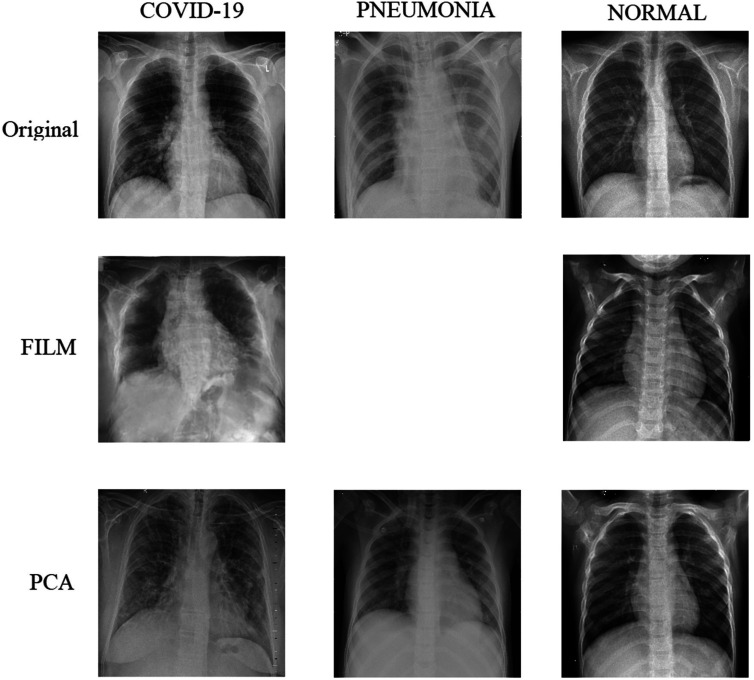
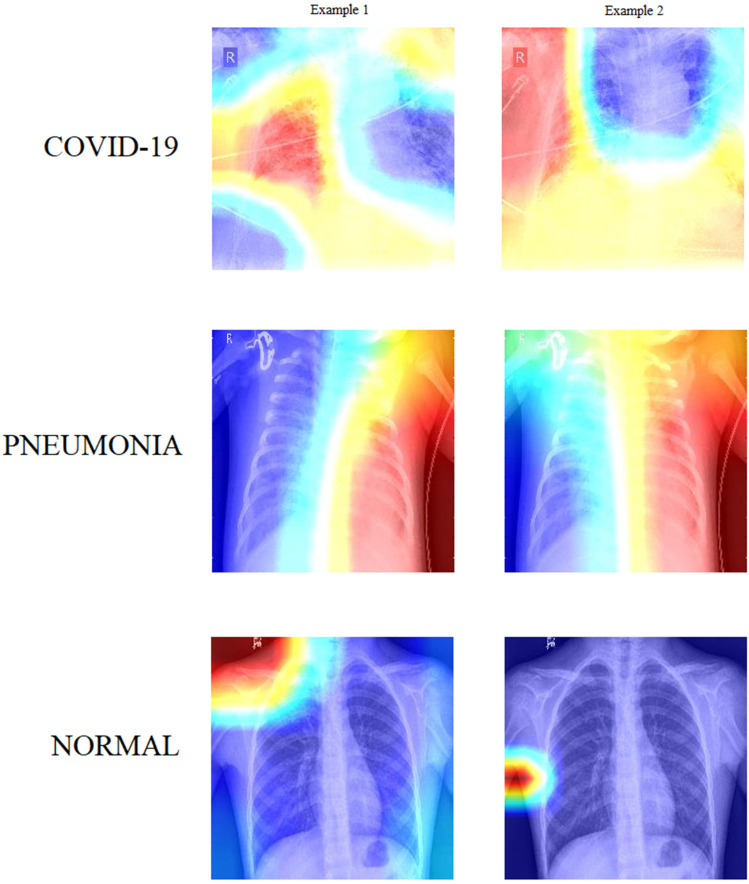
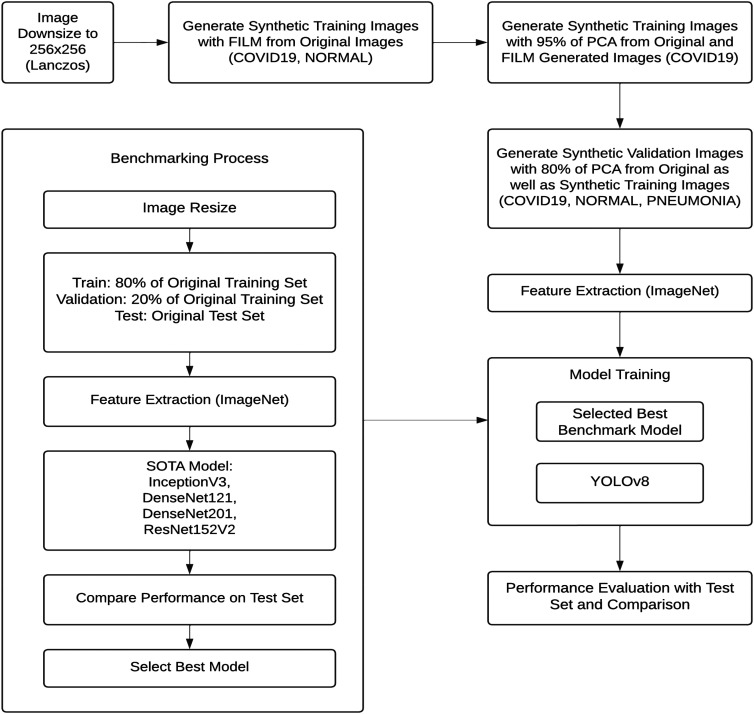
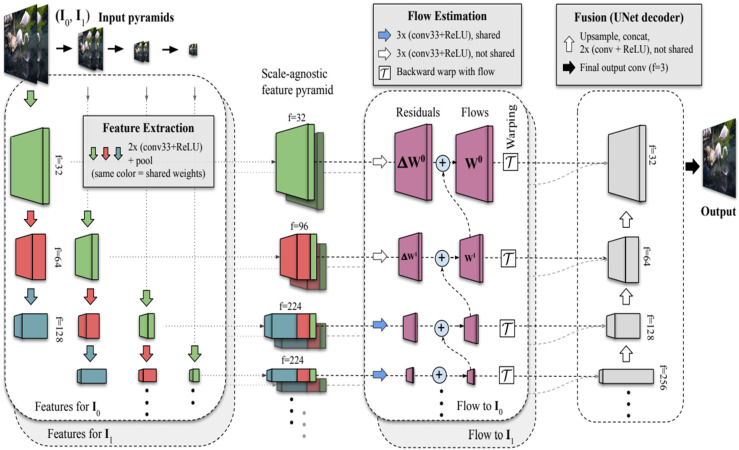
The proposed framework benchmarks state-of-the-art models (InceptionV3, DenseNet, ResNet) for initial performance evaluation. Synthetic images are generated using Feature Interpolation through Linear Mapping and principal component analysis to enrich dataset diversity and balance class distribution. YOLOv8 and InceptionV3 models, fine-tuned via transfer learning, are trained on the augmented dataset. Grad-CAM is used for model explainability, while large language models (LLMs) support visualization analysis to enhance interpretability.
YOLOv8 achieved superior performance with 97% accuracy, precision, recall, and F1-score, outperforming benchmark models. Synthetic data generation effectively reduced class imbalance and improved recall for underrepresented classes. Comparative analysis demonstrated significant advancements over existing methodologies. XAI visualizations (Grad-CAM heatmaps) highlighted anatomically plausible focus areas aligned with clinical markers of COVID-19 and pneumonia, thereby validating the model's decision-making process.
The integration of synthetic data generation, advanced DL, and XAI significantly enhances the detection of COVID-19 and pneumonia while fostering trust in AI systems. YOLOv8's high accuracy, coupled with interpretable Grad-CAM visualizations and LLM-driven analysis, promotes transparency crucial for clinical adoption. Future research will focus on developing a clinically viable, human-in-the-loop diagnostic workflow, further optimizing performance through the integration of transformer-based language models to improve interpretability and decision-making.
通过医学成像早期准确检测新冠病毒病(COVID-19)和肺炎对于有效管理患者至关重要。本研究旨在开发一个强大的框架,将合成图像增强与先进的深度学习(DL)模型相结合,以解决数据集不平衡问题,提高诊断准确性,并通过可解释人工智能(XAI)技术增强对人工智能(AI)驱动诊断的信任。
所提出的框架以先进模型(InceptionV3、DenseNet、ResNet)为基准进行初始性能评估。使用通过线性映射和主成分分析的特征插值生成合成图像,以丰富数据集多样性并平衡类别分布。通过迁移学习进行微调的YOLOv8和InceptionV3模型在增强后的数据集上进行训练。Grad-CAM用于模型可解释性,而大语言模型(LLM)支持可视化分析以增强可解释性。
YOLOv8实现了卓越性能,准确率、精确率、召回率和F1分数均达到97%,优于基准模型。合成数据生成有效减少了类别不平衡,并提高了代表性不足类别的召回率。对比分析表明与现有方法相比有显著进步。XAI可视化(Grad-CAM热图)突出了与COVID-19和肺炎临床标志物相符的解剖学上合理的重点区域,从而验证了模型的决策过程。
合成数据生成、先进的DL和XAI的整合显著增强了COVID-19和肺炎的检测,同时增强了对AI系统的信任。YOLOv8的高准确率,加上可解释的Grad-CAM可视化和LLM驱动的分析,促进了临床应用至关重要的透明度。未来的研究将专注于开发临床可行的、人在回路中的诊断工作流程,通过整合基于Transformer的语言模型进一步优化性能,以提高可解释性和决策能力。