Yu Siyue, Sze Judy Chu Dik, Cheung Annie Wai Ling, Wang Kailu, Welch Elizabeth, Smith Nick, Xu Richard Huan, Wong Eliza Lai Yi
JC School of Public Health and Primary Care, Faculty of Medicine, The Chinese University of Hong Kong, Hong Kong SAR, China.
Center for Health Systems and Policy Research, JC School of Public Health and Primary Care, Faculty of Medicine, The Chinese University of Hong Kong, Hong Kong SAR, China.
Health Qual Life Outcomes. 2025 Jun 4;23(1):57. doi: 10.1186/s12955-025-02389-5.
In light of the global challenges posed by an ageing population, the evaluation of long-term care (LTC) is of particular importance. The Adult Social Care Outcomes Toolkit Four-Level Self-completion Tool (ASCOT-SCT4) is a preference-based instrument developed to measure long-term care (LTC) related quality of life (QoL). However, it is not yet available in Hong Kong (HK). This study aims to translate and culturally adapt the ASCOT-SCT4 into Chinese and evaluate its content validity in the HK context.
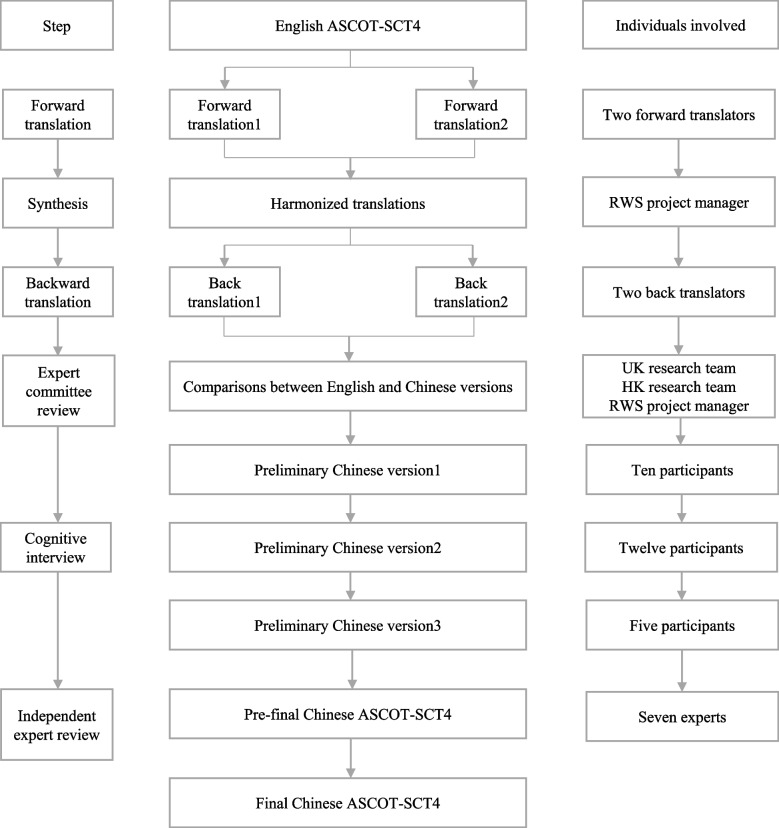
The study adhered to well-established international guidelines for conducting translation, cultural adaptation, and content validation of instruments. The translation process included forward, backward translations, and expert committee review. Subsequently, LTC users aged 60 or above and experts with diverse professional backgrounds in LTC were involved in content validation in terms of comprehensibility, relevance, and comprehensiveness through cognitive interviews and a content validity index (CVI) survey. For clarity and relevance, an item-level CVI (I-CVI) of ≥ 0.78 and a scale-level CVI (S-CVI) of ≥ 0.90 were considered acceptable.
In the translation process, concern was raised about the literal translation of 'Control over daily life' item. During the cognitive interviews, 27 LTC users perceived the instrument's length as acceptable, and experienced no sensitive feelings while completing it. However, seven of the nine items were found to have comprehension and interpretation issues, which were mostly resolved through revisions of wordings. For the 'Food and drink' and 'Dignity' items, alternative terms were used and sentence structure was revised to improve its comprehensibility while ensuring equivalence to the original English version. The final translated version demonstrated acceptable clarity (S-CVI: 0.92, I-CVIs: 0.86-1.00) as evaluated by seven experts. Both LTC users and experts found the items relevant (S-CVI: 0.97, I-CVIs: 0.94 to 1.00), and no additional LTC-related QoL domains were identified as missing from the instrument.
This study provides evidence that the Chinese version of the ASCOT-SCT4 is comprehensible, relevant, and comprehensive for the HK context, which allows for further testing on psychometric properties in a larger population.
鉴于人口老龄化带来的全球挑战,长期护理(LTC)评估尤为重要。成人社会护理结果工具包四级自我完成工具(ASCOT-SCT4)是一种基于偏好的工具,旨在测量与长期护理(LTC)相关的生活质量(QoL)。然而,它在香港(HK)尚未可用。本研究旨在将ASCOT-SCT4翻译成中文并进行文化调适,并在香港背景下评估其内容效度。
该研究遵循了关于工具翻译、文化调适和内容验证的既定国际指南。翻译过程包括正向翻译、反向翻译和专家委员会审查。随后,60岁及以上的长期护理使用者和具有不同长期护理专业背景的专家通过认知访谈和内容效度指数(CVI)调查,从可理解性、相关性和全面性方面参与内容验证。为了清晰和相关,项目级CVI(I-CVI)≥0.78和量表级CVI(S-CVI)≥0.90被认为是可接受的。
在翻译过程中,有人对“对日常生活的控制”项目的直译提出了担忧。在认知访谈中,27名长期护理使用者认为该工具的长度可以接受,并且在完成过程中没有感受到敏感情绪。然而,发现九个项目中的七个存在理解和解释问题,这些问题大多通过措辞修改得到解决。对于“饮食”和“尊严”项目,使用了替代术语并修改了句子结构,以提高其可理解性,同时确保与原始英文版本等效。七位专家评估的最终翻译版本显示出可接受的清晰度(S-CVI:0.92,I-CVI:0.86 - 1.00)。长期护理使用者和专家都发现这些项目相关(S-CVI:0.97,I-CVI:0.94至1.00),并且没有发现该工具遗漏任何其他与长期护理相关的生活质量领域。
本研究提供了证据,表明ASCOT-SCT4的中文版在香港背景下是可理解的、相关的和全面的,这使得可以在更大规模的人群中对其心理测量特性进行进一步测试。