• 文献检索
  • 文档翻译
  • 深度研究
  • 学术资讯
  • Suppr Zotero 插件Zotero 插件
  • 邀请有礼
  • 套餐&价格
  • 历史记录
应用&插件
Suppr Zotero 插件Zotero 插件浏览器插件Mac 客户端Windows 客户端微信小程序
定价
高级版会员购买积分包购买API积分包
服务
文献检索文档翻译深度研究API 文档MCP 服务
关于我们
关于 Suppr公司介绍联系我们用户协议隐私条款
关注我们

Suppr 超能文献

核心技术专利:CN118964589B侵权必究
粤ICP备2023148730 号-1Suppr @ 2026

文献检索

告别复杂PubMed语法,用中文像聊天一样搜索,搜遍4000万医学文献。AI智能推荐,让科研检索更轻松。

立即免费搜索

文件翻译

保留排版,准确专业,支持PDF/Word/PPT等文件格式,支持 12+语言互译。

免费翻译文档

深度研究

AI帮你快速写综述,25分钟生成高质量综述,智能提取关键信息,辅助科研写作。

立即免费体验

播种前用生物银纳米颗粒处理谷物可刺激玉米生长并影响其氧化还原稳态。

Pre-sowing grain treatment with bio-AgNPs stimulates plant growth and affects redox homeostasis in maize.

作者信息

Trzcińska-Wencel Joanna, Mucha Natalia, Rai Mahendra, Tyburski Jarosław, Golińska Patrycja

机构信息

Department of Microbiology, Faculty of Biological and Veterinary Sciences, Nicolaus Copernicus University in Toruń, Toruń, Poland.

Department of Plant Physiology and Biotechnology, Faculty of Biological and Veterinary Sciences, Nicolaus Copernicus University in Toruń, Toruń, Poland.

出版信息

Front Plant Sci. 2025 May 22;16:1494741. doi: 10.3389/fpls.2025.1494741. eCollection 2025.

DOI:10.3389/fpls.2025.1494741
PMID:40475907
原文链接:https://pmc.ncbi.nlm.nih.gov/articles/PMC12137326/
Abstract

INTRODUCTION

In the pursuit of sustainable development, nanotechnology provides effective solutions for enhancing agricultural productivity. Nanomaterials (NMs) can be effective in increasing plant abiotic and biotic stress tolerance. Understanding the nanoparticles (NPs)-plant interaction is essential to identify the potential of NPs for growth stimulation and phytotoxicity risks. Therefore, this study aimed to evaluate the effects of biologically synthesized silver nanoparticles (AgNPs) from IOR 825 on the growth of . Furthermore, the effect of AgNPs on oxidative stress and the antioxidant response was assessed.

METHODS

AgNPs were efficiently synthesized from IOR 825 and characterized for physicochemical properties using transmission electron microscopy (TEM), nanoparticle tracking analysis (NTA), dynamic light scattering (DLS), X-ray diffraction (XRD), and Fourier transform infrared (FTIR) spectroscopy and measurement of Zeta potential. AgNPs at concentrations of 32, 128, and 512 µg mL were used for the pre-sowing treatment of maize grains to inhibit microbial pathogens present on their surface. Sterilized maize grains were cultivated for 14 days for plantlet development. Subsequently, germination percentage (%G), mean germination time (MGT), germination rate index (GRI), fresh and dry weight (FW and DW), and the Ag content in plant organs and total chlorophyll content were analyzed. Hydrogen peroxide (HO) and malondialdehyde (MDA) were determined in leaves, roots, stems, and caryopses to assess the oxidative stress. The antioxidative system response to the AgNPs treatment was studied by determining total glutathione (GSH+GSSG) and ascorbate (ASC) contents as well as catalase (CAT), superoxide dismutase (SOD), peroxidase (POX), and ascorbate peroxidase (APX) activities.

RESULTS

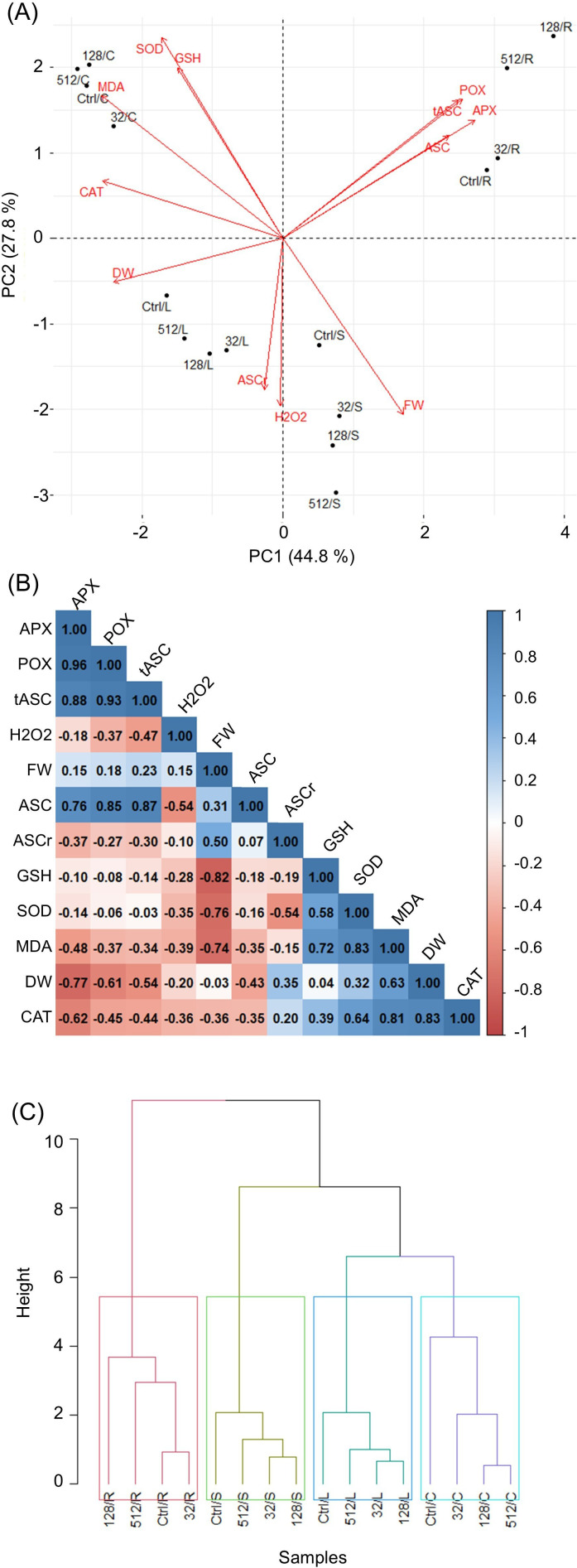
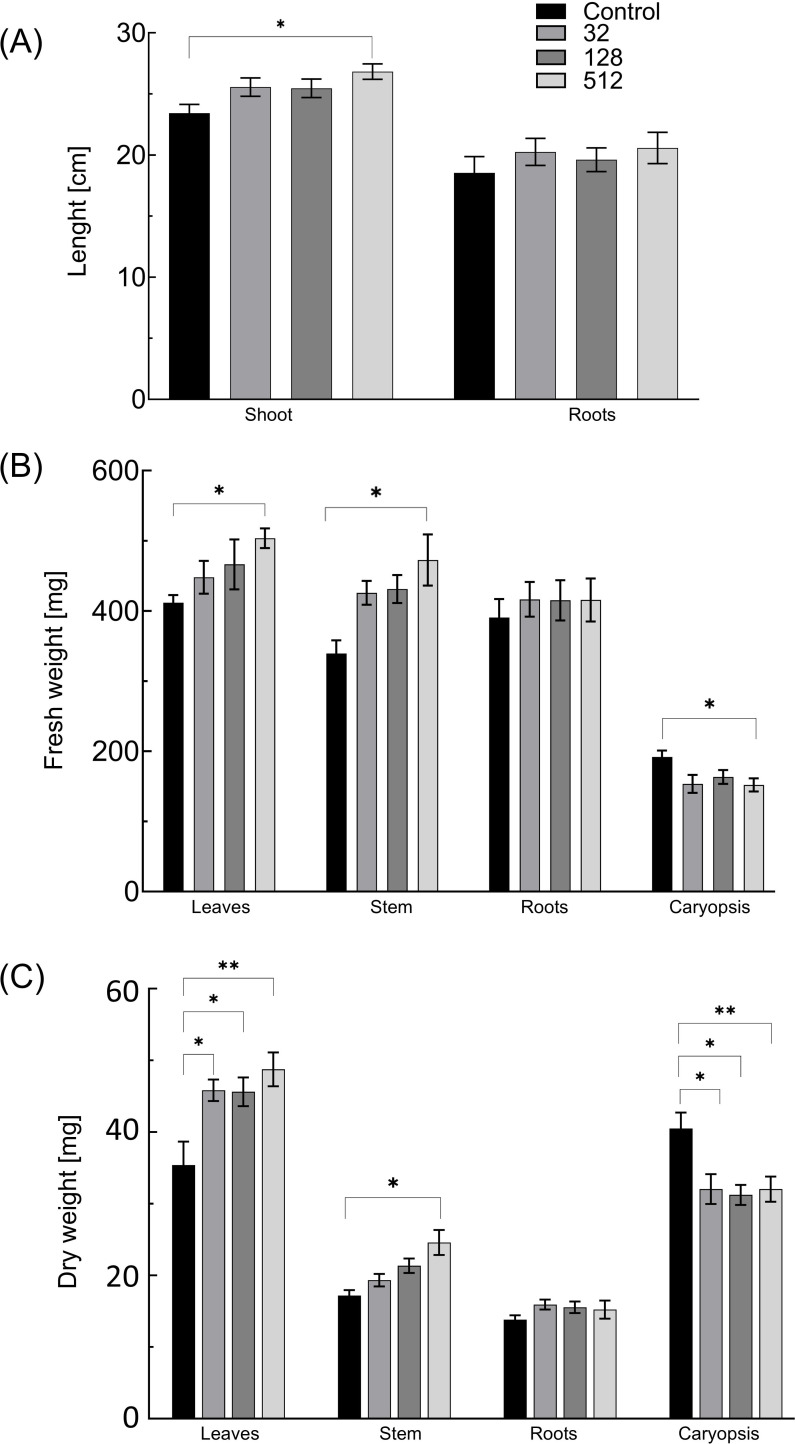
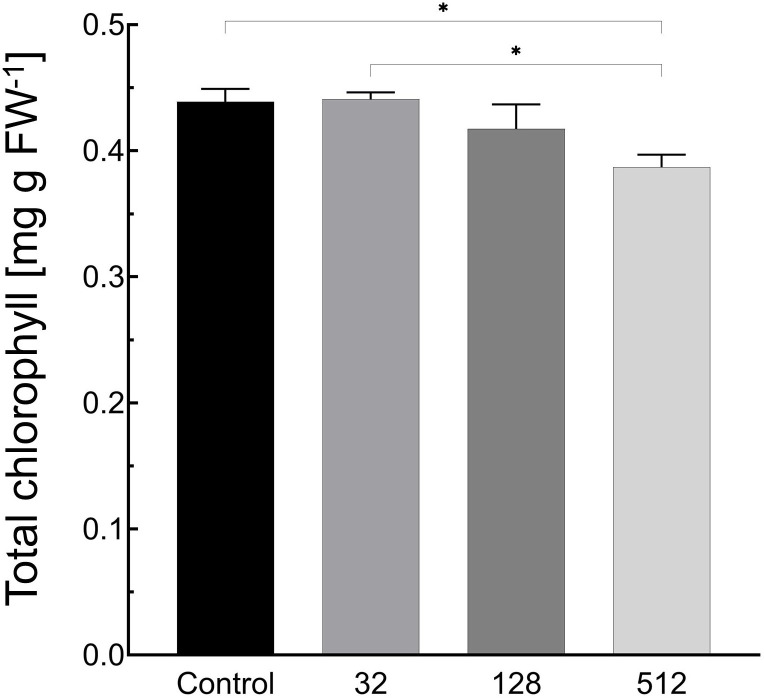
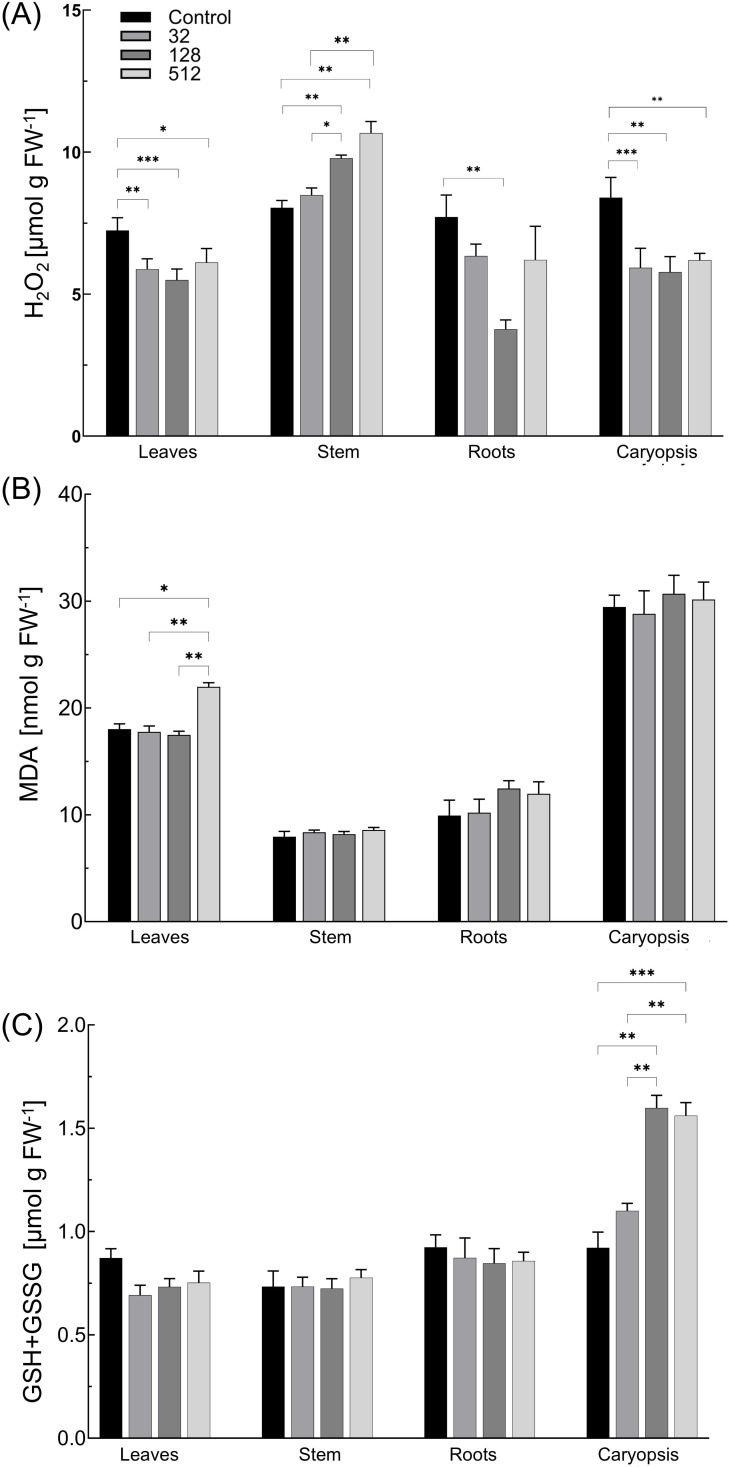
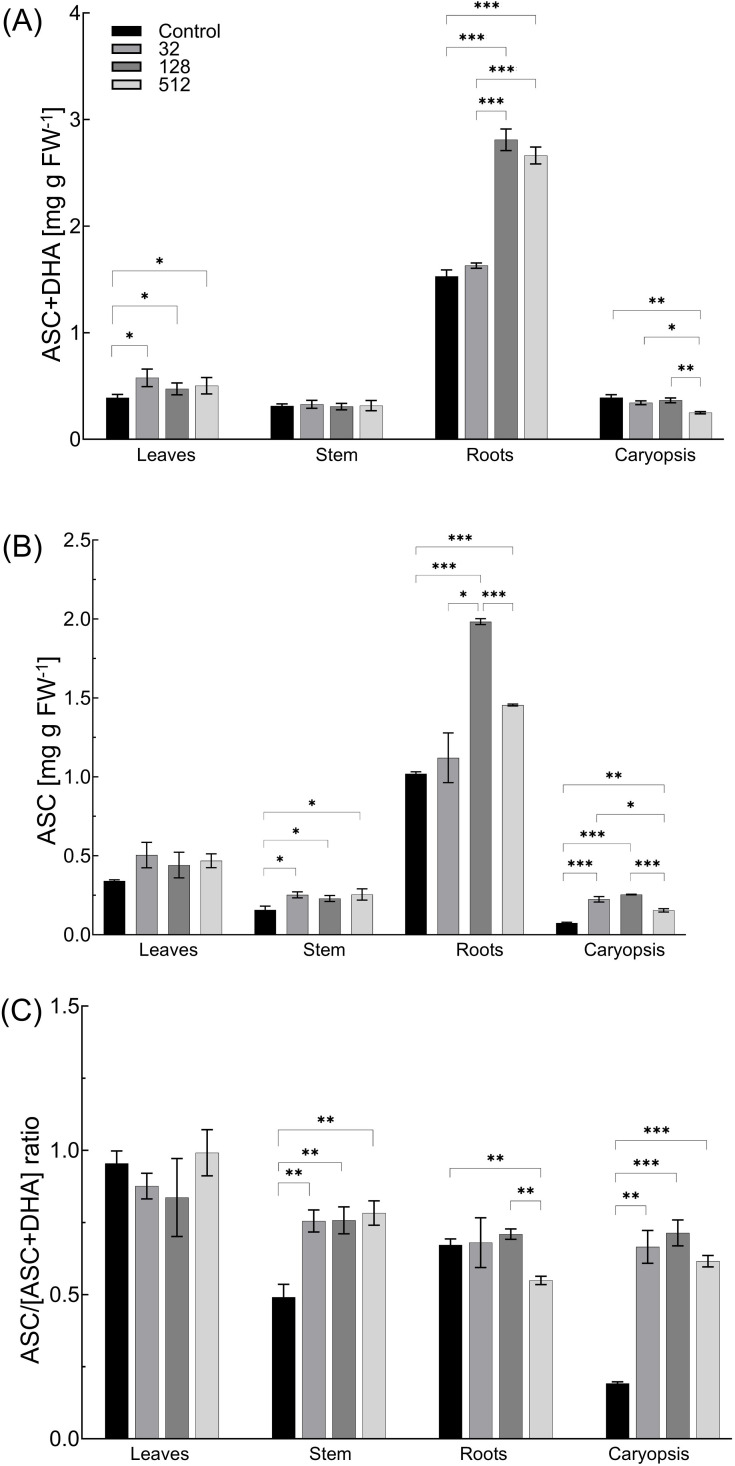
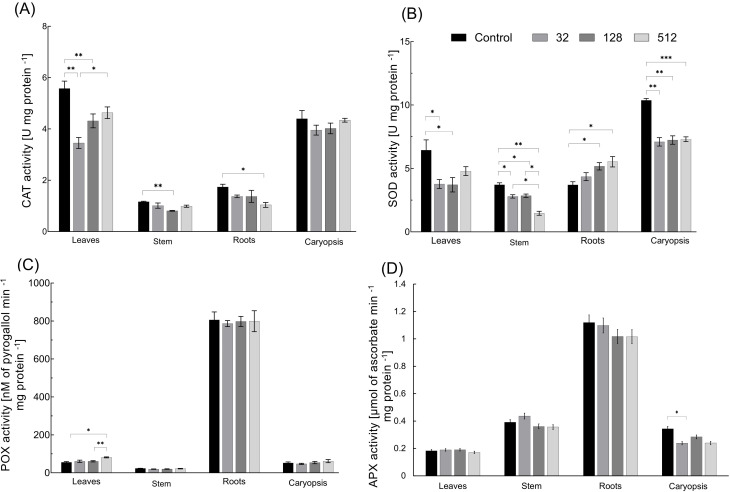
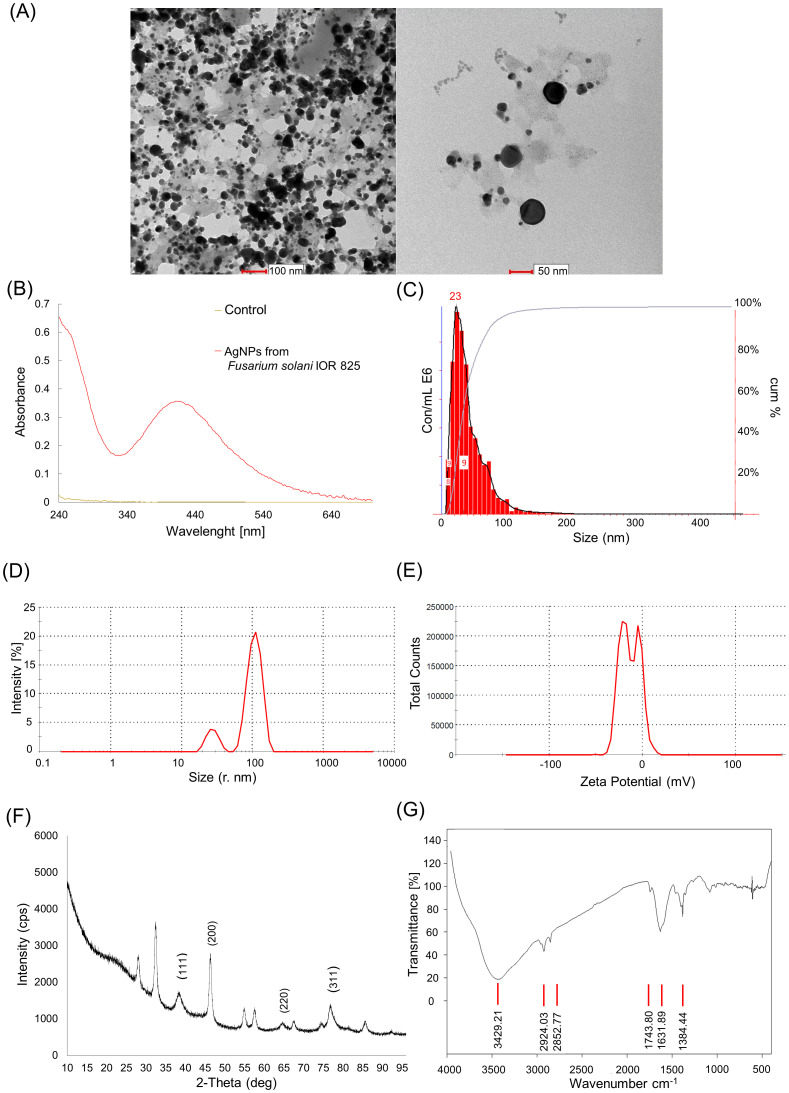
AgNPs were spherical and small [TEM average diameter of 22.97 ± 9.4 nm, NTA average size of 43 ± 36 nm, and DLS average hydrodynamic diameters of 27.44 nm (14%) and 108.4 nm (86%)]. Zeta potential revealed that NPs were negatively charged [-19.5 mV (61.3%) and -2.93 mV (38.6%)]. The diffractogram of AgNPs confirmed the presence of a face-centered cubic structure of crystalline AgNPs, while FTIR spectra showed the presence of biomolecules on their surface. The results showed a dose-dependent effect on maize growth. The increase in length and fresh weight of plants treated with a AgNPs concentration of 512 µg mL was noted. The treatment with all tested concentrations of AgNPs (32, 128, and 512 µg mL) resulted in increased dry weight of leaves. Reduced chlorophyll content was observed in plants treated with the highest tested concentration of AgNPs (512 µg mL). The treatment of grains with AgNPs decreased HO levels in all organs, except the stem where the oxidant's level increased. MDA levels were unaffected except for the highest tested concentration of AgNPs, which raised its content in leaves. ASC and total glutathione levels were increased in roots and caryopses, respectively. The highest impact of AgNPs treatment was determined for SOD activity, which decreased in leaves, stems, and caryopses and increased in roots. CAT activity was decreased in leaves, stems, and roots. There was a minor effect on POX and APX activities.

CONCLUSION

The lowest tested concentration of AgNPs (32 µg mL) on maize efficiently inhibits maize-borne pathogens, without any negative effect on plant growth and chlorophyll content. Moreover, it does not provoke oxidative stress. However, AgNPs may affect cellular redox systems when their higher concentrations (128 and 512 µg mL) are used. The results indicate the potential use of biogenically synthesized AgNPs in agriculture through a crop-safe approach to eliminate pathogens and increase maize production efficiency.

摘要

引言

在追求可持续发展的过程中,纳米技术为提高农业生产力提供了有效的解决方案。纳米材料(NMs)可有效提高植物对非生物和生物胁迫的耐受性。了解纳米颗粒(NPs)与植物的相互作用对于确定NPs促进生长的潜力和植物毒性风险至关重要。因此,本研究旨在评估从IOR 825生物合成的银纳米颗粒(AgNPs)对[植物名称未给出]生长的影响。此外,还评估了AgNPs对氧化应激和抗氧化反应的影响。

方法

从IOR 825高效合成AgNPs,并使用透射电子显微镜(TEM)、纳米颗粒跟踪分析(NTA)、动态光散射(DLS)、X射线衍射(XRD)、傅里叶变换红外(FTIR)光谱以及Zeta电位测量对其理化性质进行表征。将浓度为32、128和512 μg/mL的AgNPs用于玉米种子的播种前处理,以抑制其表面存在的微生物病原体。对灭菌后的玉米种子进行14天的培养以促进幼苗发育。随后,分析发芽率(%G)、平均发芽时间(MGT)、发芽速率指数(GRI)、鲜重和干重(FW和DW),以及植物器官中的银含量和总叶绿素含量。测定叶片、根、茎和颖果中的过氧化氢(H₂O₂)和丙二醛(MDA)含量,以评估氧化应激。通过测定总谷胱甘肽(GSH+GSSG)和抗坏血酸(ASC)含量以及过氧化氢酶(CAT)、超氧化物歧化酶(SOD)、过氧化物酶(POX)和抗坏血酸过氧化物酶(APX)活性,研究抗氧化系统对AgNPs处理的反应。

结果

AgNPs呈球形且尺寸较小[TEM平均直径为22.97±9.4 nm,NTA平均尺寸为43±36 nm,DLS平均流体动力学直径为27.44 nm(14%)和108.4 nm(86%)]。Zeta电位显示NPs带负电荷[-19.5 mV(61.3%)和-2.93 mV(38.6%)]。AgNPs的衍射图谱证实了结晶AgNPs存在面心立方结构,而FTIR光谱显示其表面存在生物分子。结果表明对玉米生长有剂量依赖性影响。注意到用512 μg/mL的AgNPs浓度处理的植物的长度和鲜重增加。用所有测试浓度的AgNPs(32、128和512 μg/mL)处理均导致叶片干重增加。在用最高测试浓度的AgNPs(512 μg/mL)处理的植物中观察到叶绿素含量降低。用AgNPs处理谷物降低了所有器官中的H₂O₂水平,但茎中氧化剂水平增加除外。除了最高测试浓度的AgNPs使叶片中MDA含量升高外,MDA水平未受影响。根和颖果中的ASC和总谷胱甘肽水平分别升高。确定AgNPs处理对SOD活性影响最大,其在叶片、茎和颖果中降低,在根中升高。CAT活性在叶片、茎和根中降低。对POX和APX活性影响较小。

结论

对玉米测试的最低浓度的AgNPs(32 μg/mL)可有效抑制玉米携带的病原体,对植物生长和叶绿素含量无任何负面影响。此外,它不会引发氧化应激。然而,当使用较高浓度(128和512 μg/mL)的AgNPs时,可能会影响细胞氧化还原系统。结果表明通过作物安全方法生物合成的AgNPs在农业中具有潜在用途,可消除病原体并提高玉米生产效率。
https://cdn.ncbi.nlm.nih.gov/pmc/blobs/e9d5/12137326/a7d114af9547/fpls-16-1494741-g007.jpg
https://cdn.ncbi.nlm.nih.gov/pmc/blobs/e9d5/12137326/f4a30811d046/fpls-16-1494741-g001.jpg
https://cdn.ncbi.nlm.nih.gov/pmc/blobs/e9d5/12137326/873cf36c19e4/fpls-16-1494741-g002.jpg
https://cdn.ncbi.nlm.nih.gov/pmc/blobs/e9d5/12137326/09924c36dfd2/fpls-16-1494741-g003.jpg
https://cdn.ncbi.nlm.nih.gov/pmc/blobs/e9d5/12137326/011edb82f777/fpls-16-1494741-g004.jpg
https://cdn.ncbi.nlm.nih.gov/pmc/blobs/e9d5/12137326/52a29d095175/fpls-16-1494741-g005.jpg
https://cdn.ncbi.nlm.nih.gov/pmc/blobs/e9d5/12137326/46268dfb6f5a/fpls-16-1494741-g006.jpg
https://cdn.ncbi.nlm.nih.gov/pmc/blobs/e9d5/12137326/a7d114af9547/fpls-16-1494741-g007.jpg
https://cdn.ncbi.nlm.nih.gov/pmc/blobs/e9d5/12137326/f4a30811d046/fpls-16-1494741-g001.jpg
https://cdn.ncbi.nlm.nih.gov/pmc/blobs/e9d5/12137326/873cf36c19e4/fpls-16-1494741-g002.jpg
https://cdn.ncbi.nlm.nih.gov/pmc/blobs/e9d5/12137326/09924c36dfd2/fpls-16-1494741-g003.jpg
https://cdn.ncbi.nlm.nih.gov/pmc/blobs/e9d5/12137326/011edb82f777/fpls-16-1494741-g004.jpg
https://cdn.ncbi.nlm.nih.gov/pmc/blobs/e9d5/12137326/52a29d095175/fpls-16-1494741-g005.jpg
https://cdn.ncbi.nlm.nih.gov/pmc/blobs/e9d5/12137326/46268dfb6f5a/fpls-16-1494741-g006.jpg
https://cdn.ncbi.nlm.nih.gov/pmc/blobs/e9d5/12137326/a7d114af9547/fpls-16-1494741-g007.jpg

相似文献

1
Pre-sowing grain treatment with bio-AgNPs stimulates plant growth and affects redox homeostasis in maize.播种前用生物银纳米颗粒处理谷物可刺激玉米生长并影响其氧化还原稳态。
Front Plant Sci. 2025 May 22;16:1494741. doi: 10.3389/fpls.2025.1494741. eCollection 2025.
2
Biofabrication of novel silver and zinc oxide nanoparticles from IOR 825 and their potential application in agriculture as biocontrol agents of phytopathogens, and seed germination and seedling growth promoters.利用IOR 825生物制造新型银和氧化锌纳米颗粒及其作为植物病原体生物防治剂以及种子发芽和幼苗生长促进剂在农业中的潜在应用。
Front Chem. 2023 Aug 4;11:1235437. doi: 10.3389/fchem.2023.1235437. eCollection 2023.
3
Biogenic nanosilver bearing antimicrobial and antibiofilm activities and its potential for application in agriculture and industry.具有抗菌和抗生物膜活性的生物源纳米银及其在农业和工业中的应用潜力。
Front Microbiol. 2023 Feb 20;14:1125685. doi: 10.3389/fmicb.2023.1125685. eCollection 2023.
4
Biogenic synthesis of silver nanoparticles using Funaria hygrometrica Hedw. and their effects on the growth of Zea mays seedlings.利用大灰藓生物合成银纳米颗粒及其对玉米幼苗生长的影响。
Microsc Res Tech. 2023 Jun;86(6):686-693. doi: 10.1002/jemt.24309. Epub 2023 Mar 3.
5
Phytostimulatory effect of silver nanoparticles (AgNPs) on rice seedling growth: An insight from antioxidative enzyme activities and gene expression patterns.银纳米粒子(AgNPs)对水稻幼苗生长的植物刺激效应:抗氧化酶活性和基因表达模式的见解。
Ecotoxicol Environ Saf. 2018 Oct;161:624-633. doi: 10.1016/j.ecoenv.2018.06.023. Epub 2018 Jun 19.
6
Nitric oxide alleviates silver nanoparticles (AgNps)-induced phytotoxicity in Pisum sativum seedlings.一氧化氮可减轻豌豆幼苗中银纳米颗粒(AgNps)诱导的植物毒性。
Plant Physiol Biochem. 2017 Jan;110:167-177. doi: 10.1016/j.plaphy.2016.06.015. Epub 2016 Jun 15.
7
Foliar application of silicon-based nanoparticles improve the adaptability of maize (Zea mays L.) in cadmium contaminated soils.叶面喷施硅基纳米颗粒可提高玉米(Zea mays L.)在镉污染土壤中的适应性。
Environ Sci Pollut Res Int. 2023 Mar;30(14):41002-41013. doi: 10.1007/s11356-023-25189-0. Epub 2023 Jan 10.
8
High Salinity Induces Different Oxidative Stress and Antioxidant Responses in Maize Seedlings Organs.高盐胁迫诱导玉米幼苗不同器官产生不同的氧化应激和抗氧化反应。
Front Plant Sci. 2016 Mar 8;7:276. doi: 10.3389/fpls.2016.00276. eCollection 2016.
9
Biological potential of Argyrolobium roseum (Camb.) Jaub & Spach mediated silver nanoparticles and their effect on the growth of wheat seeds.玫瑰叶黄芪介导的银纳米颗粒的生物学潜力及其对小麦种子生长的影响。
Microsc Res Tech. 2025 Jan;88(1):163-171. doi: 10.1002/jemt.24695. Epub 2024 Sep 5.
10
Amelioration of salt induced toxicity in pearl millet by seed priming with silver nanoparticles (AgNPs): The oxidative damage, antioxidant enzymes and ions uptake are major determinants of salt tolerant capacity.用银纳米粒子(AgNPs)对种子进行预处理可减轻盐胁迫对珍珠粟的毒性:氧化损伤、抗氧化酶和离子吸收是盐耐受能力的主要决定因素。
Plant Physiol Biochem. 2020 Nov;156:221-232. doi: 10.1016/j.plaphy.2020.09.018. Epub 2020 Sep 17.

本文引用的文献

1
Nanoparticles as catalysts of agricultural revolution: enhancing crop tolerance to abiotic stress: a review.纳米颗粒作为农业革命的催化剂:增强作物对非生物胁迫的耐受性:综述
Front Plant Sci. 2025 Jan 17;15:1510482. doi: 10.3389/fpls.2024.1510482. eCollection 2024.
2
Probiotic mediated synthesis of silver nanoparticles (AgNPs-LS): A sustainable approach and multifaceted biomedical application.益生菌介导的银纳米颗粒合成(AgNPs-LS):一种可持续的方法及其多方面的生物医学应用
Heliyon. 2024 Sep 17;10(18):e37987. doi: 10.1016/j.heliyon.2024.e37987. eCollection 2024 Sep 30.
3
The 2022 European Union report on pesticide residues in food.
2022年欧盟食品中农药残留报告。
EFSA J. 2024 Apr 23;22(4):e8753. doi: 10.2903/j.efsa.2024.8753. eCollection 2024 Apr.
4
Nano hybrid fertilizers: A review on the state of the art in sustainable agriculture.纳米混合肥料:可持续农业的最新研究进展综述。
Sci Total Environ. 2024 Jun 15;929:172533. doi: 10.1016/j.scitotenv.2024.172533. Epub 2024 Apr 20.
5
Agriculture and environmental management through nanotechnology: Eco-friendly nanomaterial synthesis for soil-plant systems, food safety, and sustainability.农业与环境纳米技术管理:用于土壤-植物体系、食品安全和可持续性的环保型纳米材料合成。
Sci Total Environ. 2024 May 20;926:171862. doi: 10.1016/j.scitotenv.2024.171862. Epub 2024 Mar 23.
6
Twenty-eight years of GM Food and feed without harm: why not accept them?28年转基因食品和饲料未造成危害:为何不接受它们?
GM Crops Food. 2024 Dec 31;15(1):40-50. doi: 10.1080/21645698.2024.2305944. Epub 2024 Mar 12.
7
Algal macromolecular mediated synthesis of nanoparticles for their application against citrus canker for food security.藻类大分子介导的纳米颗粒合成及其在防治柑橘溃疡病中的应用,以保障食品安全。
Int J Biol Macromol. 2024 Apr;263(Pt 1):130259. doi: 10.1016/j.ijbiomac.2024.130259. Epub 2024 Feb 19.
8
Determining the cytotoxicity of the Minimum Inhibitory Concentration (MIC) of silver and zinc oxide nanoparticles in ESBL and carbapenemase producing Proteus mirabilis isolated from clinical samples in Shiraz, Southwest Iran.测定来自伊朗西南部设拉子临床样本中产 ESBL 和碳青霉烯酶奇异变形杆菌的最小抑菌浓度(MIC)的银和氧化锌纳米粒子的细胞毒性。
BMC Res Notes. 2024 Jan 29;17(1):40. doi: 10.1186/s13104-023-06402-2.
9
Copper and Silver Nanoparticle Seed Priming and Foliar Spray Modulate Plant Growth and Thrips Infestation in spp.铜和银纳米颗粒引发种子及叶面喷施对 种植物生长和蓟马侵害的调控作用
ACS Omega. 2024 Jan 6;9(3):3430-3444. doi: 10.1021/acsomega.3c06961. eCollection 2024 Jan 23.
10
Stimulating effect of biogenic nanoparticles on the germination of basil (Ocimum basilicum L.) seeds.生物成因纳米粒子对罗勒(Ocimum basilicum L.)种子萌发的刺激作用。
Sci Rep. 2024 Jan 19;14(1):1715. doi: 10.1038/s41598-023-50654-8.