Martín Cruz Beatriz, Acosta Dacal Andrea, Macías-Montes Ana, Rial-Berriel Cristian, Zumbado Manuel, Henríquez-Hernández Luis Alberto, Gallo-Barneto Ramón, Cabrera-Pérez Miguel Ángel, Luzardo Octavio P
Toxicology Unit, Research Institute of Biomedical and Health Sciences (IUIBS), Universidad de Las Palmas de Gran Canaria, Paseo Blas Cabrera s/n, 35016 Las Palmas de Gran Canaria, Spain.
Spanish Biomedical Research Center in Physiopathology of Obesity and Nutrition (CIBERObn), Avenida Monforte de Lemos 3-5, Pabellón 11, Planta 0, 28029 Madrid, Spain.
Toxics. 2025 Jun 15;13(6):505. doi: 10.3390/toxics13060505.
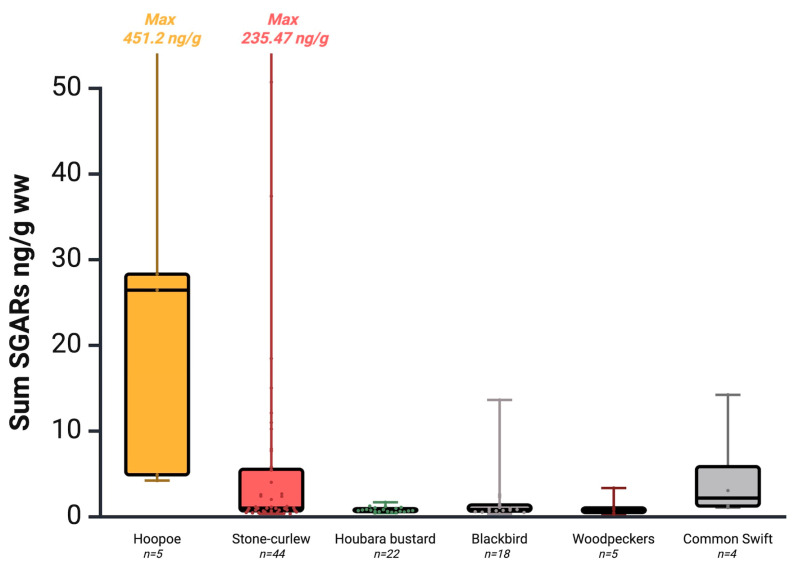
Research on anticoagulant rodenticides (ARs) in wildlife has primarily focused on apex predators, with less attention given to their potential integration into lower trophic levels and the associated exposure pathways. At the base of the terrestrial food web, invertebrates have been suggested as potential vectors of ARs to insectivorous species such as small mammals, reptiles, and birds. To explore this hypothesis, we analyzed the presence of nine anticoagulant rodenticides-including both first-generation (FGARs) and second-generation (SGARs) rodenticides-in 36 liver samples from Yemen chameleons () and 98 liver samples from six non-raptorial, predominantly insectivorous bird species from the Canary Islands. Through HPLC-MS/MS analysis, only SGARs were detected in both animal groups collected between 2021 and 2024. Approximately 80% of reptiles and 40% of birds tested positive for at least one SGAR, with brodifacoum being the most frequently detected compound. In more than 90% of positive cases, it was found as the sole contaminant, while co-occurrence with other SGARs was uncommon. Additionally, most concentrations were below 50 ng/g wet weight, except for two bird specimens, suggesting heterogeneous exposure scenarios and potential variability in contamination sources across individuals. These findings provide evidence of AR integration at the base of the terrestrial food web in the Canary Islands and suggest secondary exposure via invertebrates as a plausible route of contamination. Further research directly analyzing invertebrate samples is needed to confirm their role as vectors of ARs to insectivorous wildlife in insular ecosystems.
关于野生动物体内抗凝血灭鼠剂(ARs)的研究主要集中在顶级捕食者上,而对其在较低营养级中的潜在整合以及相关暴露途径的关注较少。在陆地食物网的底部,有研究表明无脊椎动物可能是ARs传播给食虫物种(如小型哺乳动物、爬行动物和鸟类)的潜在媒介。为了探究这一假设,我们分析了来自也门变色龙()的36份肝脏样本和来自加那利群岛6种非猛禽、主要食虫鸟类的98份肝脏样本中9种抗凝血灭鼠剂的存在情况,这些灭鼠剂包括第一代(FGARs)和第二代(SGARs)灭鼠剂。通过高效液相色谱-串联质谱(HPLC-MS/MS)分析,在2021年至2024年收集的两个动物群体中均仅检测到SGARs。大约80%的爬行动物和40%的鸟类至少有一种SGAR检测呈阳性,其中溴敌隆是最常检测到的化合物。在超过90%的阳性案例中,它是唯一的污染物,而与其他SGARs同时出现的情况并不常见。此外,除了两个鸟类标本外,大多数浓度低于50纳克/克湿重,这表明存在异质暴露情况以及个体间污染源的潜在变异性。这些发现为加那利群岛陆地食物网底部存在ARs整合提供了证据,并表明通过无脊椎动物的二次暴露是一种合理的污染途径。需要进一步直接分析无脊椎动物样本的研究来确认它们在岛屿生态系统中作为ARs传播给食虫野生动物的媒介的作用。