Liu Bo, Chen Lianglong, Huang Chaoyang, Zhang HuiHui, Zhou Hai, Chen Yanqi, Liu Xiaoyang, Xiao Zhenyong, Liang Kangyan, Xie Xiangtao, Gao Yi, Liu Kun, Qi Xiangdong
Department of Plastic and Aesthetic Surgery, Zhujiang Hospital, Southern Medical University, Guangzhou, Guangdong Province, China.
Department of Burns and Plastic, The Fourth Affiliated Hospital of Guangxi Medical University, Liuzhou, 545005, China.
Mater Today Bio. 2025 Aug 5;34:102159. doi: 10.1016/j.mtbio.2025.102159. eCollection 2025 Oct.
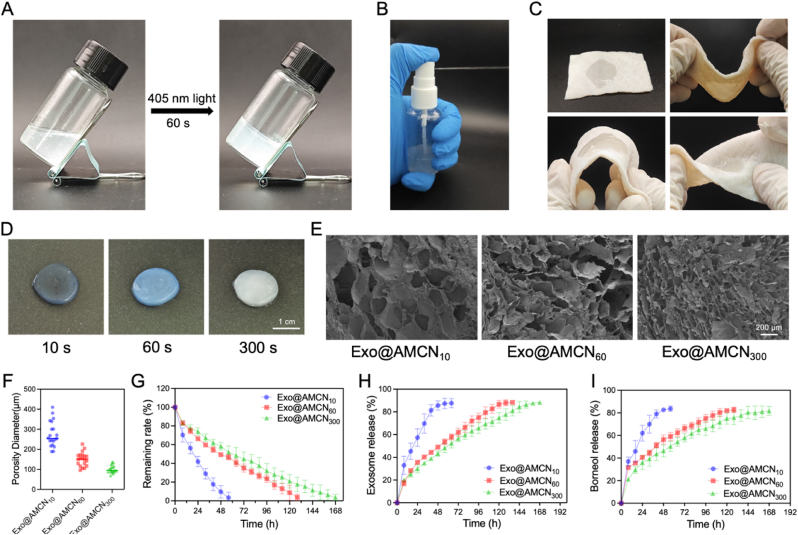
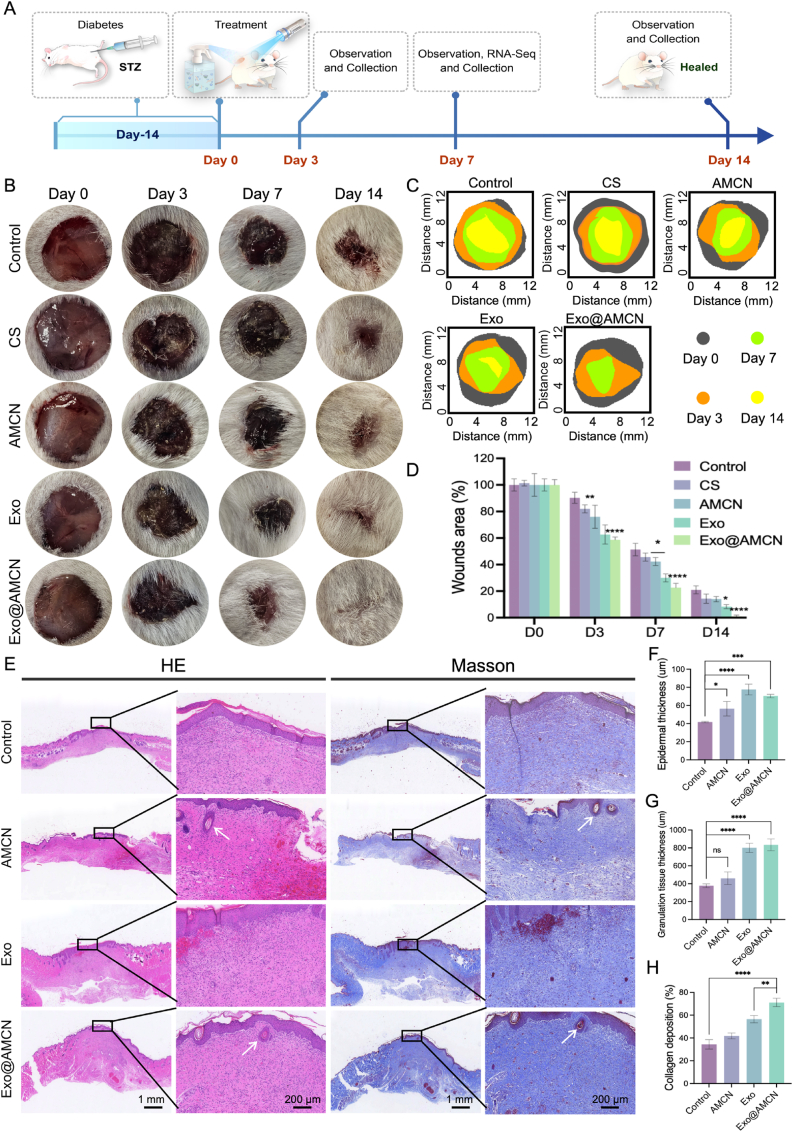
Diabetic wound healing is hindered by bacterial infections, oxidative stress, impaired vascularization, and chronic inflammation. Conventional dressings, limited by static drug release and single-functionality, fail to dynamically match the varying demands of different healing stages and dressing replacement frequencies. This study developed a multifunctional sprayable hydrogel dressing (Exo@AMCN) by photocrosslinking methacrylated decellularized dermal matrix co-loaded with human umbilical cord mesenchymal stem cell-derived exosomes (hUCMSC-Exo) and β-cyclodextrin-borneol inclusion complexes (CN). The hydrogel can be sprayed onto irregularly shaped wounds, with its crosslinking density and degradation kinetics precisely modulated by adjusting the photocuring duration. This tunability enables controlled release of exosomes and borneol over 2-7 days. Experimental findings demonstrate that Exo@AMCN displays excellent biocompatibility, broad-spectrum antibacterial activity (>85 % efficacy), and robust reactive oxygen species scavenging capacity. The dressing significantly boosts cell migration, fosters angiogenesis, and prompts macrophage polarization toward anti-inflammatory phenotypes. In a diabetic wound model, Exo@AMCN reduced residual wound area to 1.07 ± 1.27 % within 14 days by modulating tissue inflammation, enhancing collagen deposition, and stimulating neovascularization. This innovative approach, combining controlled drug release with multifunctional synergy, offers a promising individualized solution for managing diabetic wounds.
糖尿病伤口愈合受到细菌感染、氧化应激、血管生成受损和慢性炎症的阻碍。传统敷料受限于静态药物释放和单一功能,无法动态匹配不同愈合阶段和换药频率的各种需求。本研究通过光交联甲基丙烯酸化脱细胞真皮基质开发了一种多功能可喷涂水凝胶敷料(Exo@AMCN),该基质共负载人脐带间充质干细胞衍生的外泌体(hUCMSC-Exo)和β-环糊精-冰片包合物(CN)。这种水凝胶可以喷涂到形状不规则的伤口上,通过调节光固化时间可以精确调节其交联密度和降解动力学。这种可调性能够在2-7天内实现外泌体和冰片的控释。实验结果表明,Exo@AMCN具有优异的生物相容性、广谱抗菌活性(>85%的疗效)和强大的活性氧清除能力。该敷料显著促进细胞迁移,促进血管生成,并促使巨噬细胞极化为抗炎表型。在糖尿病伤口模型中,Exo@AMCN通过调节组织炎症、增强胶原蛋白沉积和刺激新血管形成,在14天内将残余伤口面积减少至1.07±1.27%。这种将控释药物与多功能协同作用相结合的创新方法,为糖尿病伤口管理提供了一种有前景的个性化解决方案。