Mäntyjärvi R A, Arstila P P, Meurman O H
Infect Immun. 1972 Nov;6(5):824-8. doi: 10.1128/iai.6.5.824-828.1972.
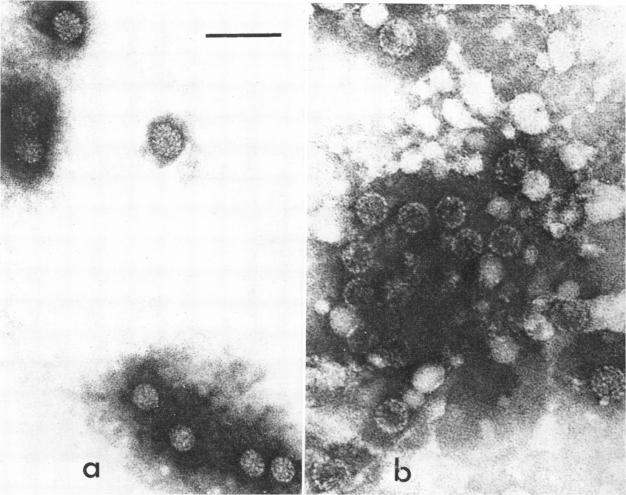
Some characteristics of hemagglutination (HA) by the BK virus, a new candidate for the papovavirus group, have been studied. Hemagglutinin prepared from cell cultures was found to be partially masked by inhibitors which could be dissociated from the virus by incubation at 37 C or by fluorocarbon extraction. Optimal conditions for HA are outlined. In routine tests, 0.5% human erythrocytes were used. The reaction was carried out at pH 7.0 on ice-water slurry. BK hemagglutinin receptors on human erythrocytes were found to be more resistant to neuraminidase than polyoma receptors. By gradient centrifugation analysis, two types of particles were found to be responsible for HA: (i) full, deoxyribonucleic acid-containing particles with a density of 1.325 g/cm(3) and (ii) empty capsids with a density 1.29 g/cm(3). Based on particle counting, one HA unit was calculated to correspond to 3 x 10(6) virus particles.
已对乳头多瘤空泡病毒组的新候选病毒BK病毒的血凝(HA)某些特性进行了研究。发现从细胞培养物制备的血凝素部分被抑制剂掩盖,这些抑制剂可通过在37℃孵育或通过氟碳萃取从病毒中解离出来。概述了HA的最佳条件。在常规试验中,使用0.5%的人红细胞。反应在pH 7.0的冰水浆液中进行。发现人红细胞上的BK血凝素受体比多瘤病毒受体对神经氨酸酶更具抗性。通过梯度离心分析,发现有两种类型的颗粒与HA有关:(i)密度为1.325 g/cm³的完整含脱氧核糖核酸颗粒和(ii)密度为1.29 g/cm³的空衣壳。基于颗粒计数,计算出一个HA单位相当于3×10⁶个病毒颗粒。