Graessmann A, Wolf H, Bornkamm G W
Proc Natl Acad Sci U S A. 1980 Jan;77(1):433-6. doi: 10.1073/pnas.77.1.433.
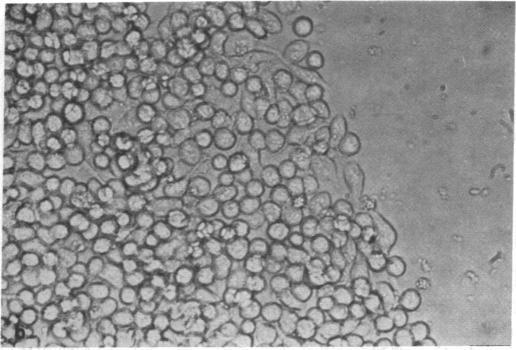
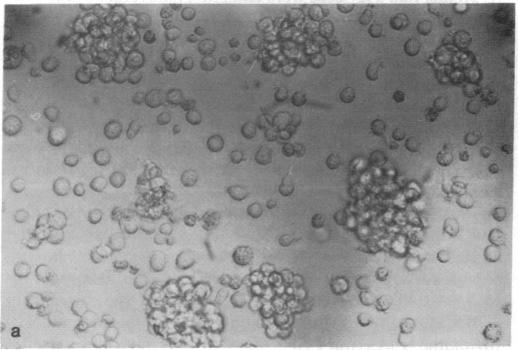
Gene expression of Epstein-Barr virus (EBV) was studied after microinjection of viral DNA into different types of cells. Raji TK- cells, known to express viral gene functions after superinfection with the EBV-P3HR-1 virus strain, were attached to plastic dishes by using anti-lymphocyte IgG, phytohemagglutinin, or concanavalin A as a ligand. It was difficult to inject DNA into the small and fragile Raji cells. After formation of polykaryons by cell fusion, microinjection became more efficient. At 24 hr after injection of P3HR-1 virus DNA, 90-100% of the injected cells expressed the early antigen complex as observed by immunofluorescence staining; 70-80% of the cells simultaneously incorported [3H]thymidine, indicating that thymidine kinase is expressed after injection of viral DNA. Additionally, synthesis of the virus capsid antigen was demonstrated in 20-30% of the recipient Raji cells. Human diploid fibroblasts, African green monkey kidney cells, and rat fibroblasts, which do not represent natural target cells for EBV, could also be induced to synthesis of early antigen complex by injection of P3HR-1 virus DNA.
将病毒DNA显微注射到不同类型的细胞后,对爱泼斯坦-巴尔病毒(EBV)的基因表达进行了研究。已知在被EBV-P3HR-1病毒株超感染后会表达病毒基因功能的Raji TK-细胞,通过使用抗淋巴细胞IgG、植物血凝素或伴刀豆球蛋白A作为配体附着在塑料培养皿上。将DNA注射到小而脆弱的Raji细胞中很困难。通过细胞融合形成多核体后,显微注射变得更有效。注射P3HR-1病毒DNA后24小时,通过免疫荧光染色观察到90-100%的注射细胞表达早期抗原复合物;70-80%的细胞同时掺入[3H]胸腺嘧啶核苷,表明注射病毒DNA后胸腺嘧啶激酶被表达。此外,在20-30%的受体Raji细胞中证明了病毒衣壳抗原的合成。人二倍体成纤维细胞、非洲绿猴肾细胞和大鼠成纤维细胞,它们不是EBV的天然靶细胞,通过注射P3HR-1病毒DNA也可被诱导合成早期抗原复合物。