Barnes W M, Bevan M
Nucleic Acids Res. 1983 Jan 25;11(2):349-68. doi: 10.1093/nar/11.2.349.
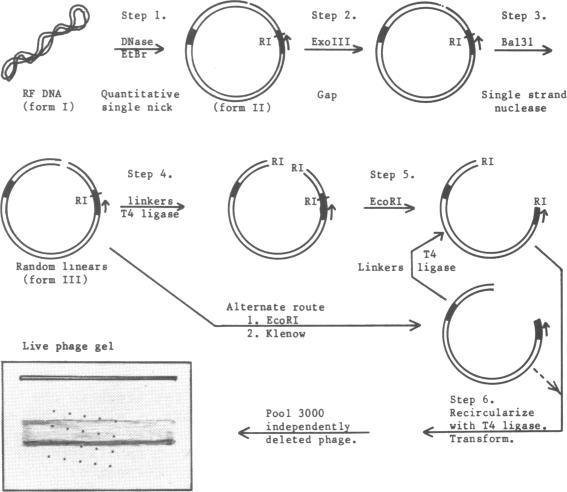
A strategy for rapid DNA sequence acquisition in an ordered, nonrandom manner, while retaining all of the conveniences of the dideoxy method with M13 transducing phage DNA template, is described. Target DNA 3 to 14 kb in size can be stably carried by our M13 vectors. Suitable targets are stretches of DNA which lack an enzyme recognition site which is unique on our cloning vectors and adjacent to the sequencing primer; current sites that are so useful when lacking are Pst, Xba, HindIII, BglII, EcoRI. By an in vitro procedure, we cut RF DNA once randomly and once specifically, to create thousands of deletions which start at the unique restriction site adjacent to the dideoxy sequencing primer and extend various distances across the target DNA. Phage carrying a desired size of deletions, whose DNA as template will give rise to DNA sequence data in a desired location along the target DNA, may be purified by electrophoresis alive on agarose gels. Phage running in the same location on the agarose gel thus conveniently give rise to nucleotide sequence data from the same kilobase of target DNA.
本文描述了一种以有序、非随机方式快速获取DNA序列的策略,该策略在使用M13转导噬菌体DNA模板时保留了双脱氧法的所有便利之处。我们的M13载体可以稳定携带大小为3至14 kb的目标DNA。合适的目标是那些在我们的克隆载体上缺乏独特酶识别位点且与测序引物相邻的DNA片段;目前缺乏这些位点时很有用的酶切位点有Pst、Xba、HindIII、BglII、EcoRI。通过体外操作,我们将RF DNA随机切割一次,特异性切割一次,以产生数千个缺失片段,这些缺失片段从与双脱氧测序引物相邻的独特限制酶位点开始,并跨越目标DNA延伸不同距离。携带所需大小缺失片段的噬菌体,其DNA作为模板将在目标DNA上的所需位置产生DNA序列数据,可以通过在琼脂糖凝胶上进行活体电泳来纯化。在琼脂糖凝胶上同一位置运行的噬菌体因此方便地从目标DNA的同一千碱基产生核苷酸序列数据。