Hessling B, Souvignier G, Gerwert K
Max-Planck-Institut für Molekulare Physiologie, Dortmund, Germany.
Biophys J. 1993 Nov;65(5):1929-41. doi: 10.1016/S0006-3495(93)81264-5.
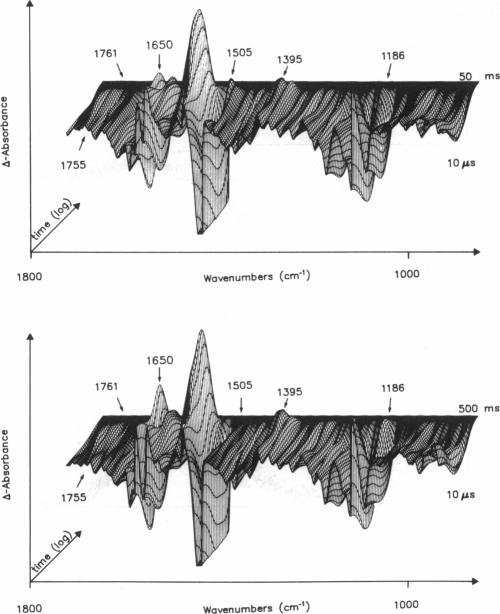
By using factor analysis and decomposition, bacteriorhodopsin's intramolecular reactions have been assigned to photocycle intermediates. Independent of specific kinetic models, the pure BR-L, BR-M, BR-N, and BR-O difference spectra were calculated by analyzing simultaneously two different measurements in the visible and infrared spectral region performed at pH 6.5, 298 K, 1 M KCl, and pH 7.5, 288 K, 1 M KCl. Even though after M formation L, M, N, and O intermediates kinetically overlap under physiological conditions, their pure spectra have been separated by this analysis in contrast to other approaches at which unphysiological conditions or mutants have been used or specific photocycle models have been assumed. The results now provide a set reference spectra for further studies. The following conclusions for physiologically relevant reactions are drawn: (a) the catalytic proton release binding site, asp 85, is protonated in the L to M transition and remains protonated in the intermediates N and O; (b) the catalytic proton uptake binding site asp 96 is deprotonated in the M to N transition and already reprotonated in the N to O transition; (c) proton transfer between asp 96 and the Schiff base is facilitated by backbone movements of a few peptide carbonyl groups in the M to N transition.
通过因子分析和分解,细菌视紫红质的分子内反应已被归因于光循环中间体。独立于特定的动力学模型,通过同时分析在pH 6.5、298 K、1 M KCl以及pH 7.5、288 K、1 M KCl条件下在可见光和红外光谱区域进行的两种不同测量,计算出了纯的BR-L、BR-M、BR-N和BR-O差光谱。尽管在生理条件下形成M后,L、M、N和O中间体在动力学上相互重叠,但与使用非生理条件或突变体或假设特定光循环模型的其他方法相比,通过这种分析已将它们的纯光谱分离。这些结果现在为进一步研究提供了一组参考光谱。得出了关于生理相关反应的以下结论:(a) 催化质子释放结合位点asp 85在从L到M的转变中被质子化,并在中间体N和O中保持质子化;(b) 催化质子摄取结合位点asp 96在从M到N的转变中去质子化,并在从N到O的转变中已经重新质子化;(c) 在从M到N的转变中,少数肽羰基的主链运动促进了asp 96和席夫碱之间的质子转移。