Bergman J J, van den Brink G R, Rauws E A, de Wit L, Obertop H, Huibregtse K, Tytgat G N, Gouma D J
Department of Gastroenterology, University of Amsterdam, The Netherlands.
Gut. 1996 Jan;38(1):141-7. doi: 10.1136/gut.38.1.141.
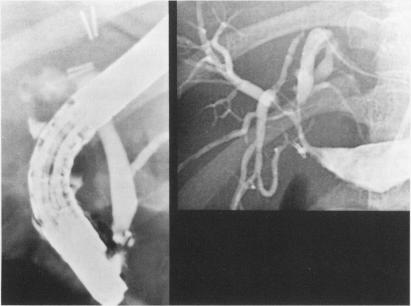
From January 1990 to June 1994, 53 patients who sustained bile duct injuries during laparoscopic cholecystectomy were treated at the Amsterdam Academic Medical Centre. There were 16 men and 37 women with a mean age of 47 years. Follow up was established in all patients for a median of 17 months. Four types of ductal injury were identified. Type A (18 patients) had leakage from cystic ducts or peripheral hepatic radicles, type B (11 patients) had major bile duct leakage, type C (nine patients) had an isolated ductal stricture, and type D (15 patients) had complete transection of the bile duct. Endoscopic retrograde cholangiopancreatography (ERCP) established the diagnosis in all type A, B, and C lesions. In type D lesions percutaneous cholangiography was required to delineate the proximal extent of the injury. Initial treatment (until resolution of symptoms and discharge from hospital) comprised endoscopy in 36 patients and surgery in 26 patients. Endoscopic treatment was possible and successful in 16 of 18 of type A lesions, five of seven of type B lesions, and three of nine of type C lesions. Most failures resulted from inability to pass strictures or leaks at the initial endoscopy. During initial treatment additional surgery was required in seven patients. Fourteen patients underwent percutaneous or surgical drainage of bile collections, or both. After endoscopic treatment early complications occurred in three patients, with a fatal outcome in two (not related to the endoscopic therapy). During follow up six patients developed late complications. All 15 patients with complete transection and four patients with major bile duct leakage were initially treated surgically. During initial treatment additional endoscopy was required in two patients. Early complications occurred in eight patients. During follow up seven patients developed stenosis of the anastomosis or bile duct. Reconstructive surgery in the early postoperative phase was associated with more complications than elective reconstructive surgery. Most type A and B bile duct injuries after laparoscopic cholecystectomy (80%) can be treated endoscopically. In patients with more severe ductal injury (type C and D) reconstructive surgery is eventually required in 70%. Multidisciplinary approach to these lesions is advocated and algorithms for treatment are proposed.
1990年1月至1994年6月,阿姆斯特丹学术医疗中心收治了53例在腹腔镜胆囊切除术期间发生胆管损伤的患者。其中男性16例,女性37例,平均年龄47岁。所有患者均进行了随访,中位随访时间为17个月。确定了四种类型的胆管损伤。A型(18例患者)为胆囊管或肝外周分支渗漏,B型(11例患者)为主要胆管渗漏,C型(9例患者)为孤立性胆管狭窄,D型(15例患者)为胆管完全横断。内镜逆行胰胆管造影(ERCP)对所有A型、B型和C型损伤均做出了诊断。对于D型损伤,需要经皮胆管造影来确定损伤的近端范围。初始治疗(直至症状缓解并出院)包括36例患者接受内镜治疗,26例患者接受手术治疗。内镜治疗在18例A型损伤中的16例、7例B型损伤中的5例和9例C型损伤中的3例中可行且成功。大多数治疗失败是由于在初次内镜检查时无法通过狭窄或渗漏部位。在初始治疗期间,7例患者需要额外进行手术。14例患者接受了经皮或手术胆汁引流,或两者皆有。内镜治疗后,3例患者出现早期并发症,2例死亡(与内镜治疗无关)。随访期间,6例患者出现晚期并发症。所有15例胆管完全横断的患者和4例主要胆管渗漏的患者最初均接受了手术治疗。在初始治疗期间,2例患者需要额外进行内镜检查。8例患者出现早期并发症。随访期间,7例患者出现吻合口或胆管狭窄。术后早期进行重建手术比择期重建手术并发症更多。腹腔镜胆囊切除术后大多数A型和B型胆管损伤(80%)可通过内镜治疗。对于更严重的胆管损伤(C型和D型)患者,最终70%需要进行重建手术。提倡对这些损伤采取多学科方法,并提出了治疗方案。