Huang T, Campadelli-Fiume G
Departmental of Experimental Pathology, Section of Microbiology and Virology, University of Bologna, Italy.
Proc Natl Acad Sci U S A. 1996 Mar 5;93(5):1836-40. doi: 10.1073/pnas.93.5.1836.
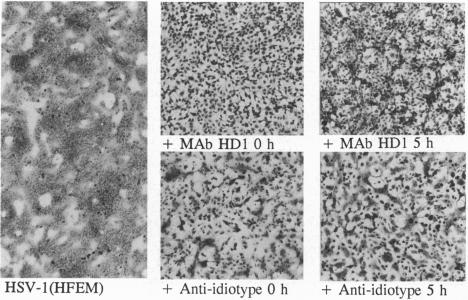
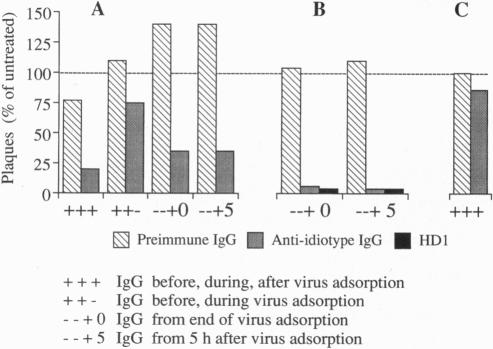
Glycoprotein D (gD) of herpes simplex virus 1 (HSV-1) is required for stable attachment and penetration of the virus into susceptible cells after initial binding. We derived anti-idiotypic antibodies to the neutralizing monoclonal antibody HD1 to gD of HSV-1. These antibodies have the properties expected of antibodies against a gD receptor. Specifically, they bind to the surface of HEp-2, Vero, and HeLa cells susceptible to HSV infection and specifically react with a Mr 62,000 protein in these and other (143TK- and BHK) cell lines. They neutralize virion infectivity, drastically decrease plaque formation by impairing cell-to-cell spread of virions, and reduce polykaryocytosis induced by strain HFEM, which carries a syncytial (syn-) mutation. They do not affect HSV growth in a single-step cycle and plaque formation by an unrelated virus, indicating that they specifically affect the interaction of HSV gD) with a cell surface receptor. We conclude that the Mr 62,000 cell surface protein interacts with gD to enable spread of HSV-1 from cell to cell and virus-induced polykaryocytosis.
单纯疱疹病毒1型(HSV-1)的糖蛋白D(gD)是病毒在初始结合后稳定附着并穿透易感细胞所必需的。我们制备了针对HSV-1 gD的中和单克隆抗体HD1的抗独特型抗体。这些抗体具有针对gD受体的抗体所预期的特性。具体而言,它们能结合到易受HSV感染的HEp-2、Vero和HeLa细胞表面,并与这些细胞系以及其他(143TK和BHK)细胞系中的一种分子量为62,000的蛋白质发生特异性反应。它们能中和病毒粒子的感染性,通过损害病毒粒子的细胞间传播大幅减少噬斑形成,并减少携带合胞体(syn-)突变的HFEM毒株诱导的多核细胞形成。它们不影响HSV在单步周期中的生长以及无关病毒的噬斑形成,这表明它们特异性地影响HSV gD与细胞表面受体的相互作用。我们得出结论,分子量为62,000的细胞表面蛋白与gD相互作用,以使HSV-1在细胞间传播并引发病毒诱导的多核细胞形成。