Wenzl Peter, Li Haobing, Carling Jason, Zhou Meixue, Raman Harsh, Paul Edie, Hearnden Phillippa, Maier Christina, Xia Ling, Caig Vanessa, Ovesná Jaroslava, Cakir Mehmet, Poulsen David, Wang Junping, Raman Rosy, Smith Kevin P, Muehlbauer Gary J, Chalmers Ken J, Kleinhofs Andris, Huttner Eric, Kilian Andrzej
Triticarte P/L, PO Box 7141 Yarralumla, Canberra, ACT 2600, Australia.
BMC Genomics. 2006 Aug 12;7:206. doi: 10.1186/1471-2164-7-206.
Molecular marker technologies are undergoing a transition from largely serial assays measuring DNA fragment sizes to hybridization-based technologies with high multiplexing levels. Diversity Arrays Technology (DArT) is a hybridization-based technology that is increasingly being adopted by barley researchers. There is a need to integrate the information generated by DArT with previous data produced with gel-based marker technologies. The goal of this study was to build a high-density consensus linkage map from the combined datasets of ten populations, most of which were simultaneously typed with DArT and Simple Sequence Repeat (SSR), Restriction Enzyme Fragment Polymorphism (RFLP) and/or Sequence Tagged Site (STS) markers.
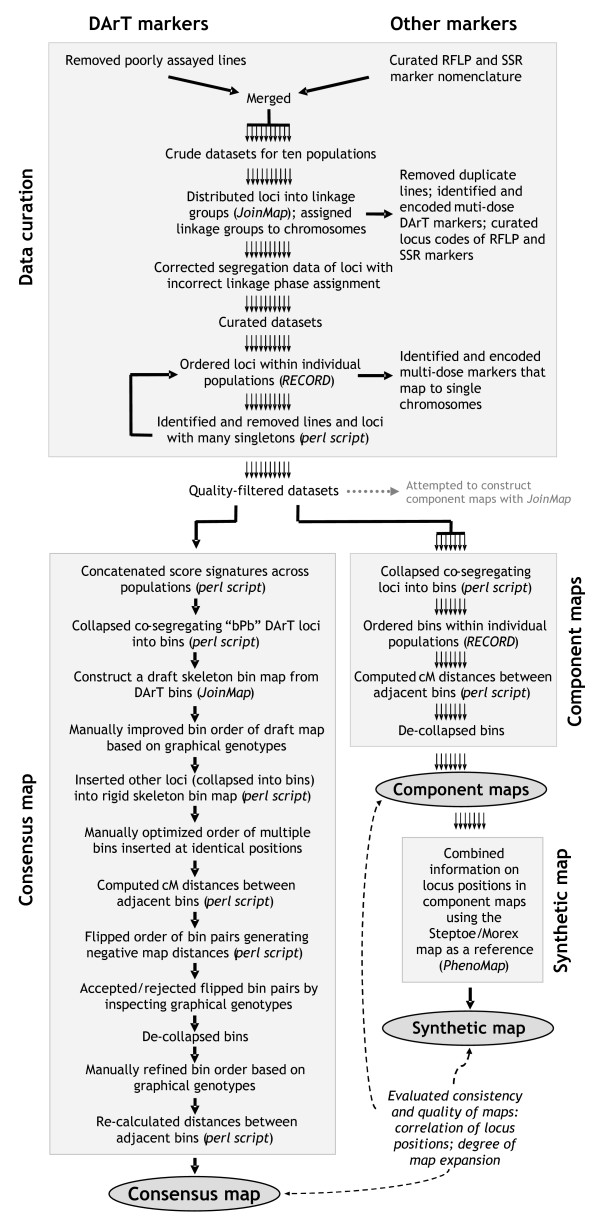
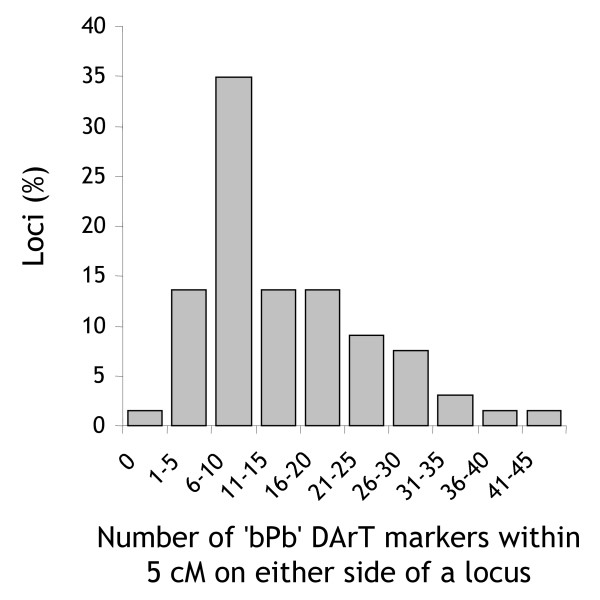
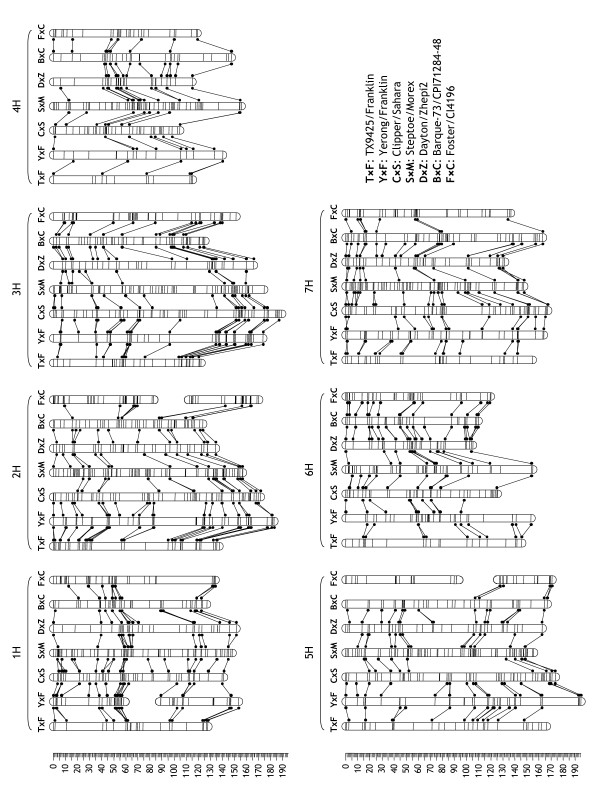
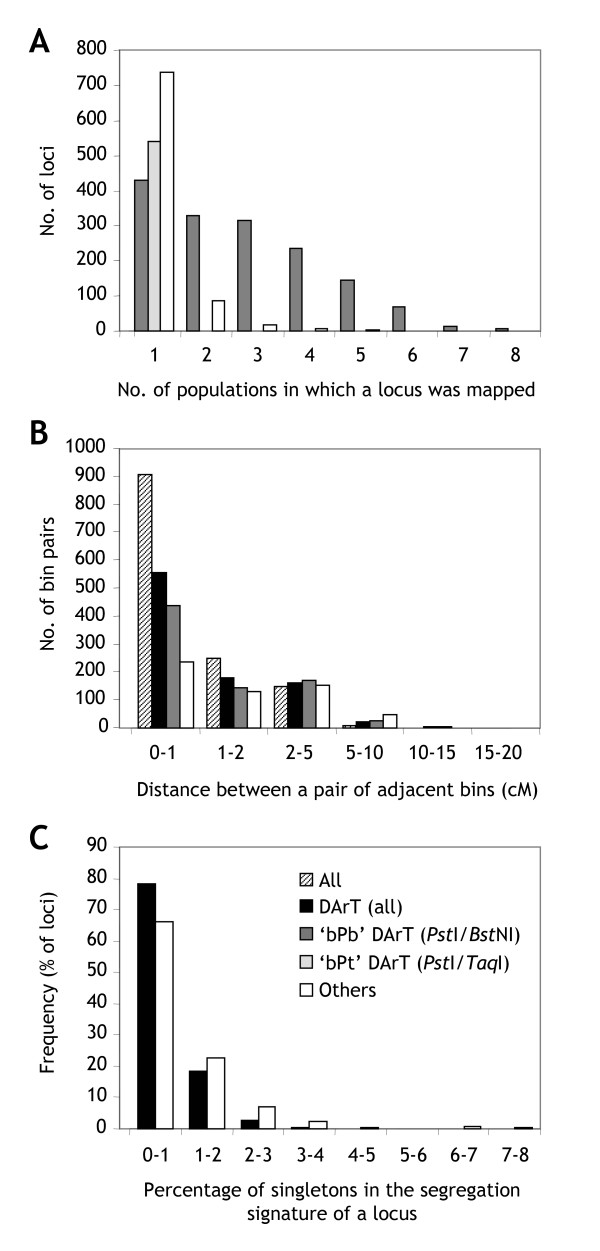
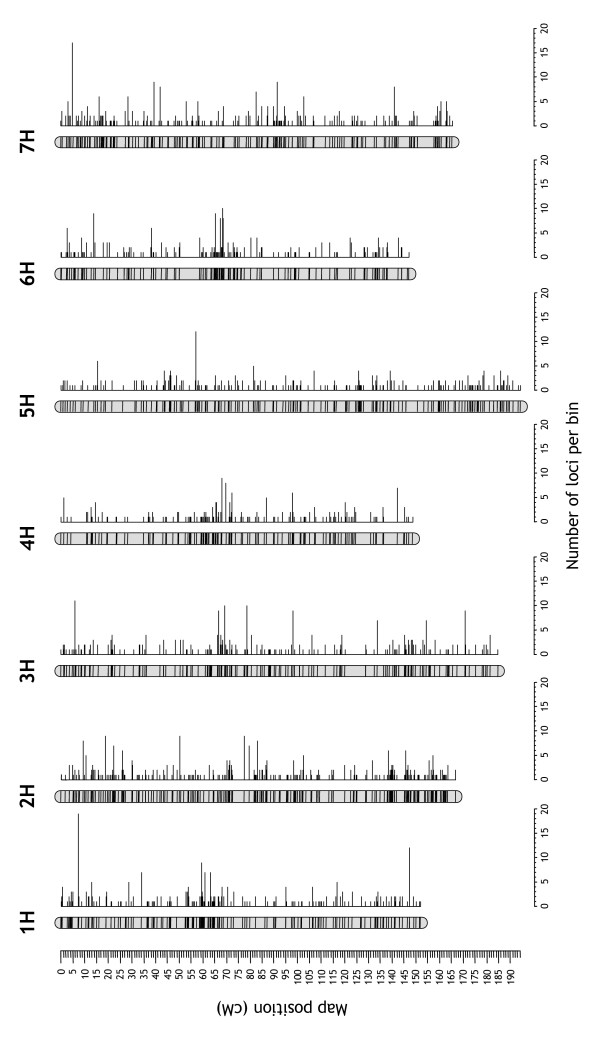
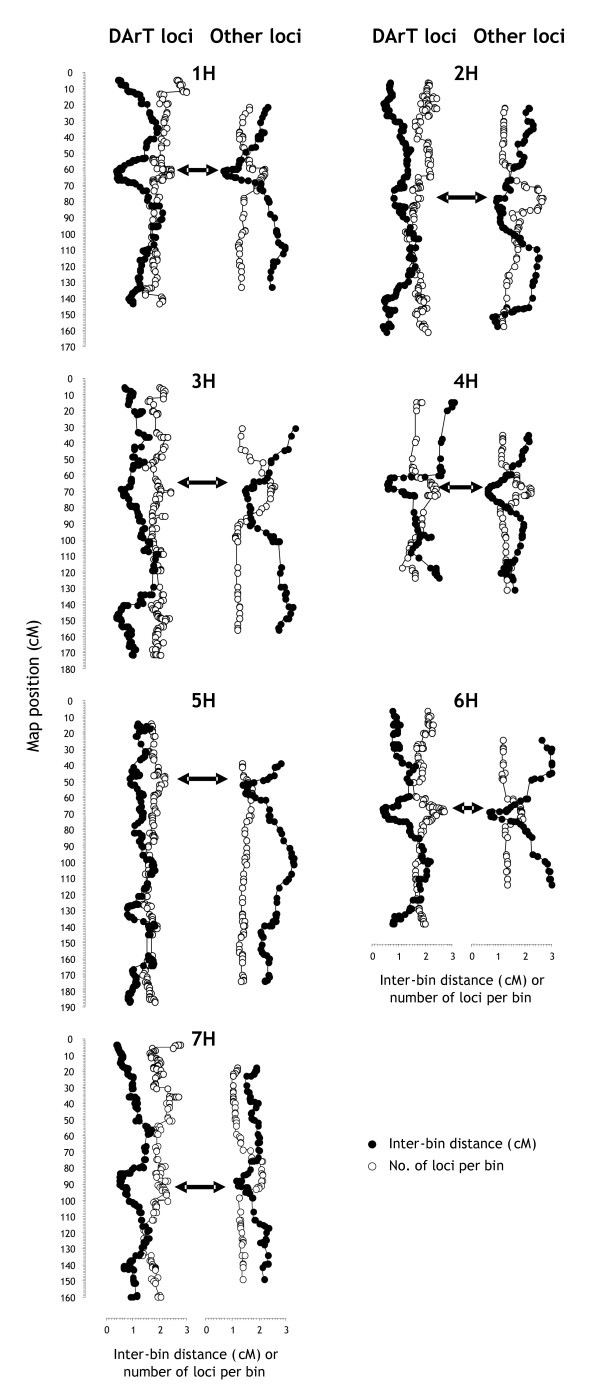
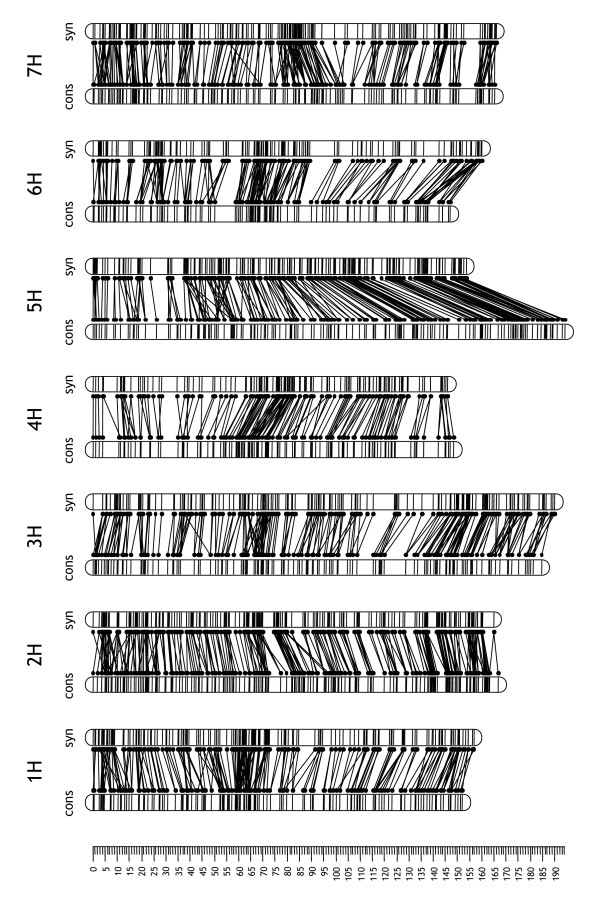
The consensus map, built using a combination of JoinMap 3.0 software and several purpose-built perl scripts, comprised 2,935 loci (2,085 DArT, 850 other loci) and spanned 1,161 cM. It contained a total of 1,629 'bins' (unique loci), with an average inter-bin distance of 0.7 +/- 1.0 cM (median = 0.3 cM). More than 98% of the map could be covered with a single DArT assay. The arrangement of loci was very similar to, and almost as optimal as, the arrangement of loci in component maps built for individual populations. The locus order of a synthetic map derived from merging the component maps without considering the segregation data was only slightly inferior. The distribution of loci along chromosomes indicated centromeric suppression of recombination in all chromosomes except 5H. DArT markers appeared to have a moderate tendency toward hypomethylated, gene-rich regions in distal chromosome areas. On the average, 14 +/- 9 DArT loci were identified within 5 cM on either side of SSR, RFLP or STS loci previously identified as linked to agricultural traits.
Our barley consensus map provides a framework for transferring genetic information between different marker systems and for deploying DArT markers in molecular breeding schemes. The study also highlights the need for improved software for building consensus maps from high-density segregation data of multiple populations.
分子标记技术正在经历从主要测量DNA片段大小的序列分析向具有高多重性水平的基于杂交的技术转变。多样性阵列技术(DArT)是一种基于杂交的技术,越来越多地被大麦研究人员采用。有必要将DArT产生的信息与以前基于凝胶的标记技术产生的数据整合起来。本研究的目的是根据十个群体的组合数据集构建一个高密度的一致性连锁图谱,其中大多数群体同时使用DArT和简单序列重复(SSR)、限制性酶切片段多态性(RFLP)和/或序列标签位点(STS)标记进行分型。
使用JoinMap 3.0软件和几个专门编写的perl脚本构建的一致性图谱包含2935个位点(2085个DArT位点,850个其他位点),跨度为1161厘摩。它总共包含1629个“bin”(独特位点),平均bin间距离为0.7±1.0厘摩(中位数=0.3厘摩)。超过98%的图谱可以用单一的DArT分析覆盖。位点的排列与为各个群体构建的组件图谱中位点的排列非常相似,几乎同样优化。在不考虑分离数据的情况下合并组件图谱得到的综合图谱的位点顺序仅略逊一筹。位点沿染色体的分布表明,除5H染色体外,所有染色体的着丝粒区域均存在重组抑制。DArT标记在远端染色体区域的低甲基化、基因丰富区域似乎有中等程度的倾向。平均而言,在先前确定与农艺性状连锁的SSR、RFLP或STS位点两侧5厘摩范围内鉴定出14±9个DArT位点。
我们的大麦一致性图谱为在不同标记系统之间转移遗传信息以及在分子育种方案中部署DArT标记提供了一个框架。该研究还强调了需要改进软件,以便从多个群体的高密度分离数据构建一致性图谱。