UPRE Lyssavirus Dynamics and Host Adaptation, WHO Collaborating Center for Reference and Research on Rabies, Institut Pasteur, Paris, France; Department de Biologia Animal, Facultat de Biolgia, Universitat de Barcelona, Barcelona, Spain.
PLoS One. 2007 Jun 27;2(6):e566. doi: 10.1371/journal.pone.0000566.
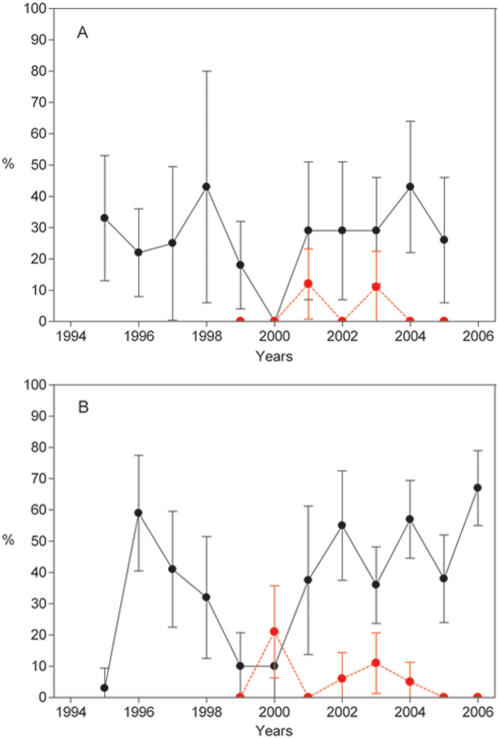
Many emerging RNA viruses of public health concern have recently been detected in bats. However, the dynamics of these viruses in natural bat colonies is presently unknown. Consequently, prediction of the spread of these viruses and the establishment of appropriate control measures are hindered by a lack of information. To this aim, we collected epidemiological, virological and ecological data during a twelve-year longitudinal study in two colonies of insectivorous bats (Myotis myotis) located in Spain and infected by the most common bat lyssavirus found in Europe, the European bat lyssavirus subtype 1 (EBLV-1). This active survey demonstrates that cyclic lyssavirus infections occurred with periodic oscillations in the number of susceptible, immune and infected bats. Persistence of immunity for more than one year was detected in some individuals. These data were further used to feed models to analyze the temporal dynamics of EBLV-1 and the survival rate of bats. According to these models, the infection is characterized by a predicted low basic reproductive rate (R(0) = 1.706) and a short infectious period (D = 5.1 days). In contrast to observations in most non-flying animals infected with rabies, the survival model shows no variation in mortality after EBLV-1 infection of M. myotis. These findings have considerable public health implications in terms of management of colonies where lyssavirus-positive bats have been recorded and confirm the potential risk of rabies transmission to humans. A greater understanding of the dynamics of lyssavirus in bat colonies also provides a model to study how bats contribute to the maintenance and transmission of other viruses of public health concern.
最近在蝙蝠中检测到了许多具有公共卫生意义的新兴 RNA 病毒。然而,目前尚不清楚这些病毒在自然蝙蝠群体中的动态。因此,由于缺乏信息,这些病毒的传播预测和适当的控制措施的建立受到阻碍。为此,我们在西班牙的两个食虫蝙蝠(Myotis myotis)群体中进行了为期 12 年的纵向研究,收集了流行病学、病毒学和生态学数据,这些蝙蝠感染了在欧洲最常见的蝙蝠李萨如病毒,即欧洲蝙蝠李萨如病毒 1 型(EBLV-1)。这项主动调查表明,周期性病毒感染与易感、免疫和感染蝙蝠数量的周期性波动有关。在一些个体中检测到超过一年的免疫持久性。这些数据进一步用于为模型提供信息,以分析 EBLV-1 的时间动态和蝙蝠的存活率。根据这些模型,感染的特征是预测的低基本繁殖率(R(0) = 1.706)和短传染期(D = 5.1 天)。与大多数感染狂犬病的非飞行动物的观察结果相反,在 EBLV-1 感染 M. myotis 后,存活模型显示死亡率没有变化。这些发现对管理记录有李萨如病毒阳性蝙蝠的群体具有重要的公共卫生意义,并证实了向人类传播狂犬病的潜在风险。对蝙蝠群体中李萨如病毒动态的更深入了解还提供了一个模型,用于研究蝙蝠如何有助于维持和传播其他具有公共卫生意义的病毒。