Herbstman Julie B, Sjödin Andreas, Apelberg Benjamin J, Witter Frank R, Patterson Donald G, Halden Rolf U, Jones Richard S, Park Annie, Zhang Yalin, Heidler Jochen, Needham Larry L, Goldman Lynn R
Columbia Children's Center for Environmental Health, Columbia Mailman School of Public Health, New York, NY, USA.
Environ Health Perspect. 2007 Dec;115(12):1794-800. doi: 10.1289/ehp.10333.
Recent studies have reported blood levels of polybrominated diphenyl ethers (PBDEs) in the U.S. population. Information about neonatal levels and about the relationship to polychlorinated biphenyls (PCBs) exposures is limited.
The objective was to characterize levels and determinants of fetal exposure to PBDEs and PCBs among newborns from Baltimore, Maryland.
We analyzed umbilical cord blood for eight PBDEs and 35 PCBs from infants delivered at the Johns Hopkins Hospital. Maternal and infant characteristics were abstracted from medical records.
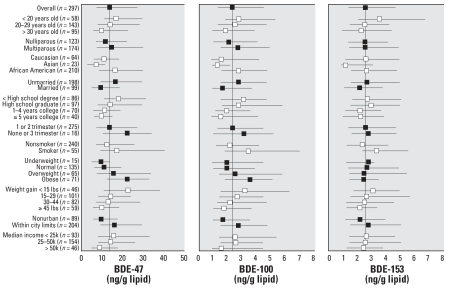
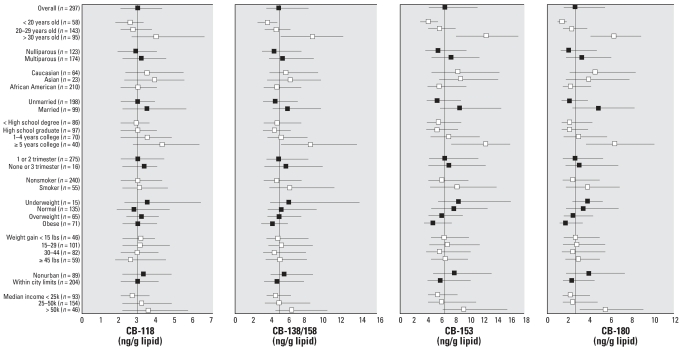
Ninety-four percent of cord serum samples had quantifiable levels of at least one PBDE congener, and > 99% had at least one detectable PCB congener. PBDE concentrations in cord blood were similar to those reported in other studies from North America. Strong correlations were observed within but not across PCB and PBDE classes. Multivariate models showed that many factors independently predicted exposure to BDE-47, BDE-100, and BDE-153 and CB-118, CB-138/158, CB-153, and CB-180. Generally, infants of Asian mothers had lower PBDE and PCB levels, and infants of smokers had higher levels. Increased maternal body mass index was associated with lower levels of PCBs but not PBDEs. Levels of PCBs but not PBDEs were lower in births from married and multiparous mothers. Increased maternal age was associated with higher PCB levels but lower PBDE levels.
Although many of the factors we investigated were independent predictors of both PBDE and PCB levels, in some cases the direction of associations was different. More research is needed to better understand the sources and pathways of PBDE exposure.
近期研究报告了美国人群中多溴二苯醚(PBDEs)的血液水平。关于新生儿体内PBDEs水平及其与多氯联苯(PCBs)暴露关系的信息有限。
旨在描述马里兰州巴尔的摩市新生儿胎儿期接触PBDEs和PCBs的水平及决定因素。
我们分析了约翰霍普金斯医院分娩婴儿的脐带血中8种PBDEs和35种PCBs的含量。从病历中提取母婴特征信息。
94%的脐带血清样本中至少有一种PBDE同系物的含量可检测,>99%的样本中至少有一种可检测到的PCB同系物。脐带血中PBDEs的浓度与北美其他研究报告的浓度相似。在PCB和PBDE类别内部观察到强相关性,但跨类别则未观察到。多变量模型显示,许多因素可独立预测BDE - 47、BDE - 100、BDE - 153以及CB - 118、CB - 138/158、CB - 153和CB - 180的暴露情况。一般来说,亚洲母亲的婴儿PBDEs和PCBs水平较低,吸烟者的婴儿水平较高。母亲体重指数增加与PCBs水平降低有关,但与PBDEs无关。已婚和经产妇所生婴儿的PCBs水平较低,但PBDEs水平无此关联。母亲年龄增加与PCBs水平升高但PBDEs水平降低有关。
尽管我们研究的许多因素是PBDEs和PCBs水平的独立预测因素,但在某些情况下,关联方向有所不同。需要更多研究以更好地了解PBDEs暴露的来源和途径。