Department of Computer Engineering, University of Tubingen, 72076 Tubingen, Germany.
Comput Intell Neurosci. 2007;2007:71863. doi: 10.1155/2007/71863.
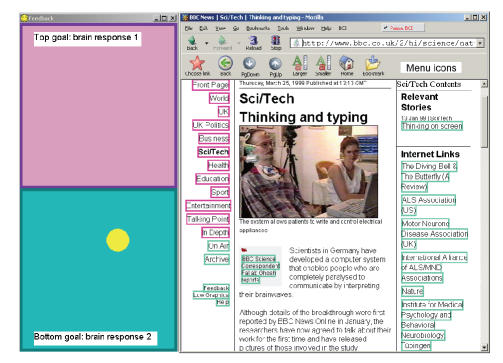
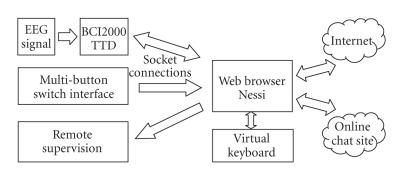
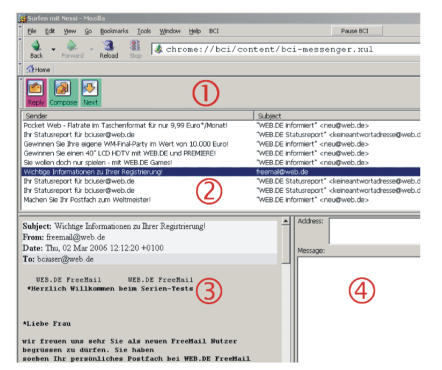
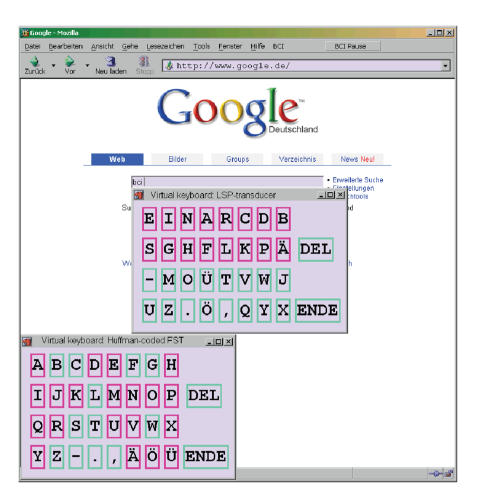
We have previously demonstrated that an EEG-controlled web browser based on self-regulation of slow cortical potentials (SCPs) enables severely paralyzed patients to browse the internet independently of any voluntary muscle control. However, this system had several shortcomings, among them that patients could only browse within a limited number of web pages and had to select links from an alphabetical list, causing problems if the link names were identical or if they were unknown to the user (as in graphical links). Here we describe a new EEG-controlled web browser, called Nessi, which overcomes these shortcomings. In Nessi, the open source browser, Mozilla, was extended by graphical in-place markers, whereby different brain responses correspond to different frame colors placed around selectable items, enabling the user to select any link on a web page. Besides links, other interactive elements are accessible to the user, such as e-mail and virtual keyboards, opening up a wide range of hypertext-based applications.
我们之前已经证明,基于慢皮质电位(SCP)自我调节的 EEG 控制网络浏览器使严重瘫痪的患者能够在无需任何自主肌肉控制的情况下独立上网。然而,该系统存在几个缺点,其中包括患者只能浏览有限数量的网页,并且必须从字母列表中选择链接,如果链接名称相同或者用户不熟悉(如图形链接),则会出现问题。在这里,我们描述了一种新的 EEG 控制网络浏览器,称为 Nessi,它克服了这些缺点。在 Nessi 中,开源浏览器 Mozilla 通过图形在位标记进行了扩展,其中不同的大脑反应对应于放置在可选择项目周围的不同帧颜色,使用户能够选择网页上的任何链接。除了链接之外,用户还可以访问其他交互元素,例如电子邮件和虚拟键盘,从而打开了各种基于超文本的应用程序。