Nilsson Anna C, Björkman Per, Persson Kenneth
Department of Clinical Sciences, Malmö, Infectious Disease Research Unit, Lund University, Malmö University Hospital, Sweden.
BMC Microbiol. 2008 Jun 11;8:93. doi: 10.1186/1471-2180-8-93.
Diagnosis of Mycoplasma pneumoniae (MP) infection is traditionally based on serology, which may require more than two weeks for diagnostic antibodies to develop. PCR-based methods offer earlier diagnosis. During a community outbreak of MP infection, we compared semi-nested and real-time PCR of oropharyngeal swabs with serology for diagnosis of MP infection at different time points after disease onset. PCR-positive individuals were followed longitudinally to assess the persistence of MP DNA in throat secretions. We also studied carriage of MP among household contacts and school children.
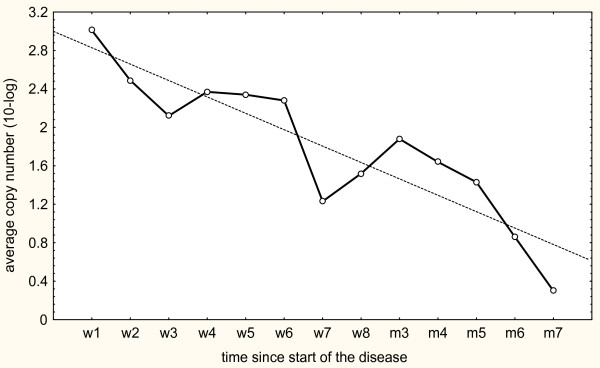
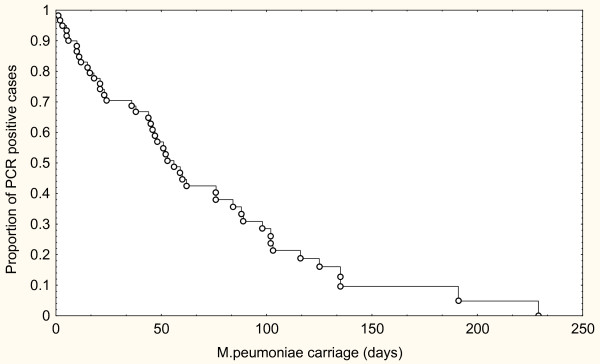
MP infection was diagnosed in 48 of 164 patients with respiratory tract infection. Forty-five (29%) had detectable MP DNA in oropharynx. A significant increase in MP IgG IgG titre or MP IgM antibodies was detected in 44/154 (27%) subjects. Two MP PCR-positive patients lacked antibody responses. Sera were missing from another two patients. The agreement between serology and PCR was good, kappa = 0.90. During the first three weeks after disease onset the performance of PCR was excellent and all patients but one were detected. In contrast, only 21% of the patients with confirmed MP infection were positive by serum 1 during the first symptomatic week (56% during the second and 100% during the third week). Only 1/237 (0.4%) school children was positive by PCR. This child had respiratory symptoms. Eighteen of 22 (75%) symptomatic household contacts were MP PCR positive. Persistence of MP DNA in the throat was common. Median time for carriage of MP DNA was 7 weeks after disease onset (range 2 days - 7 months). Adequate antibiotic treatment did not shorten the period of persistence. Bacterial load, measured by quantitative real-time PCR declined gradually, and all followed patients eventually became PCR-negative.
PCR is superior to serology for diagnosis of MP infection during the early phases of infection. Persistent, sometimes long-term, carriage of MP DNA in the throat is common following acute infection, and is not affected by antibiotic therapy. Asymptomatic carriage of MP even during an outbreak is uncommon.
肺炎支原体(MP)感染的诊断传统上基于血清学,诊断性抗体的产生可能需要两周以上时间。基于聚合酶链反应(PCR)的方法能实现更早诊断。在一次社区MP感染暴发期间,我们比较了口咽拭子的半巢式PCR和实时PCR与血清学在疾病发作后不同时间点对MP感染的诊断情况。对PCR阳性个体进行纵向随访,以评估MP DNA在咽喉分泌物中的持续存在情况。我们还研究了家庭接触者和学童中MP的携带情况。
164例呼吸道感染患者中有48例诊断为MP感染。45例(29%)口咽中可检测到MP DNA。154例受试者中有44例(27%)检测到MP IgG滴度或MP IgM抗体显著升高。两名PCR阳性患者缺乏抗体反应。另外两名患者血清缺失。血清学与PCR之间的一致性良好,kappa值为0.90。在疾病发作后的前三周,PCR的表现出色,除一名患者外所有患者均被检测到。相比之下,在第一个有症状周期间,确诊MP感染的患者中只有21%血清1呈阳性(第二周为56%,第三周为100%)。237名学童中只有1名(0.4%)PCR呈阳性。该儿童有呼吸道症状。22名有症状的家庭接触者中有18名(75%)MP PCR呈阳性。MP DNA在咽喉中的持续存在很常见。疾病发作后MP DNA携带的中位时间为7周(范围2天至7个月)。充分的抗生素治疗并未缩短持续时间。通过定量实时PCR测量的细菌载量逐渐下降,所有随访患者最终均变为PCR阴性。
在感染早期,PCR诊断MP感染优于血清学。急性感染后,MP DNA在咽喉中持续携带,有时长期携带很常见,且不受抗生素治疗影响。即使在暴发期间,MP的无症状携带也不常见。