Functional Genomics and Systems Biology for Health, CNRS Institute of Biological Sciences, 7 rue Guy Moquet, BP8, 94801 Villejuif, France.
Int J Mol Sci. 2009 Apr 17;10(4):1658-69. doi: 10.3390/ijms10041658.
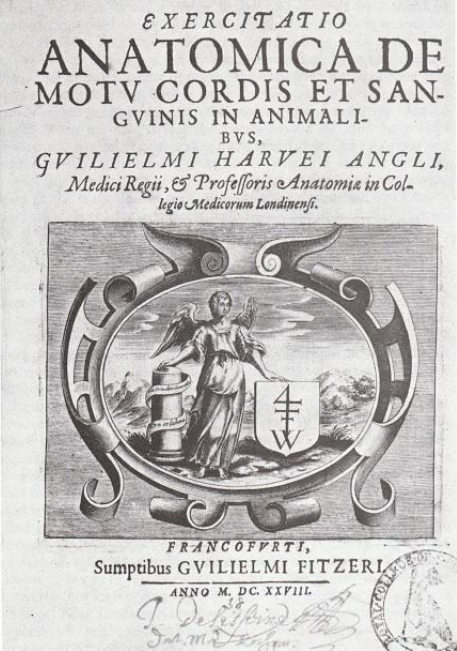
In this article we continue our exploration of the historical roots of systems biology by considering the work of William Harvey. Central arguments in his work on the movement of the heart and the circulation of the blood can be shown to presage the concepts and methods of integrative systems biology. These include: (a) the analysis of the level of biological organization at which a function (e.g. cardiac rhythm) can be said to occur; (b) the use of quantitative mathematical modelling to generate testable hypotheses and deduce a fundamental physiological principle (the circulation of the blood) and (c) the iterative submission of his predictions to an experimental test. This article is the result of a tri-lingual study: as Harvey's masterpiece was published in Latin in 1628, we have checked the original edition and compared it with and between the English and French translations, some of which are given as notes to inform the reader of differences in interpretation.
在本文中,我们继续探讨系统生物学的历史根源,研究威廉·哈维(William Harvey)的工作。他关于心脏运动和血液循环的研究中的核心论点可以预见整合系统生物学的概念和方法。这些包括:(a)分析可以说发生功能(例如心脏节律)的生物学组织水平;(b)使用定量数学建模来生成可检验的假设并推导出基本的生理原理(血液循环);(c)将他的预测反复提交给实验测试。本文是一项三语研究的结果:由于哈维的杰作于 1628 年以拉丁文出版,我们查阅了原文版本,并将其与英文和法文翻译进行了比较和对照,其中一些翻译作为注释提供,以告知读者解释上的差异。