Huang Jason C, Chang Ying-Feng, Chen Kuan-Hsuan, Su Li-Chen, Lee Chun-Wei, Chen Chii-Chang, Chen Yi-Ming Arthur, Chou Chien
Department of Biotechnology and Laboratory Science in Medicine, National Yang-Ming University, Taipei 112, Taiwan.
Biosens Bioelectron. 2009 Oct 15;25(2):320-5. doi: 10.1016/j.bios.2009.07.012. Epub 2009 Jul 17.
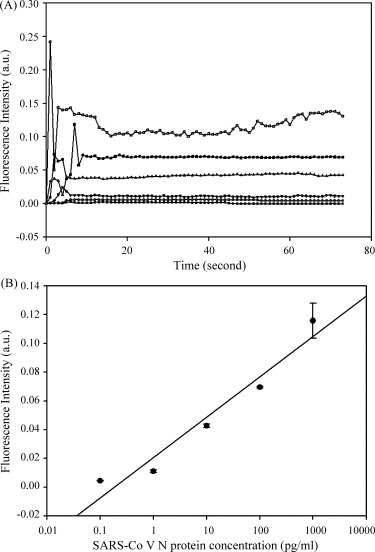
In order to enhance the sensitivity of conventional immunoassay technology for the detection of SARS coronavirus (SARS-CoV) nucleocapsid protein (N protein), we developed a localized surface plasmon coupled fluorescence (LSPCF) fiber-optic biosensor that combines sandwich immunoassay with the LSP technique. Experimentally, a linear relationship between the fluorescence signal and the concentration of recombinant SARS-CoV N (GST-N) protein in buffer solution could be observed from 0.1 pg/mL to 1 ng/mL. In addition, the concentration of GST-N protein in diluted serum across a similar range could also be measured. The correlation coefficients (linear scale) for these two measurements were 0.9469 and 0.9624, respectively. In comparison with conventional enzyme linked immunosorbent assay (ELISA), the detection limit of the LSPCF fiber-optic biosensor for the GST-N protein was improved at least 10(4)-fold using the same monoclonal antibodies. Therefore, the LSPCF fiber-optic biosensor shows an ability to detect very low concentration (approximately 1 pg/mL) of SARS-CoV N protein in serum. The biosensor should help with the early diagnosis of SARS infection.
为提高传统免疫分析技术检测严重急性呼吸综合征冠状病毒(SARS-CoV)核衣壳蛋白(N蛋白)的灵敏度,我们开发了一种将夹心免疫分析与局域表面等离子体耦合荧光(LSPCF)技术相结合的光纤生物传感器。实验表明,在缓冲溶液中,荧光信号与重组SARS-CoV N(GST-N)蛋白浓度在0.1 pg/mL至1 ng/mL范围内呈线性关系。此外,在相似浓度范围内,稀释血清中GST-N蛋白的浓度也可被测定。这两种测量的相关系数(线性范围)分别为0.9469和0.9624。与传统酶联免疫吸附测定(ELISA)相比,使用相同的单克隆抗体,LSPCF光纤生物传感器对GST-N蛋白的检测限至少提高了10^4倍。因此,LSPCF光纤生物传感器能够检测血清中极低浓度(约1 pg/mL)的SARS-CoV N蛋白。该生物传感器应有助于SARS感染的早期诊断。