Department of Epidemiology, Biostatistics and Occupational Health, McGill University, Montreal, Quebec, Canada.
PLoS One. 2009 Dec 14;4(12):e8237. doi: 10.1371/journal.pone.0008237.
An association between insufficient milk supply, the inability of a mother's breast milk to provide sufficiently for her infant, and breast cancer has been suggested by observations in animal models. To determine if an association has been reported in epidemiological studies of human breast cancer, a systematic review of the literature has been conducted. We also sought to identify the methodological limitations of existing studies to guide the design of any future prospective studies in this field.
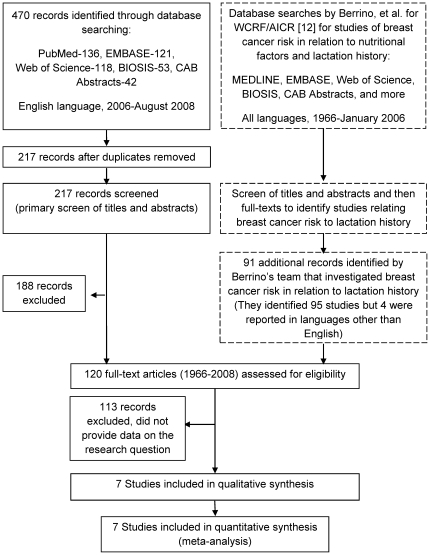
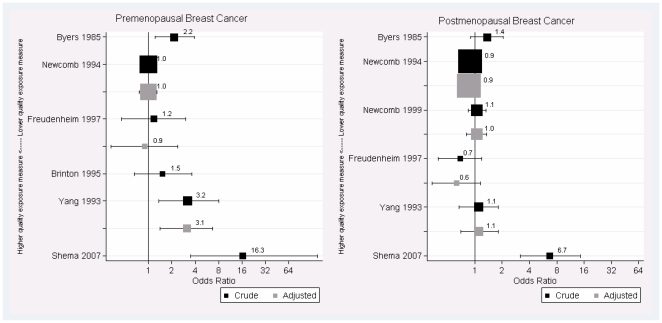
METHODOLOGY/PRINCIPAL FINDINGS: PubMed, EMBASE, Web of Science, BIOSIS, and CAB abstracts were searched. We selected any study that (1) assessed breast cancer in association with breastfeeding history and (2) examined the relationship between insufficient milk supply with breast cancer. Seven relevant studies were identified that met both criteria. There was statistically significant heterogeneity among the results which likely reflects clinically significant differences in definitions of insufficient milk supply and reference groups that were used. Among premenopausal women who had experienced insufficient milk supply, odds ratios (ORs) for breast cancer risk ranged from 0.9 to 16.3. Among postmenopausal women, ORs ranged from 0.6 to 6.7. Based on the range of odds ratios obtained in the studies reported in this review, it remains unclear if there is a true association between insufficient milk supply and breast cancer.
CONCLUSIONS/SIGNIFICANCE: Although some studies have shown a strong positive association, there is no consistent evidence for an effect of insufficient milk supply on breast cancer risk. Exposure definitions are in need of improvement in order to focus on primary insufficient milk supply. Reference groups consisting of women who have successfully breastfed may also introduce positive bias (inflation of the odds ratio) into study results because of the protective effect of prolonged breastfeeding in the control group.
动物模型的观察结果表明,母乳供应不足、母亲的母乳无法充分满足婴儿的需求与乳腺癌之间存在关联。为了确定这种关联是否在人类乳腺癌的流行病学研究中得到了报道,我们对文献进行了系统回顾。我们还试图确定现有研究的方法学局限性,以指导该领域未来前瞻性研究的设计。
方法/主要发现:检索了 PubMed、EMBASE、Web of Science、BIOSIS 和 CAB 摘要。我们选择了任何评估乳腺癌与母乳喂养史相关的研究,以及研究母乳供应不足与乳腺癌之间关系的研究。符合这两个标准的有 7 项相关研究。结果存在统计学上的显著异质性,这可能反映了在母乳供应不足的定义和使用的参考组方面存在临床意义上的差异。在经历过母乳供应不足的绝经前妇女中,乳腺癌风险的比值比(OR)范围为 0.9 至 16.3。在绝经后妇女中,OR 范围为 0.6 至 6.7。根据本综述中报告的研究中获得的比值比范围,母乳供应不足与乳腺癌之间是否存在真正的关联仍不清楚。
结论/意义:尽管一些研究显示出强烈的正相关,但没有一致的证据表明母乳供应不足会影响乳腺癌的风险。为了专注于原发性母乳供应不足,暴露定义需要改进。由成功母乳喂养的女性组成的参考组也可能会因对照组中延长母乳喂养的保护作用而引入正向偏差(比值比膨胀),从而对研究结果产生积极影响。