Wathen C Nadine, Jamieson Ellen, Wilson Margo, Daly Martin, Worster Andrew, Macmillan Harriet L
Open Med. 2007 Aug 27;1(2):e113-22.
Intimate partner violence against women is prevalent and is associated with poor health outcomes. Understanding indicators of exposure to intimate partner violence can assist health care professionals to identify and respond to abused women. This study was undertaken to determine the strength of association between selected evidence-based risk indicators and exposure to intimate partner violence.
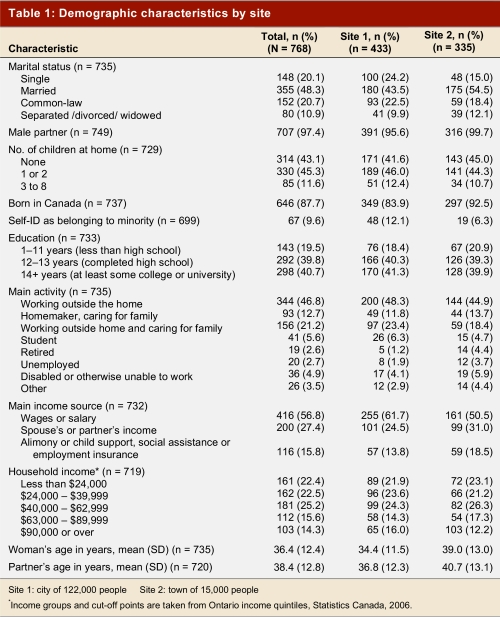
In this cross-sectional study of 768 English-speaking women aged 18-64 years who presented to 2 emergency departments in Ontario, Canada, participants answered questions about risk indicators and completed the Composite Abuse Scale to determine their exposure to intimate partner violence in the past year.
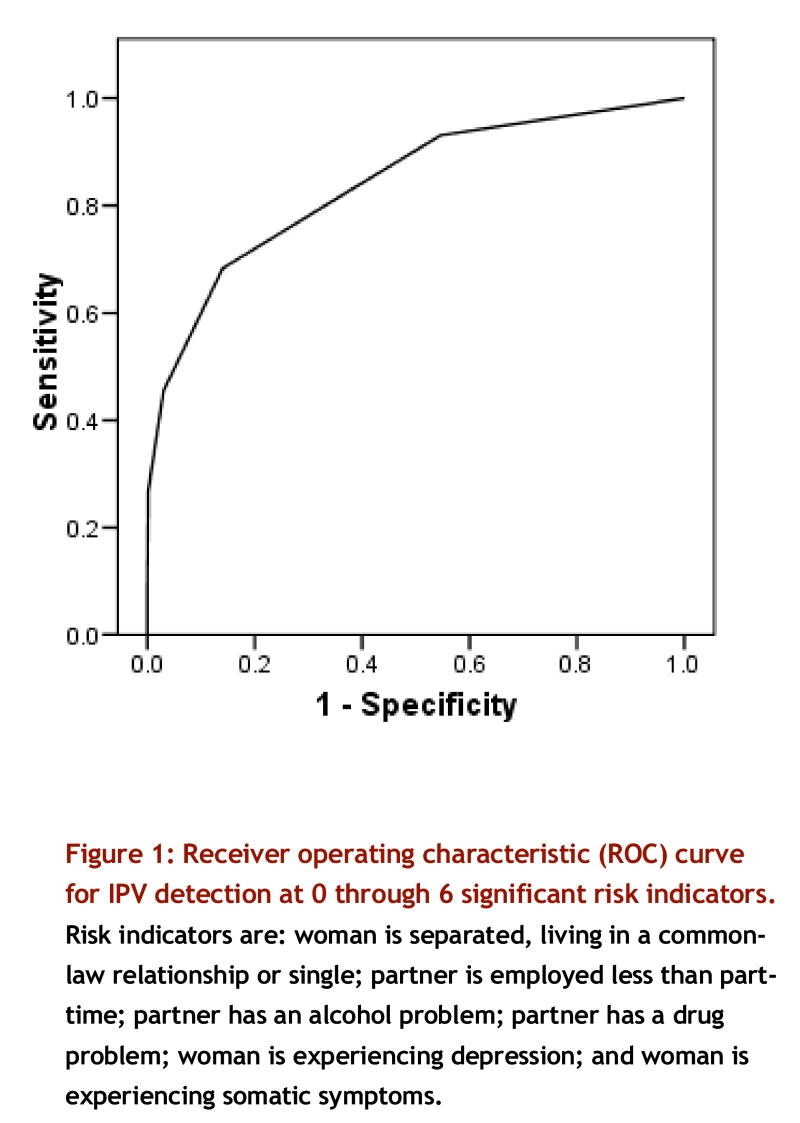
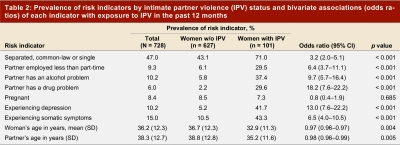
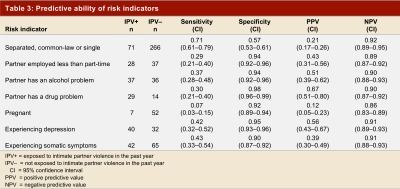
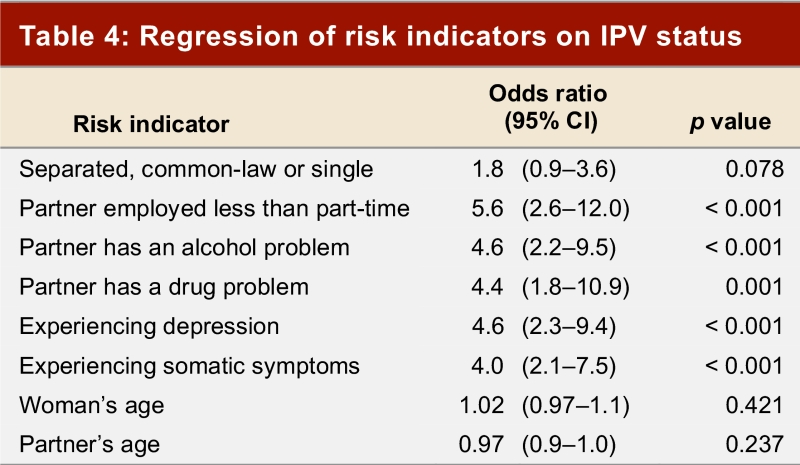
Intimate partner violence was significantly associated with being separated, in a common-law relationship or single (odds ratio [OR] = 2.08, 95% confidence interval [CI] 1.17-3.71); scoring positive for depression (OR = 4.26, 95% CI 2.11-8.60) or somatic symptoms (OR = 4.09, 95% CI 2.18-7.67); having a male partner who was employed less than part time (OR = 5.12, 95% CI 2.46-10.64), or having a partner with an alcohol (OR = 4.36, 95% CI 2.16-8.81) or drug problem (OR = 4.63, 95% CI 1.89-11.38). Each unit increase in the number of indicators corresponded to a four-fold increase in the risk of intimate partner violence (OR = 3.92, 95% CI 3.06-5.02); women with 3 or more indicators had a greater than 50% probability of a positive score on the Composite Abuse Scale. Intimate partner violence was not associated with pregnancy status.
Specific characteristics of male partners, relationships and women's mental health are significantly related to exposure to intimate partner violence in the past year. Identification of these indicators has implications for the clinical care of women who present to health care settings.
亲密伴侣对女性的暴力行为普遍存在,且与不良健康后果相关。了解亲密伴侣暴力暴露的指标有助于医护人员识别受虐待女性并做出应对。本研究旨在确定选定的循证风险指标与亲密伴侣暴力暴露之间的关联强度。
在这项横断面研究中,768名年龄在18至64岁之间、讲英语的女性前往加拿大安大略省的2个急诊科就诊,参与者回答了有关风险指标的问题,并完成了综合虐待量表,以确定她们在过去一年中遭受亲密伴侣暴力的情况。
亲密伴侣暴力与分居、处于同居关系或单身显著相关(优势比[OR]=2.08,95%置信区间[CI]1.17-3.71);抑郁(OR=4.26,95%CI 2.11-8.60)或躯体症状(OR=4.09,95%CI 2.18-7.67)得分呈阳性;男性伴侣兼职工作时间少于全职(OR=5.12,95%CI 2.46-10.64),或伴侣有酗酒(OR=4.36,95%CI 2.16-8.81)或吸毒问题(OR=4.63,95%CI 1.89-11.38)。指标数量每增加一个单位,亲密伴侣暴力风险就会增加四倍(OR=3.92,95%CI 3.06-5.02);有3个或更多指标的女性在综合虐待量表上得分为阳性的概率超过50%。亲密伴侣暴力与怀孕状况无关。
男性伴侣的特定特征、关系以及女性的心理健康与过去一年中遭受亲密伴侣暴力显著相关。识别这些指标对前往医疗机构就诊的女性的临床护理具有重要意义。