The MRC Centre for Causal Analyses in Translational Epidemiology, University of Bristol, Bristol, United Kingdom.
J Adolesc Health. 2010 Jul;47(1):35-42. doi: 10.1016/j.jadohealth.2009.12.022. Epub 2010 Mar 15.
Conduct problems and peer effects are among the strongest risk factors for adolescent substance use and problem use. However, it is unclear to what extent the effects of conduct problems and peer behavior interact, and whether adolescents' capacity to refuse the offer of substances may moderate such links. This study was conducted to examine relationships between conduct problems, close friends' substance use, and refusal assertiveness with adolescents' alcohol use problems, tobacco, and marijuana use.
We studied a population-based sample of 1,237 individuals from the Cardiff Study of All Wales and North West of England Twins aged 11-18 years. Adolescent and mother-reported information was obtained. Statistical analyses included cross-sectional and prospective logistic regression models and family-based permutations.
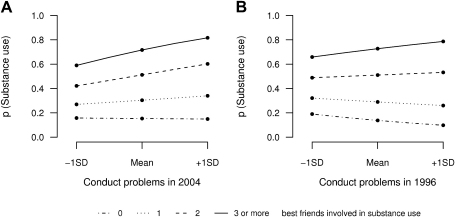
Conduct problems and close friends' substance use were associated with increased adolescents' substance use, whereas refusal assertiveness was associated with lower use of cigarettes, alcohol, and marijuana. Peer substance use moderated the relationship between conduct problems and alcohol use problems, such that conduct problems were only related to increased risk for alcohol use problems in the presence of substance-using friends. This effect was found in both cross-sectional and prospective analyses and confirmed using the permutation approach.
Reduced opportunities for interaction with alcohol-using peers may lower the risk of alcohol use problems in adolescents with conduct problems.
行为问题和同伴影响是青少年物质使用和问题使用的最强风险因素之一。然而,目前尚不清楚行为问题和同伴行为的影响在多大程度上相互作用,以及青少年拒绝提供物质的能力是否会调节这些联系。本研究旨在探讨行为问题、密友物质使用和拒绝自信与青少年酒精使用问题、烟草和大麻使用之间的关系。
我们研究了来自卡迪夫全威尔士和英格兰西北部双胞胎研究的 1237 名 11-18 岁个体的基于人群的样本。获得了青少年和母亲报告的信息。统计分析包括横断面和前瞻性逻辑回归模型和基于家庭的排列。
行为问题和密友物质使用与青少年物质使用增加有关,而拒绝自信与吸烟、饮酒和使用大麻减少有关。同伴物质使用调节了行为问题与酒精使用问题之间的关系,使得在存在使用物质的朋友的情况下,行为问题仅与酒精使用问题的风险增加有关。这种影响在横断面和前瞻性分析中均存在,并通过排列方法得到证实。
减少与饮酒同伴互动的机会可能会降低行为问题青少年酒精使用问题的风险。