• 文献检索
  • 文档翻译
  • 深度研究
  • 学术资讯
  • Suppr Zotero 插件Zotero 插件
  • 邀请有礼
  • 套餐&价格
  • 历史记录
应用&插件
Suppr Zotero 插件Zotero 插件浏览器插件Mac 客户端Windows 客户端微信小程序
定价
高级版会员购买积分包购买API积分包
服务
文献检索文档翻译深度研究API 文档MCP 服务
关于我们
关于 Suppr公司介绍联系我们用户协议隐私条款
关注我们

Suppr 超能文献

核心技术专利:CN118964589B侵权必究
粤ICP备2023148730 号-1Suppr @ 2026

文献检索

告别复杂PubMed语法,用中文像聊天一样搜索,搜遍4000万医学文献。AI智能推荐,让科研检索更轻松。

立即免费搜索

文件翻译

保留排版,准确专业,支持PDF/Word/PPT等文件格式,支持 12+语言互译。

免费翻译文档

深度研究

AI帮你快速写综述,25分钟生成高质量综述,智能提取关键信息,辅助科研写作。

立即免费体验

降低非洲间日疟原虫疟疾的传播:干预策略的基于模型的评估。

Reducing Plasmodium falciparum malaria transmission in Africa: a model-based evaluation of intervention strategies.

机构信息

MRC Centre for Outbreak Analysis & Modelling, Department of Infectious Disease Epidemiology, Imperial College London, London, England.

出版信息

PLoS Med. 2010 Aug 10;7(8):e1000324. doi: 10.1371/journal.pmed.1000324.

DOI:10.1371/journal.pmed.1000324
PMID:20711482
原文链接:https://pmc.ncbi.nlm.nih.gov/articles/PMC2919425/
Abstract

BACKGROUND

Over the past decade malaria intervention coverage has been scaled up across Africa. However, it remains unclear what overall reduction in transmission is achievable using currently available tools.

METHODS AND FINDINGS

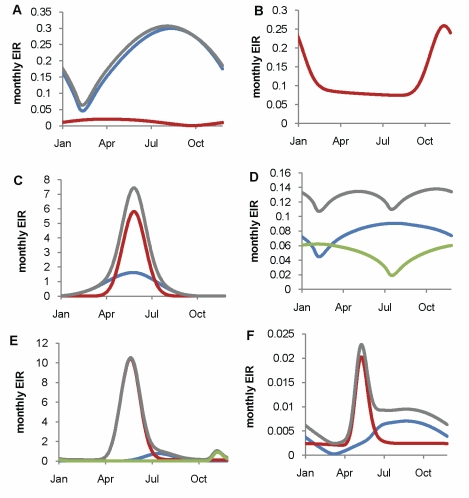
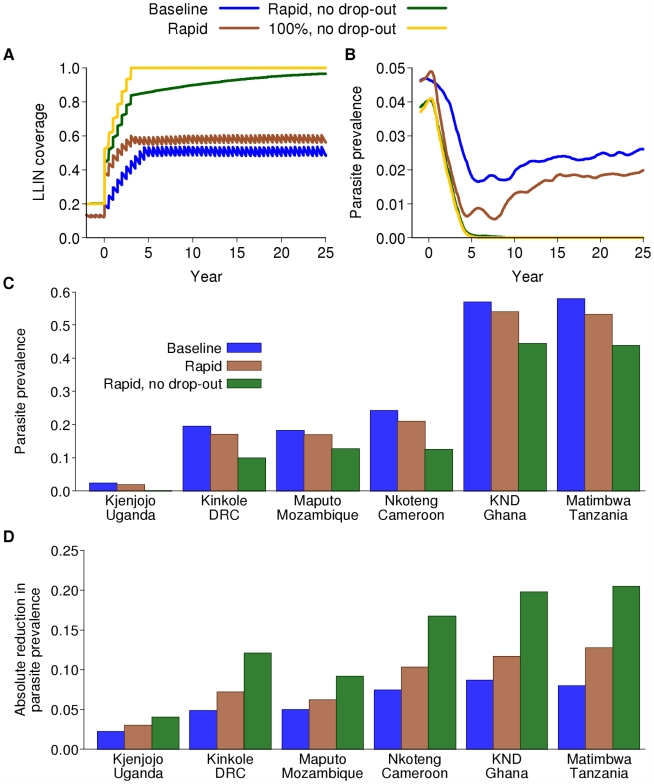
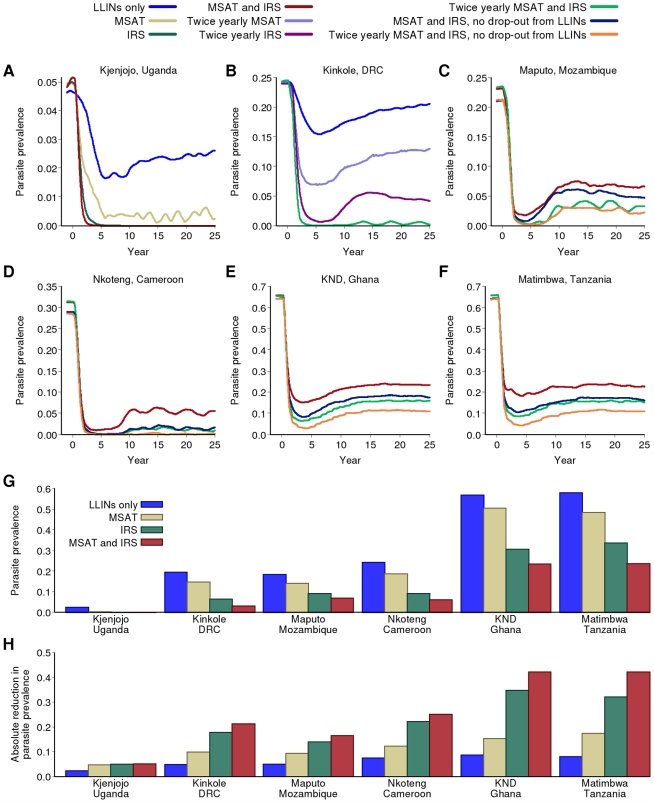
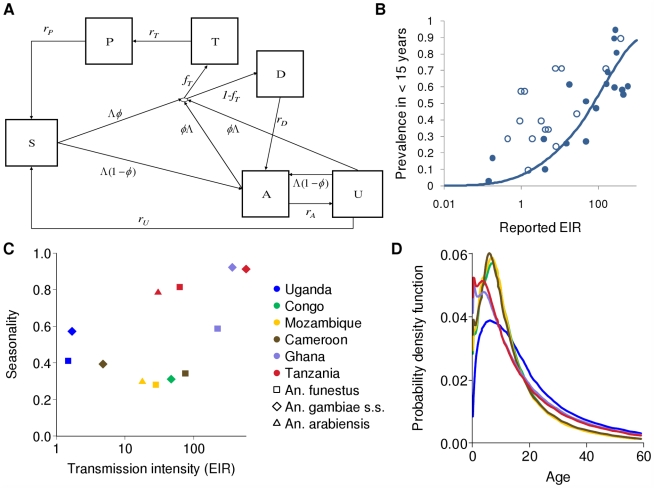
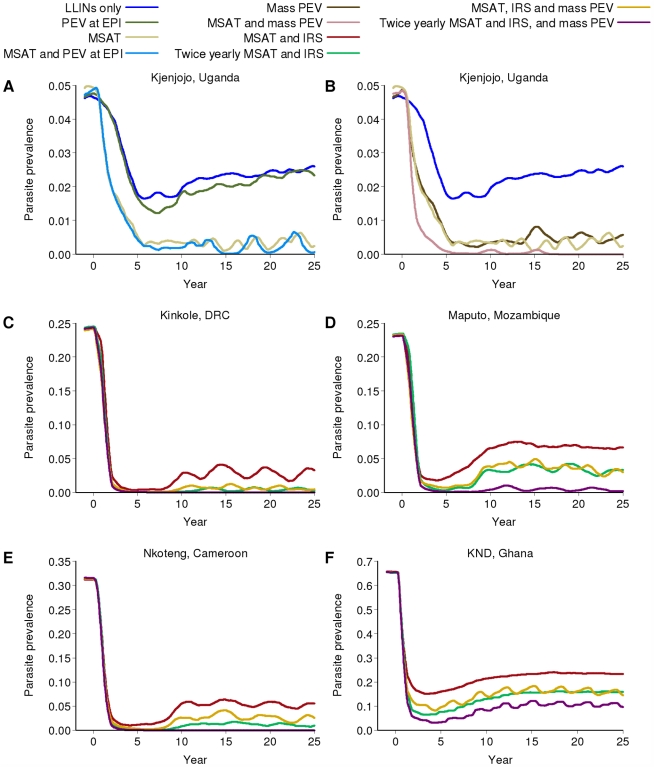
We developed an individual-based simulation model for Plasmodium falciparum transmission in an African context incorporating the three major vector species (Anopheles gambiae s.s., An. arabiensis, and An. funestus) with parameters obtained by fitting to parasite prevalence data from 34 transmission settings across Africa. We incorporated the effect of the switch to artemisinin-combination therapy (ACT) and increasing coverage of long-lasting insecticide treated nets (LLINs) from the year 2000 onwards. We then explored the impact on transmission of continued roll-out of LLINs, additional rounds of indoor residual spraying (IRS), mass screening and treatment (MSAT), and a future RTS,S/AS01 vaccine in six representative settings with varying transmission intensity (as summarized by the annual entomological inoculation rate, EIR: 1 setting with low, 3 with moderate, and 2 with high EIRs), vector-species combinations, and patterns of seasonality. In all settings we considered a realistic target of 80% coverage of interventions. In the low-transmission setting (EIR approximately 3 ibppy [infectious bites per person per year]), LLINs have the potential to reduce malaria transmission to low levels (<1% parasite prevalence in all age-groups) provided usage levels are high and sustained. In two of the moderate-transmission settings (EIR approximately 43 and 81 ibppy), additional rounds of IRS with DDT coupled with MSAT could drive parasite prevalence below a 1% threshold. However, in the third (EIR = 46) with An. arabiensis prevailing, these interventions are insufficient to reach this threshold. In both high-transmission settings (EIR approximately 586 and 675 ibppy), either unrealistically high coverage levels (>90%) or novel tools and/or substantial social improvements will be required, although considerable reductions in prevalence can be achieved with existing tools and realistic coverage levels.

CONCLUSIONS

Interventions using current tools can result in major reductions in P. falciparum malaria transmission and the associated disease burden in Africa. Reduction to the 1% parasite prevalence threshold is possible in low- to moderate-transmission settings when vectors are primarily endophilic (indoor-resting), provided a comprehensive and sustained intervention program is achieved through roll-out of interventions. In high-transmission settings and those in which vectors are mainly exophilic (outdoor-resting), additional new tools that target exophagic (outdoor-biting), exophilic, and partly zoophagic mosquitoes will be required.
https://cdn.ncbi.nlm.nih.gov/pmc/blobs/3bd0/2919425/a7f7f8539363/pmed.1000324.g006.jpg
https://cdn.ncbi.nlm.nih.gov/pmc/blobs/3bd0/2919425/509af3837ca8/pmed.1000324.g001.jpg
https://cdn.ncbi.nlm.nih.gov/pmc/blobs/3bd0/2919425/29c90ca50ccf/pmed.1000324.g002.jpg
https://cdn.ncbi.nlm.nih.gov/pmc/blobs/3bd0/2919425/28c5ce9d6bab/pmed.1000324.g003.jpg
https://cdn.ncbi.nlm.nih.gov/pmc/blobs/3bd0/2919425/6149bdf92c4c/pmed.1000324.g004.jpg
https://cdn.ncbi.nlm.nih.gov/pmc/blobs/3bd0/2919425/1b55194e810d/pmed.1000324.g005.jpg
https://cdn.ncbi.nlm.nih.gov/pmc/blobs/3bd0/2919425/a7f7f8539363/pmed.1000324.g006.jpg
https://cdn.ncbi.nlm.nih.gov/pmc/blobs/3bd0/2919425/509af3837ca8/pmed.1000324.g001.jpg
https://cdn.ncbi.nlm.nih.gov/pmc/blobs/3bd0/2919425/29c90ca50ccf/pmed.1000324.g002.jpg
https://cdn.ncbi.nlm.nih.gov/pmc/blobs/3bd0/2919425/28c5ce9d6bab/pmed.1000324.g003.jpg
https://cdn.ncbi.nlm.nih.gov/pmc/blobs/3bd0/2919425/6149bdf92c4c/pmed.1000324.g004.jpg
https://cdn.ncbi.nlm.nih.gov/pmc/blobs/3bd0/2919425/1b55194e810d/pmed.1000324.g005.jpg
https://cdn.ncbi.nlm.nih.gov/pmc/blobs/3bd0/2919425/a7f7f8539363/pmed.1000324.g006.jpg
摘要

背景

在过去的十年中,疟疾干预措施的覆盖范围在非洲得到了扩大。然而,目前尚不清楚利用现有的工具可以实现多大程度的传播总体减少。

方法和发现

我们开发了一种基于个体的模拟模型,用于在非洲背景下传播疟原虫,该模型结合了三种主要的蚊子物种(冈比亚按蚊 s.s.、阿拉伯按蚊和芬斯顿按蚊),并使用从非洲 34 个传播环境中获得的寄生虫流行数据进行拟合。我们纳入了从 2000 年开始使用青蒿素联合疗法(ACT)和增加长效驱虫蚊帐(LLIN)覆盖率的影响。然后,我们在六个具有不同传播强度(以每年的昆虫接种率 EIR 来概括:1 个低强度、3 个中强度和 2 个高强度设置)、蚊子物种组合和季节性模式的代表性环境中,探索了继续推出 LLIN、额外的室内滞留喷洒(IRS)、大规模筛查和治疗(MSAT)以及未来 RTS,S/AS01 疫苗对传播的影响。在所有环境中,我们都考虑了干预措施 80%的覆盖率这一现实目标。在低传播环境(EIR 约为 3 ibppy[每年每人感染性叮咬次数])中,如果使用水平高且持续,LLIN 有可能将疟疾传播降低到低水平(所有年龄组的寄生虫流行率均低于 1%)。在两个中度传播环境(EIR 约为 43 和 81 ibppy)中,使用滴滴涕进行额外的 IRS 与 MSAT 结合可以将寄生虫流行率降低到 1%以下的阈值。然而,在第三个(EIR=46)以阿拉伯按蚊为主的环境中,这些干预措施不足以达到这一阈值。在两个高强度传播环境(EIR 约为 586 和 675 ibppy)中,要么需要不切实际的高覆盖率(>90%),要么需要新的工具和/或实质性的社会改善,尽管通过现有工具和现实的覆盖率水平可以实现患病率的显著降低。

结论

使用现有工具的干预措施可以大大降低非洲间日疟的传播和相关疾病负担。在以嗜内(室内休息)为主的蚊子的低至中度传播环境中,当实现综合和持续的干预计划时,将传播率降低到 1%的寄生虫流行率阈值是可能的。在高度传播的环境中,以及在以嗜外(室外休息)为主的环境中,将需要新的工具,这些工具将针对嗜外(室外叮咬)、嗜外和部分食虫性蚊子。

相似文献

1
Reducing Plasmodium falciparum malaria transmission in Africa: a model-based evaluation of intervention strategies.降低非洲间日疟原虫疟疾的传播:干预策略的基于模型的评估。
PLoS Med. 2010 Aug 10;7(8):e1000324. doi: 10.1371/journal.pmed.1000324.
2
Impact of insecticide-treated bed nets on malaria transmission indices on the south coast of Kenya.肯尼亚南部沿海地区经杀虫剂处理过的蚊帐对疟疾传播指数的影响。
Malar J. 2011 Dec 13;10:356. doi: 10.1186/1475-2875-10-356.
3
Is outdoor vector control needed for malaria elimination? An individual-based modelling study.消除疟疾是否需要进行户外病媒控制?一项基于个体的建模研究。
Malar J. 2017 Jul 3;16(1):266. doi: 10.1186/s12936-017-1920-y.
4
Frequent blood feeding enables insecticide-treated nets to reduce transmission by mosquitoes that bite predominately outdoors.频繁吸血使经杀虫剂处理的蚊帐能够减少主要在户外叮咬的蚊子的传播。
Malar J. 2016 Mar 10;15:156. doi: 10.1186/s12936-016-1195-8.
5
Persistently high estimates of late night, indoor exposure to malaria vectors despite high coverage of insecticide treated nets.尽管经杀虫剂处理的蚊帐覆盖率很高,但对深夜室内接触疟疾传播媒介的估计仍然居高不下。
Parasit Vectors. 2014 Aug 20;7:380. doi: 10.1186/1756-3305-7-380.
6
The role of Anopheles arabiensis and Anopheles coustani in indoor and outdoor malaria transmission in Taveta District, Kenya.肯尼亚塔韦塔区阿拉伯按蚊和库蚊在室内外疟疾传播中的作用。
Parasit Vectors. 2013 Apr 20;6:114. doi: 10.1186/1756-3305-6-114.
7
Role of Anopheles (Cellia) rufipes (Gough, 1910) and other local anophelines in human malaria transmission in the northern savannah of Cameroon: a cross-sectional survey.冈比亚按蚊(Cellia)rufipes(Gough,1910)和其他当地按蚊在喀麦隆北部热带稀树草原地区人类疟疾传播中的作用:一项横断面调查。
Parasit Vectors. 2017 Jan 11;10(1):22. doi: 10.1186/s13071-016-1933-3.
8
Indoor and outdoor malaria transmission in two ecological settings in rural Mali: implications for vector control.在马里农村的两种生态环境中室内和室外疟疾传播:对病媒控制的影响。
Malar J. 2021 Mar 4;20(1):127. doi: 10.1186/s12936-021-03650-0.
9
Simulation of malaria epidemiology and control in the highlands of Western Kenya.肯尼亚西部高地疟疾流行病学和控制模拟。
Malar J. 2012 Oct 29;11:357. doi: 10.1186/1475-2875-11-357.
10
Resting behaviour of malaria vectors in highland and lowland sites of western Kenya: Implication on malaria vector control measures.肯尼亚西部高原和低地地区疟疾病媒的休息行为:对疟疾病媒控制措施的启示。
PLoS One. 2020 Feb 25;15(2):e0224718. doi: 10.1371/journal.pone.0224718. eCollection 2020.

引用本文的文献

1
Modelling the effects of adult emergence on the surveillance and age distribution of medically important mosquitoes.模拟成年蚊子羽化对重要医学蚊子监测及年龄分布的影响。
PLoS Comput Biol. 2025 Aug 18;21(8):e1013035. doi: 10.1371/journal.pcbi.1013035. eCollection 2025 Aug.
2
Know your enemy: understanding mosquito biology to advance malaria elimination in Africa.了解你的敌人:认识蚊子生物学以推动非洲消除疟疾
Parasitol Res. 2025 Aug 18;124(8):93. doi: 10.1007/s00436-025-08534-9.
3
A model-informed target product profile for population modification gene drives for malaria control.

本文引用的文献

1
Identification of hot spots of malaria transmission for targeted malaria control.鉴定疟疾传播热点以进行有针对性的疟疾控制。
J Infect Dis. 2010 Jun 1;201(11):1764-74. doi: 10.1086/652456.
2
Entomopathogenic fungi as the next-generation control agents against malaria mosquitoes.昆虫病原真菌作为对抗疟疾蚊子的下一代控制剂。
Future Microbiol. 2010 Mar;5(3):339-41. doi: 10.2217/fmb.10.11.
3
Contribution of integrated campaign distribution of long-lasting insecticidal nets to coverage of target groups and total populations in malaria-endemic areas in Madagascar.
用于疟疾控制的群体修饰基因驱动的模型知情目标产品概况。
PLOS Glob Public Health. 2025 Aug 6;5(8):e0005026. doi: 10.1371/journal.pgph.0005026. eCollection 2025.
4
Multitask deep learning for the emulation and calibration of an agent-based malaria transmission model.用于基于主体的疟疾传播模型仿真与校准的多任务深度学习
PLoS Comput Biol. 2025 Jul 31;21(7):e1013330. doi: 10.1371/journal.pcbi.1013330. eCollection 2025 Jul.
5
Heterogeneous impacts for malaria control from larviciding across villages and considerations for monitoring and evaluation.不同村庄开展杀幼虫剂灭蚊对疟疾控制的异质性影响及监测与评估考量
PLoS Pathog. 2025 Jul 28;21(7):e1013287. doi: 10.1371/journal.ppat.1013287. eCollection 2025 Jul.
6
Wonder drugs and where to use them: a forecast of ivermectin's impact on malaria in Africa.神奇药物及其应用领域:伊维菌素对非洲疟疾影响的预测
Infect Dis Model. 2025 Jun 27;10(4):1229-1237. doi: 10.1016/j.idm.2025.06.003. eCollection 2025 Dec.
7
Evaluating the cost of malaria elimination by Anopheles gambiae precision guided SIT in the Upper River region, The Gambia.评估冈比亚上河区通过冈比亚按蚊精准导向昆虫不育技术消除疟疾的成本。
PLOS Glob Public Health. 2025 Jul 18;5(7):e0004903. doi: 10.1371/journal.pgph.0004903. eCollection 2025.
8
An improved multiplex RT-quantitative PCR assay can reveal sex-specific activity of transmission-blocking drugs on ex vivo gametocytes from Plasmodium falciparum asymptomatic infections.一种改进的多重逆转录定量PCR检测方法能够揭示传播阻断药物对恶性疟原虫无症状感染的离体配子体的性别特异性活性。
J Antimicrob Chemother. 2025 Jul 1;80(7):1907-1914. doi: 10.1093/jac/dkaf146.
9
Modelling health outcomes of a decade of HIV, malaria and tuberculosis initiatives, Malawi.马拉维十年艾滋病毒、疟疾和结核病防治举措的健康成果建模
Bull World Health Organ. 2025 May 1;103(5):304-315. doi: 10.2471/BLT.24.292439. Epub 2025 Mar 7.
10
Mathematical modeling of malaria vaccination with seasonality and immune feedback.具有季节性和免疫反馈的疟疾疫苗接种数学模型。
PLoS Comput Biol. 2025 May 12;21(5):e1012988. doi: 10.1371/journal.pcbi.1012988. eCollection 2025 May.
长效杀虫蚊帐综合运动分发对马达加斯加疟疾流行地区目标人群和总人口覆盖率的贡献。
Am J Trop Med Hyg. 2010 Mar;82(3):420-5. doi: 10.4269/ajtmh.2010.09-0597.
4
Insecticide-treated nets can reduce malaria transmission by mosquitoes which feed outdoors.经杀虫剂处理的蚊帐可以减少在户外觅食的蚊子传播疟疾。
Am J Trop Med Hyg. 2010 Mar;82(3):415-9. doi: 10.4269/ajtmh.2010.09-0579.
5
Significance of travel to rural areas as a risk factor for malarial anemia in an urban setting.在城市环境中,前往农村地区旅行作为疟疾性贫血的一个风险因素的意义。
Am J Trop Med Hyg. 2010 Mar;82(3):391-7. doi: 10.4269/ajtmh.2010.09-0047.
6
Attracting, trapping and killing disease-transmitting mosquitoes using odor-baited stations - The Ifakara Odor-Baited Stations.使用气味诱捕站吸引、诱捕并杀死传播疾病的蚊子——伊法卡拉气味诱捕站。
Parasit Vectors. 2010 Mar 1;3:12. doi: 10.1186/1756-3305-3-12.
7
Anopheles gambiae: historical population decline associated with regional distribution of insecticide-treated bed nets in western Nyanza Province, Kenya.冈比亚按蚊:肯尼亚西尼亚扎省经杀虫剂处理的蚊帐区域分布相关的历史人口下降。
Malar J. 2010 Feb 26;9:62. doi: 10.1186/1475-2875-9-62.
8
Developing global maps of the dominant anopheles vectors of human malaria.绘制人类疟疾主要疟蚊的全球分布图。
PLoS Med. 2010 Feb 9;7(2):e1000209. doi: 10.1371/journal.pmed.1000209.
9
Assessment of a national voucher scheme to deliver insecticide-treated mosquito nets to pregnant women.评估国家代金券计划,以向孕妇提供经杀虫剂处理的蚊帐。
CMAJ. 2010 Feb 9;182(2):152-6. doi: 10.1503/cmaj.090268. Epub 2010 Jan 11.
10
Local scale prediction of Plasmodium falciparum malaria transmission in an endemic region using temperature and rainfall.利用温度和降雨量对流行地区的疟疾病媒(恶性疟原虫)传播进行局地尺度预测。
Glob Health Action. 2009 Nov 11;2. doi: 10.3402/gha.v2i0.1923.