VU University Medical Center, Department of Clinical Neurophysiology, Amsterdam, The Netherlands.
Neuroimage. 2011 Feb 14;54(4):2732-40. doi: 10.1016/j.neuroimage.2010.10.036. Epub 2010 Oct 20.
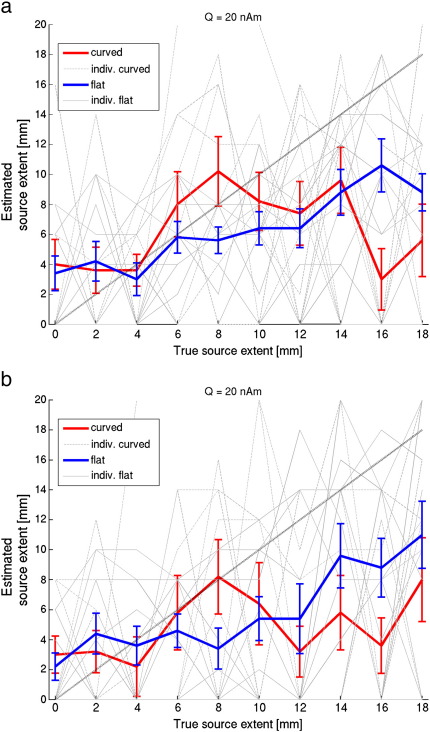
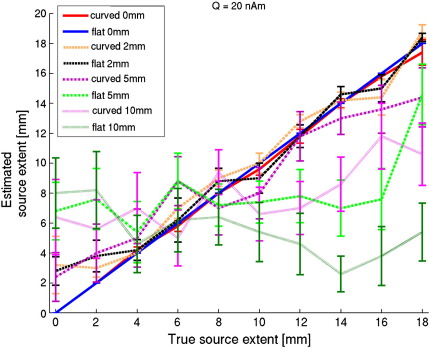
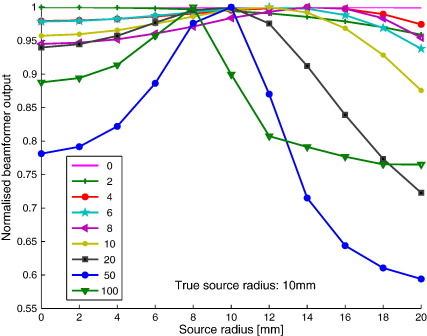
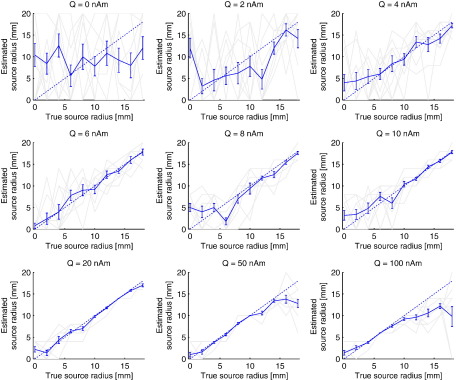
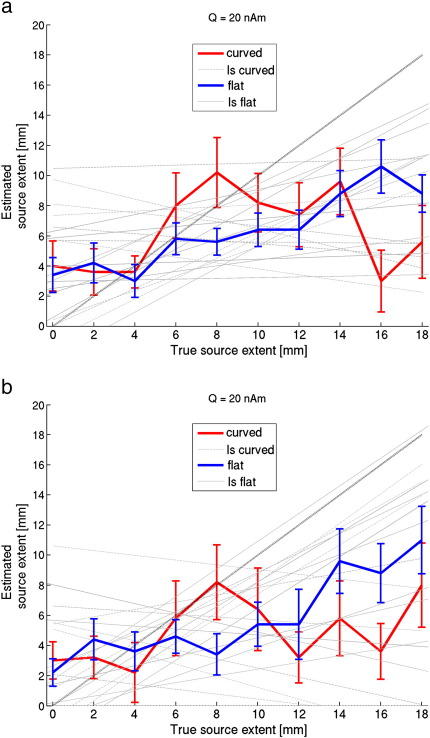
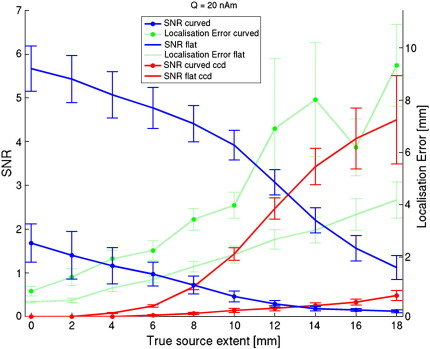
We aimed to determine practical constraints on the estimation of the spatial extent of neuronal activation using MEG beamformers. Correct estimation of spatial extent is a pre-requisite for accurate models of electrical activity, allows one to estimate current density, and enables non-invasive monitoring of functional recovery following stroke. The output of an MEG beamformer is maximum when the correct source model is used, so that the spatial extent of a source can in principal be determined through evaluation of different source models with the beamformer. Here, we simulated 275-channel MEG data using sources of varying spatial extents that followed the cortical geometry. These data were subsequently used to estimate the spatial extent of generic disc elements without knowledge of the underlying surface, and we compared these results to estimates based on cortical surface geometry (with and without error in surface location). We found that disc-shaped source models are too simplistic, particularly for areas with high curvature. For areas with low curvature spatial extent was underestimated, although on average there was a linear relationship between the true and estimated extent. In contrast, cortical surface models gave accurate predictions of spatial extent. However, adding small errors (>2 mm) to the estimated location of the cortical surface abolished this relationship between true and estimated extent, implying that accurate co-registration is needed with such models. Our results show that models exploiting surface information are necessary in order to model spatial extent and in turn current density, but in order to render such models applicable in practical situations, the accuracy of the cortical surface model itself needs to improve.
我们旨在确定使用 MEG 波束形成器估计神经元激活空间范围的实际限制。空间范围的准确估计是电活动精确模型的前提条件,允许估计电流密度,并能够在中风后进行功能恢复的非侵入性监测。当使用正确的源模型时,MEG 波束形成器的输出最大,因此可以通过使用波束形成器评估不同的源模型来确定源的空间范围。在这里,我们使用遵循皮质几何形状的不同空间范围的源模拟了 275 通道 MEG 数据。随后,这些数据用于在不了解基础表面的情况下估计通用盘状元素的空间范围,我们将这些结果与基于皮质表面几何形状的估计(带有和不带有表面位置误差)进行了比较。我们发现盘状源模型过于简单化,尤其是在曲率较高的区域。对于曲率较低的区域,空间范围被低估,尽管平均而言,真实和估计的范围之间存在线性关系。相比之下,皮质表面模型可以准确预测空间范围。然而,向皮质表面的估计位置添加小误差(>2 毫米)会破坏真实和估计范围之间的这种关系,这意味着需要与此类模型进行精确的配准。我们的结果表明,为了建模空间范围并进而建模电流密度,需要利用表面信息的模型,但为了使这些模型在实际情况下适用,皮质表面模型本身的准确性需要提高。