Department of Epidemiology, Center for Social Epidemiology and Population Health, University of Michigan School of Public Health, Ann Arbor, 48109-2029, USA.
Environ Health Perspect. 2011 Mar;119(3):390-6. doi: 10.1289/ehp.1002883. Epub 2010 Nov 29.
Exposure to environmental toxicants is associated with numerous disease outcomes, many of which involve underlying immune and inflammatory dysfunction.
To address the gap between environmental exposures and immune dysfunction, we investigated the association of two endocrine-disrupting compounds (EDCs) with markers of immune function.
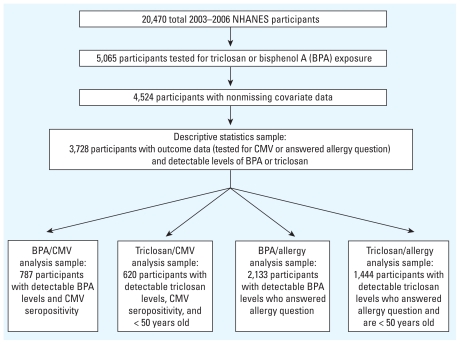
Using data from the 2003-2006 National Health and Nutrition Examination Survey, we compared urinary bisphenol A (BPA) and triclosan levels with serum cytomegalovirus (CMV) antibody levels and diagnosis of allergies or hay fever in U.S. adults and children ≥ 6 years of age. We used multivariate ordinary least squares linear regression models to examine the association of BPA and triclosan with CMV antibody titers, and multivariate logistic regression models to investigate the association of these chemicals with allergy or hay fever diagnosis. Statistical models were stratified by age (< 18 years and ≥ 18 years).
In analyses adjusted for age, sex, race, body mass index, creatinine levels, family income, and educational attainment, in the ≥ 18-year age group, higher urinary BPA levels were associated with higher CMV antibody titers (p < 0.001). In the < 18-year age group, lower levels of BPA were associated with higher CMV antibody titers (p < 0.05). However, triclosan, but not BPA, showed a positive association with allergy or hay fever diagnosis. In the < 18-year age group, higher levels of triclosan were associated with greater odds of having been diagnosed with allergies or hay fever (p < 0.01).
EDCs such as BPA and triclosan may negatively affect human immune function as measured by CMV antibody levels and allergy or hay fever diagnosis, respectively, with differential consequences based on age. Additional studies should be done to investigate these findings.
暴露于环境毒物与许多疾病结局有关,其中许多涉及潜在的免疫和炎症功能障碍。
为了解决环境暴露与免疫功能障碍之间的差距,我们研究了两种内分泌干扰化合物(EDCs)与免疫功能标志物的关系。
利用 2003-2006 年全国健康与营养调查的数据,我们比较了美国成年人和 6 岁以上儿童尿液中的双酚 A(BPA)和三氯生水平与血清巨细胞病毒(CMV)抗体水平以及过敏或花粉热的诊断。我们使用多元普通最小二乘线性回归模型来检查 BPA 和三氯生与 CMV 抗体滴度的关联,并使用多元逻辑回归模型来研究这些化学物质与过敏或花粉热诊断的关联。统计模型按年龄(<18 岁和≥18 岁)分层。
在调整了年龄、性别、种族、体重指数、肌酐水平、家庭收入和教育程度的分析中,在≥18 岁年龄组中,较高的尿液 BPA 水平与较高的 CMV 抗体滴度相关(p<0.001)。在<18 岁年龄组中,较低的 BPA 水平与较高的 CMV 抗体滴度相关(p<0.05)。然而,三氯生而不是 BPA 与过敏或花粉热的诊断呈正相关。在<18 岁年龄组中,较高的三氯生水平与被诊断为过敏或花粉热的几率增加相关(p<0.01)。
EDCs 如 BPA 和三氯生可能会对人类免疫功能产生负面影响,如 CMV 抗体水平和过敏或花粉热诊断所示,具体后果取决于年龄。应开展更多研究来调查这些发现。