Department of Chemistry and Biochemistry & the Biodesign Institute.
Nano Lett. 2010 Dec 8;10(12):5065-9. doi: 10.1021/nl1033073. Epub 2010 Nov 11.
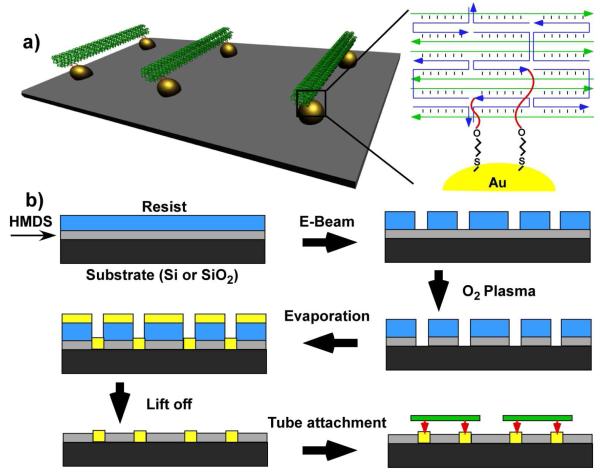
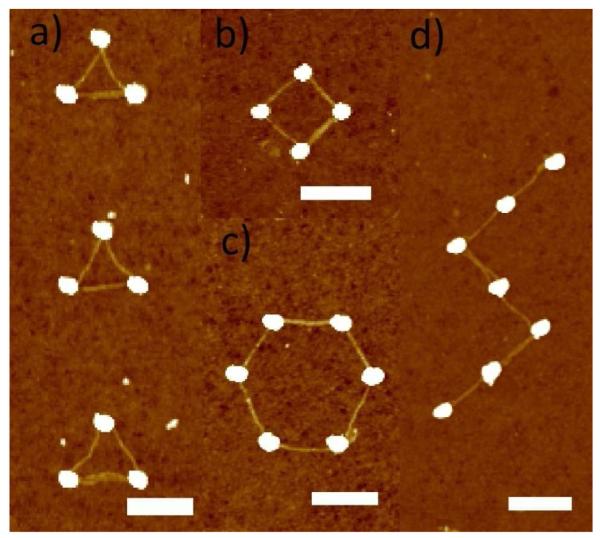
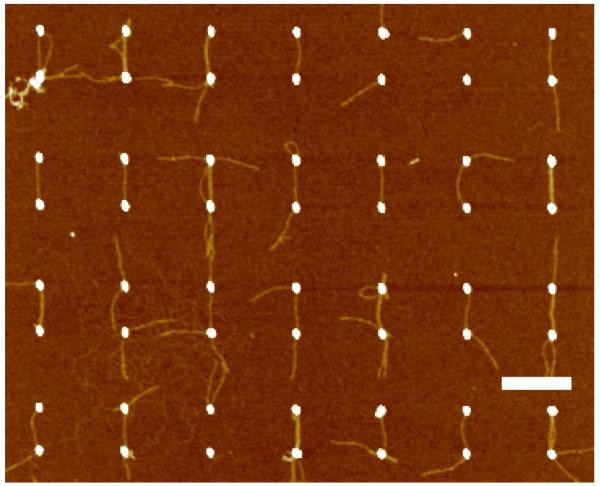
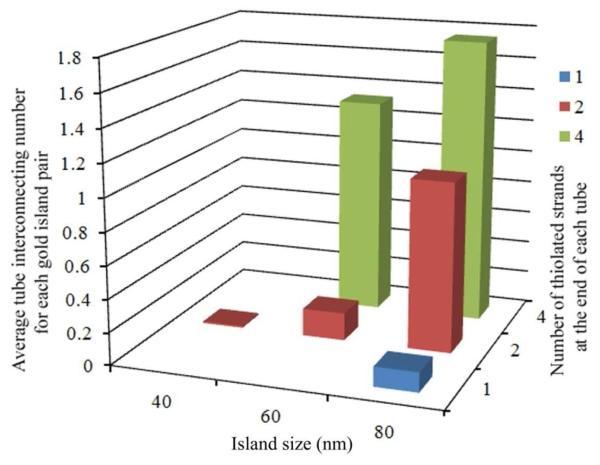
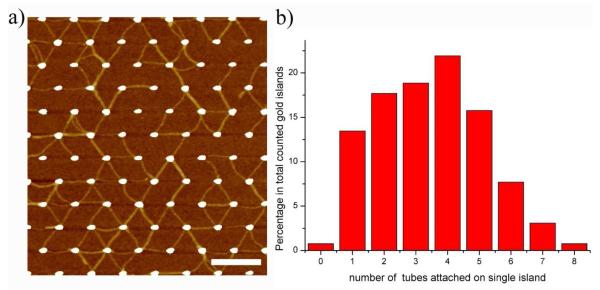
Scaffolded DNA origami has recently emerged as a versatile, programmable method to fold DNA into arbitrarily shaped nanostructures that are spatially addressable, with sub-10-nm resolution. Toward functional DNA nanotechnology, one of the key challenges is to integrate the bottom-up self-assembly of DNA origami with the top-down lithographic methods used to generate surface patterning. In this report we demonstrate that fixed length DNA origami nanotubes, modified with multiple thiol groups near both ends, can be used to connect surface patterned gold islands (tens of nanometers in diameter) fabricated by electron beam lithography (EBL). Atomic force microscopic imaging verified that the DNA origami nanotubes can be efficiently aligned between gold islands with various interisland distances and relative locations. This development represents progress toward the goal of bridging bottom-up and top-down assembly approaches.
支架 DNA 折纸术最近作为一种通用的、可编程的方法而出现,可将 DNA 折叠成具有空间可寻址性的任意形状的纳米结构,分辨率达到亚 10nm。为了实现功能性 DNA 纳米技术,其中一个关键的挑战是将 DNA 折纸术的自下而上的自组装与用于产生表面图案的自上而下的光刻方法相结合。在本报告中,我们证明了通过在两端附近修饰多个硫醇基团,可以将固定长度的 DNA 折纸纳米管用于连接由电子束光刻(EBL)制造的表面图案化金岛(直径数十纳米)。原子力显微镜成像证实,DNA 折纸纳米管可以在具有各种岛间距离和相对位置的金岛之间有效地对齐。这一发展代表着在桥接自下而上和自上而下的组装方法方面取得了进展。