Whitmer Diane, Worrell Gregory, Stead Matt, Lee Il Keun, Makeig Scott
Swartz Center for Computational Neuroscience, Institute for Neural Computation, University of California San Diego La Jolla, CA, USA.
Front Hum Neurosci. 2010 Nov 2;4:184. doi: 10.3389/fnhum.2010.00184. eCollection 2010.
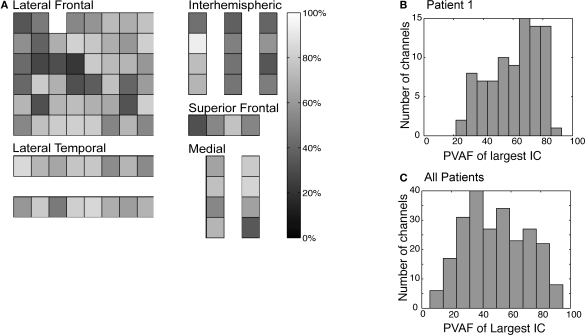
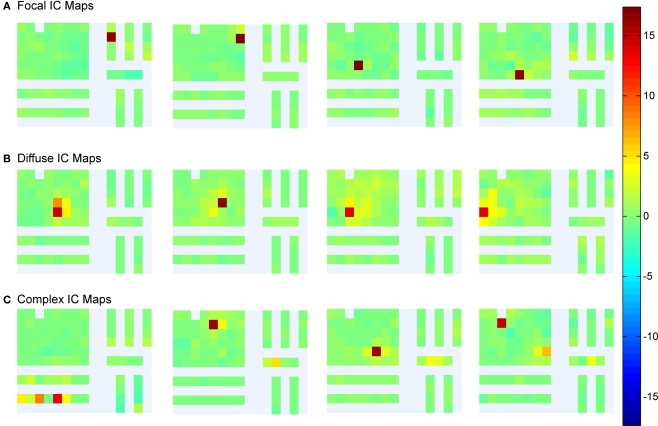
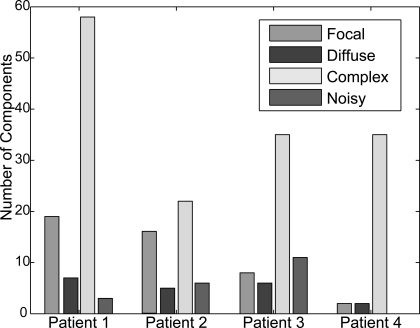
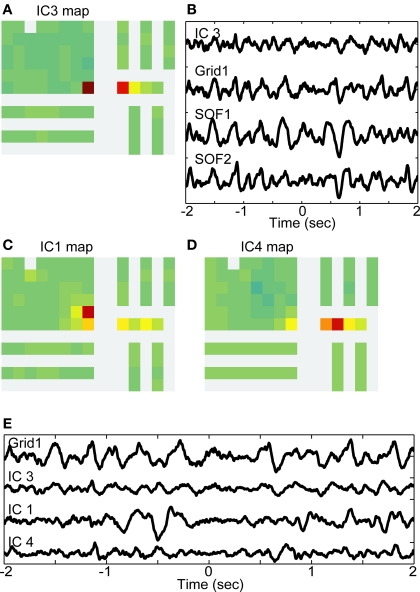
Electrode arrays are sometimes implanted in the brains of patients with intractable epilepsy to better localize seizure foci before epilepsy surgery. Analysis of intracranial EEG (iEEG) recordings is typically performed in the electrode channel domain without explicit separation of the sources that generate the signals. However, intracranial EEG signals, like scalp EEG signals, could be linear mixtures of local activity and volume-conducted activity arising in multiple source areas. Independent component analysis (ICA) has recently been applied to scalp EEG data, and shown to separate the signal mixtures into independently generated brain and non-brain source signals. Here, we applied ICA to unmix source signals from intracranial EEG recordings from four epilepsy patients during a visually cued finger movement task in the presence of background pathological brain activity. This ICA decomposition demonstrated that the iEEG recordings were not maximally independent, but rather are linear mixtures of activity from multiple sources. Many of the independent component (IC) projections to the iEEG recording grid were consistent with sources from single brain regions, including components exhibiting classic movement-related dynamics. Notably, the largest IC projection to each channel accounted for no more than 20-80% of the channel signal variance, implying that in general intracranial recordings cannot be accurately interpreted as recordings of independent brain sources. These results suggest that ICA can be used to identify and monitor major field sources of local and distributed functional networks generating iEEG data. ICA decomposition methods are useful for improving the fidelity of source signals of interest, likely including distinguishing the sources of pathological brain activity.
有时会将电极阵列植入难治性癫痫患者的大脑中,以便在癫痫手术前更好地定位癫痫病灶。颅内脑电图(iEEG)记录的分析通常在电极通道域中进行,而不会明确分离产生信号的源。然而,与头皮脑电图信号一样,颅内脑电图信号可能是多个源区域中局部活动和容积传导活动的线性混合。独立成分分析(ICA)最近已应用于头皮脑电图数据,并被证明可将信号混合分离为独立产生的脑源信号和非脑源信号。在这里,我们应用ICA在存在背景病理性脑活动的情况下,对四名癫痫患者在视觉提示的手指运动任务期间的颅内脑电图记录中的源信号进行解混。这种ICA分解表明,iEEG记录并非最大程度独立,而是多个源活动的线性混合。许多到iEEG记录网格的独立成分(IC)投影与单个脑区的源一致,包括表现出经典运动相关动态的成分。值得注意的是,每个通道的最大IC投影占通道信号方差的比例不超过20 - 80%,这意味着一般来说,颅内记录不能准确地解释为独立脑源的记录。这些结果表明,ICA可用于识别和监测生成iEEG数据的局部和分布式功能网络的主要场源。ICA分解方法有助于提高感兴趣的源信号的保真度,可能包括区分病理性脑活动的源。