Gimble Jeffrey M, Grayson Warren, Guilak Farshid, Lopez Mandi J, Vunjak-Novakovic Gordana
Pennington Biomedical Research Center, Louisiana State University System, Baton Rouge, LA, USA.
Front Biosci (Schol Ed). 2011 Jan 1;3(1):69-81. doi: 10.2741/s133.
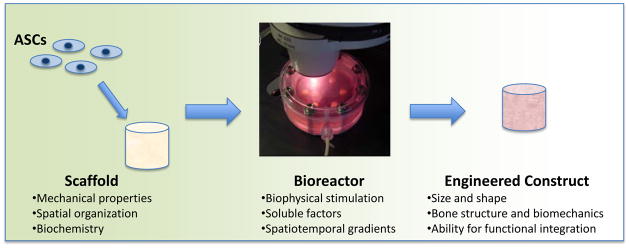
Adipose tissue is an abundant, easily accessible, and reproducible cell source for musculo-skeletal regenerative medicine applications. Initial derivation steps yield a heterogeneous population of cells of stromal vascular fraction (SVF) cells. Subsequent adherent selection of the SVF results in a relatively homogeneous population of adipose-derived stromal/stem cells (ASCs) capable of adipogenic, chondrogenic, myogenic, and osteogenic differentiation in vitro on scaffolds in bioreactors and in vivo in pre-clinical animal models. Unlike hematopoietic cells, ASCs do not elicit a robust lymphocyte reaction and instead release immunosuppressive factors, such as prostaglandin E2. These immunomodulatory features suggest that allogeneic and autologous ASCs will engraft successfully for tissue regeneration purposes. The differentiation and expansion potential of ASCs can be modified by growth factors, bio-inductive scaffolds, and bioreactors providing environmental control and biophysical stimulation. Gene therapy approaches using lentiviral transduction can be used to direct differentiation of ASCs to particular lineages. We discuss the utility of ASCs for musculo-skeletal tissue repair and some of the technologies that can be implemented to unlock the full regenerative potential of these highly valuable cells.
脂肪组织是一种丰富、易于获取且可再生的细胞来源,可用于肌肉骨骼再生医学应用。最初的衍生步骤会产生基质血管成分(SVF)细胞的异质群体。随后对SVF进行贴壁筛选,可得到相对均质的脂肪来源的基质/干细胞(ASC)群体,这些细胞在生物反应器中的支架上以及临床前动物模型的体内,能够在体外进行成脂、成软骨、成肌和成骨分化。与造血细胞不同,ASC不会引发强烈的淋巴细胞反应,而是释放免疫抑制因子,如前列腺素E2。这些免疫调节特性表明,同种异体和自体ASC将成功植入以实现组织再生目的。ASC的分化和扩增潜力可通过生长因子、生物诱导支架和提供环境控制及生物物理刺激的生物反应器来改变。使用慢病毒转导的基因治疗方法可用于引导ASC向特定谱系分化。我们讨论了ASC在肌肉骨骼组织修复中的效用以及一些可用于释放这些极有价值细胞的全部再生潜力的技术。