Departments of Social and Decision Sciences and of Engineering and Public Policy, Carnegie Mellon University, Pittsburgh, Pennsylvania (WBB)
Department of Economics, Tilburg University, Tilburg, the Netherlands (KGC)
Med Decis Making. 2012 Mar-Apr;32(2):232-6. doi: 10.1177/0272989X11404077. Epub 2011 Apr 26.
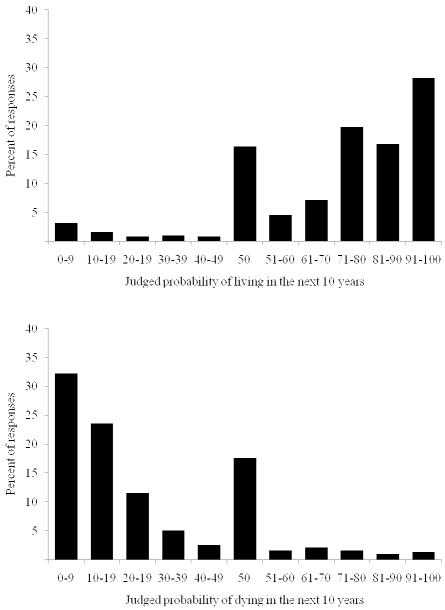
Risk perceptions are central to good health decisions. People can judge valid probabilities but use 50% disproportionately. The authors hypothesized that 50% is more likely than other responses to reflect not knowing the probability, especially among individuals with low education and numeracy, and evaluated the usefulness of eliciting "don't know" explanations.
Respondents (n = 1020) judged probabilities for living or dying in the next 10 years, indicating whether they gave a good estimate or did not know the chances. They completed demographics, medical history, and numeracy questions.
Overall, 50% was more likely than other probabilities to be explained as "don't know" (v. "a good estimate"). Correlations of using 50% with low education and numeracy were mediated by expressing "don't know." Judged probabilities for survival and mortality explained as "don't know" had lower correlations with age, diseases, and specialist visits.
When judging risks, 50% may reflect not knowing the probability, especially among individuals with low numeracy and education. Probabilities expressed as "don't know" are less valid. Eliciting uncertainty could benefit theoretical models and educational efforts.
风险认知是做出健康决策的关键。人们可以判断有效的概率,但却过度依赖 50%。作者假设,50%的回答比其他回答更有可能反映出不知道概率,尤其是在受教育程度和计算能力较低的人群中,并评估了引出“不知道”解释的有用性。
本研究共纳入了 1020 名受访者,要求他们判断在未来 10 年内的生存或死亡概率,并表示他们是否给出了较好的估计或不知道机会的概率。他们还完成了人口统计学、病史和计算能力方面的问题。
总体而言,50%的概率比其他概率更有可能被解释为“不知道”(v. “一个好的估计”)。用 50%来表示“不知道”的概率与受教育程度和计算能力较低之间的相关性,受到了表达“不知道”的中介作用。解释为“不知道”的生存和死亡率的判断概率与年龄、疾病和专科就诊的相关性较低。
在判断风险时,50%可能反映出不知道概率,尤其是在计算能力和受教育程度较低的人群中。表示为“不知道”的概率不太有效。引出不确定性可能会使理论模型和教育工作受益。