Vaidya Chandan J
Department of Psychology, Georgetown University, Washington, DC, USA,
Curr Top Behav Neurosci. 2012;9:49-66. doi: 10.1007/7854_2011_138.
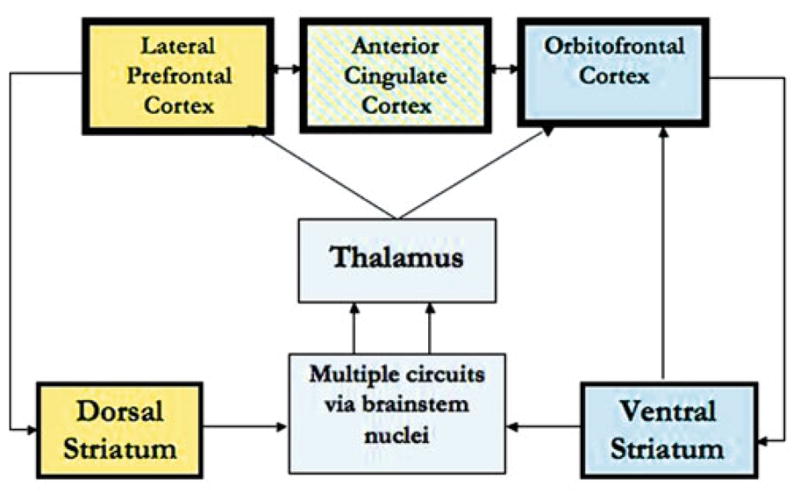
Structural and functional imaging studies in subjects with attention deficit hyperactivity disorder (ADHD) are reviewed with the goal of gleaning information about neurodevelopmental abnormalities characterizing the disorder. Structural imaging studies, particularly those with longitudinal designs, suggest that brain maturation is delayed by a few years in ADHD. However, a maturational delay model alone is incomplete: alternate courses are suggested by differences associated with phenotypic factors, such as symptom remission/persistence and exposure to stimulant treatment. Findings from functional imaging studies point to multiple loci of abnormalities that are not limited to frontal-striatal circuitry, which is important for executive and motivational function, but also include parietal, temporal and motor cortices, and the cerebellum. However, a definitive conclusion about maturational delays or alternate trajectories cannot be drawn from this work as activation patterns are influenced by task-specific factors that may induce variable performance levels and strategies across development. In addition, no studies have implemented cross-sectional or longitudinal designs, without which the developmental origin of differences in activation cannot be inferred. Thus, current task-evoked functional imaging provides information about dynamic or state-dependent differences rather than fixed or trait-related differences. In the future, task-free functional imaging holds promise for revealing neurodevelopmental information that is minimally influenced by performance/strategic differences. Further, studies using longitudinal designs that identify sources of phenotypic heterogeneity in brain maturation and characterize the relationship between brain function and underlying structural properties are needed to provide a comprehensive view of neurodevelopmental abnormalities in ADHD.
对患有注意力缺陷多动障碍(ADHD)的受试者进行的结构和功能成像研究进行了综述,目的是收集有关该障碍特征性神经发育异常的信息。结构成像研究,特别是那些采用纵向设计的研究表明,ADHD患者的大脑成熟延迟了数年。然而,仅成熟延迟模型是不完整的:与表型因素相关的差异,如症状缓解/持续以及接触兴奋剂治疗,提示了不同的发展过程。功能成像研究的结果指出了多个异常位点,这些位点不仅限于对执行和动机功能很重要的额叶-纹状体回路,还包括顶叶、颞叶和运动皮层以及小脑。然而,由于激活模式受任务特定因素影响,这些因素可能在整个发育过程中诱导不同的表现水平和策略,因此无法从这项工作中得出关于成熟延迟或不同轨迹的明确结论。此外,没有研究采用横断面或纵向设计,没有这些设计就无法推断激活差异的发育起源。因此,当前的任务诱发功能成像提供的是关于动态或状态依赖性差异的信息,而不是固定或特质相关差异的信息。未来,无任务功能成像有望揭示受表现/策略差异影响最小的神经发育信息。此外,需要使用纵向设计的研究来确定大脑成熟过程中表型异质性的来源,并描述脑功能与潜在结构特性之间的关系,以全面了解ADHD中的神经发育异常。