BEEgroup, Biocentre, Würzburg University, Würzburg, Germany.
PLoS One. 2011;6(5):e19669. doi: 10.1371/journal.pone.0019669. Epub 2011 May 13.
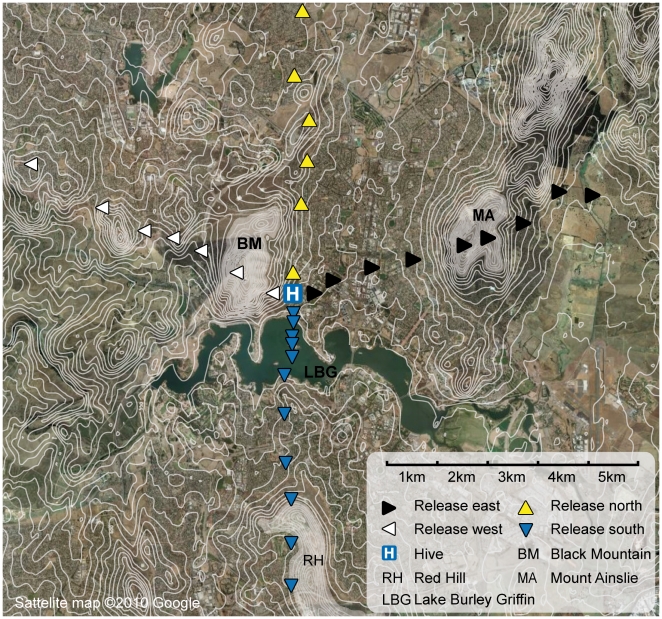
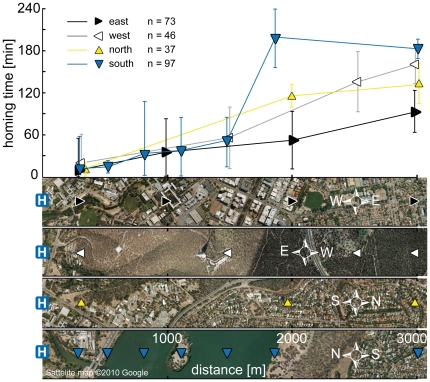
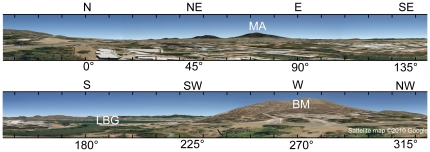
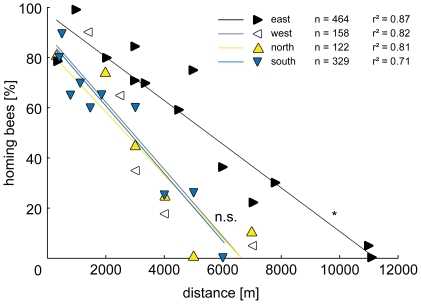
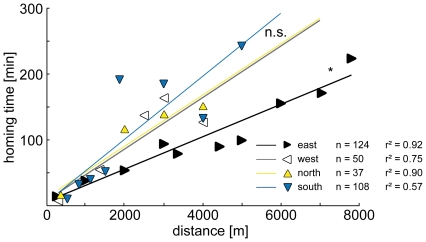
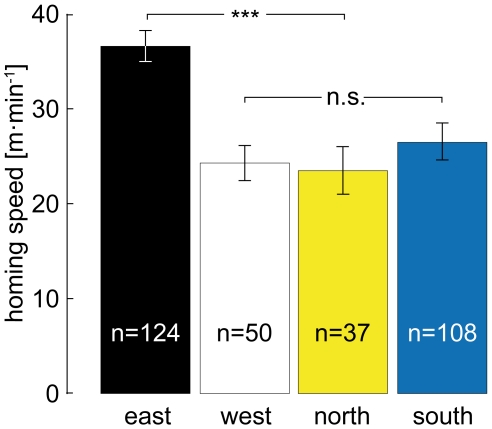
Honeybee foragers frequently fly several kilometres to and from vital resources, and communicate those locations to their nest mates by a symbolic dance language. Research has shown that they achieve this feat by memorizing landmarks and the skyline panorama, using the sun and polarized skylight as compasses and by integrating their outbound flight paths. In order to investigate the capacity of the honeybees' homing abilities, we artificially displaced foragers to novel release spots at various distances up to 13 km in the four cardinal directions. Returning bees were individually registered by a radio frequency identification (RFID) system at the hive entrance. We found that homing rate, homing speed and the maximum homing distance depend on the release direction. Bees released in the east were more likely to find their way back home, and returned faster than bees released in any other direction, due to the familiarity of global landmarks seen from the hive. Our findings suggest that such large scale homing is facilitated by global landmarks acting as beacons, and possibly the entire skyline panorama.
蜜蜂采集者经常往返于几公里外的重要资源地,并通过象征性的舞蹈语言将这些地点传达给它们的巢友。研究表明,它们通过记住地标和天空全景,利用太阳和偏振天光作为罗盘,并整合它们的出飞行路径,从而实现了这一壮举。为了研究蜜蜂归巢能力的能力,我们将采集者人为地转移到距离蜂巢不同方向的新释放点,距离最远可达 13 公里。返回的蜜蜂通过蜂巢入口的射频识别(RFID)系统被单独记录。我们发现,归巢率、归巢速度和最大归巢距离取决于释放方向。从蜂巢中看到的全球地标熟悉程度,使从东方释放的蜜蜂更有可能找到回家的路,并且比从任何其他方向释放的蜜蜂返回得更快。我们的发现表明,这种大规模归巢是由充当信标的全局地标以及可能是整个天空全景来辅助的。