Ontario Ginseng Innovation and Research Consortium, the University of Western Ontario, London, Ontario, N6A 5C1, Canada.
Chin Med. 2011 May 27;6(1):21. doi: 10.1186/1749-8546-6-21.
Immuno-modulatory effects of ginseng, including both immuno-stimulatory and immuno-suppressive effects, have been widely reported. This study aims to determine whether the paradoxical immuno-modulatory effect is related to unique phytochemical profiles of different North American (NA) ginseng, namely aqueous (AQ) and alcoholic (ALC) extracts.
AQ and ALC extracts were prepared and their immuno-bioactivity were studied in vitro in murine macrophages (Raw 264.7) through measuring the direct stimulatory production of pro-inflammatory mediator and cytokines as well as the suppression of lipopolysaccharide (LPS)-stimulatory response by the two extracts. Gel permeation chromatography was used to fractionate and isolate phytochemicals for characterization of ginseng extracts.
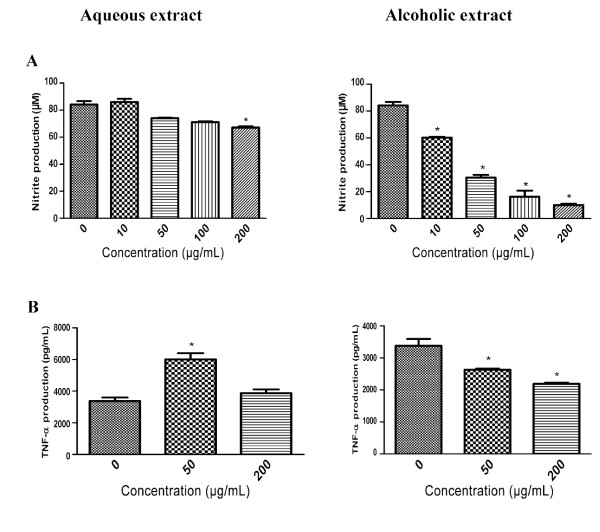
AQ extract up-regulated the production of nitric oxide (NO), tumour necrosis factor-α (TNF-α) and interleukin-6 (IL-6) while ALC extract did not. ALC extract but not AQ extract suppressed LPS-induced macrophage NO and TNF-α production. These immuno-stimulatory and suppressive effects were exhibited at similar extract concentrations. Moreover, the macrophage-stimulating activity of the AQ extract was inhibited in the presence of ALC extract. Fractionation of AQ extract revealed the presence of two major peaks at 230 nm with average molecular weights of 73,000 and 37,000 Da. The first fraction had similar elution volume as the crude polysaccharide (PS) fraction isolated from the AQ extract, and it was the only bioactive species. Parallel fractionation study of ALC extract yielded similar elution profiles; however, both sub-fractions were devoid of PS. Fraction I of the ALC extract suppressed LPS-induced NO production dose-dependently.
ALC extract of NA ginseng, which was devoid of PS, was immuno-inhibitory whereas the AQ extract, which contained PS, was immuno-stimulatory. These extract-related anti-inflammatory and pro-inflammatory effects may be considered as the Yin and Yang actions of ginseng.
人参具有免疫调节作用,包括免疫刺激和免疫抑制作用,这已得到广泛报道。本研究旨在确定这种矛盾的免疫调节作用是否与不同北美(NA)人参的独特植物化学特征有关,即水提物(AQ)和醇提物(ALC)。
制备 AQ 和 ALC 提取物,并通过测量两种提取物对小鼠巨噬细胞(Raw 264.7)的直接刺激产生促炎介质和细胞因子的作用,以及抑制脂多糖(LPS)刺激反应,研究其免疫生物活性。凝胶渗透色谱用于分离和鉴定植物化学物质,以表征人参提取物。
AQ 提取物上调一氧化氮(NO)、肿瘤坏死因子-α(TNF-α)和白细胞介素-6(IL-6)的产生,而 ALC 提取物则没有。ALC 提取物而非 AQ 提取物抑制 LPS 诱导的巨噬细胞 NO 和 TNF-α的产生。这些免疫刺激和抑制作用在相似的提取物浓度下表现出来。此外,ALC 提取物抑制了 AQ 提取物对巨噬细胞的刺激活性。AQ 提取物的分离结果显示,在 230nm 处有两个主要峰,平均分子量分别为 73000 和 37000Da。第一个峰的洗脱体积与从 AQ 提取物中分离出的粗多糖(PS)部分相似,它是唯一具有生物活性的物质。ALC 提取物的平行分离研究得到了相似的洗脱图谱,但两个亚部分都不含 PS。ALC 提取物的 I 部分对 LPS 诱导的 NO 产生呈剂量依赖性抑制。
缺乏 PS 的北美人参醇提物具有免疫抑制作用,而含有 PS 的水提物具有免疫刺激作用。这些提取物相关的抗炎和促炎作用可以被认为是人参的阴阳作用。