Aldabal Laila, Bahammam Ahmed S
Department of Pulmonary Medicine, Rashid Hospital, Dubai Health Authority, United Arab Emirates.
Open Respir Med J. 2011;5:31-43. doi: 10.2174/1874306401105010031. Epub 2011 Jun 23.
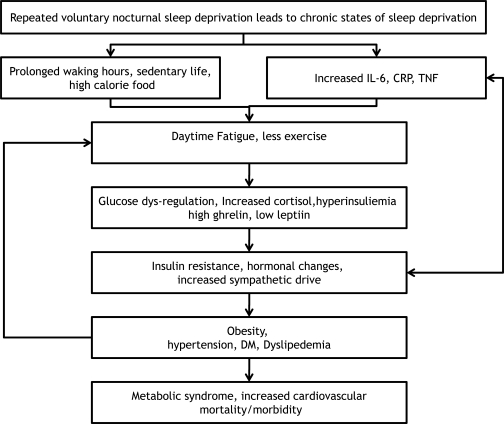
Over the last three to four decades, it has been observed that the average total hours of sleep have decreased to less than seven hours per person per night. Concomitantly, global figures relating to obesity and diabetes mellitus have increased in an alarming fashion in adults and children, and it has been hypothesized that neuro-hormonal changes accompanying this behavioral sleep deprivation may lead to insulin resistance and, subsequently, to diabetes mellitus. Sleep deprivation has been associated with multiple physiological changes, including increased cortisol and ghrelin levels, decreased leptin levels and impaired glucose metabolism. Experimental studies have also shown an increase in inflammatory and pro-inflammatory markers, which are indicators of body stress, under sleep deprivation. This review elaborates further on this hypothesis, exploring the molecular basis for the link between both entities and the underlying pathophysiology that results in insulin resistance and diabetes mellitus. We review the results of experimental and epidemiological studies, specifically examining the relationship between sleep duration and the immune and endocrine systems.
在过去的三四十年间,人们观察到人均每晚的总睡眠时间已降至不足7小时。与此同时,全球范围内,成人和儿童肥胖症及糖尿病的数据都在以惊人的速度增长,据推测,伴随这种行为性睡眠剥夺的神经激素变化可能会导致胰岛素抵抗,进而引发糖尿病。睡眠剥夺与多种生理变化相关,包括皮质醇和胃饥饿素水平升高、瘦素水平降低以及葡萄糖代谢受损。实验研究还表明,在睡眠剥夺状态下,作为身体应激指标的炎症和促炎标志物会增加。本综述将进一步阐述这一假说,探讨这两种情况之间联系的分子基础以及导致胰岛素抵抗和糖尿病的潜在病理生理学机制。我们回顾了实验研究和流行病学研究的结果,特别考察了睡眠时间与免疫和内分泌系统之间的关系。