Department for Biomedical Research, East-Slovak Institute of Cardiovascular Diseases, Košice, Slovak Republic.
Acta Histochem Cytochem. 2011 Oct 26;44(5):191-9. doi: 10.1267/ahc.11014. Epub 2011 Aug 10.
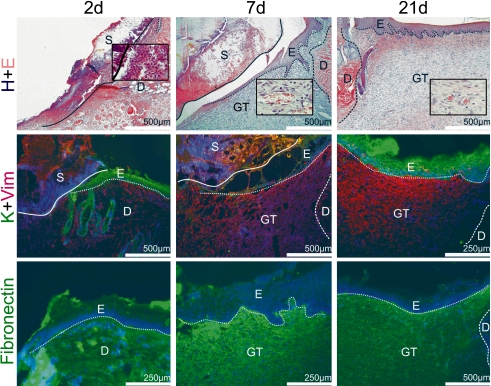
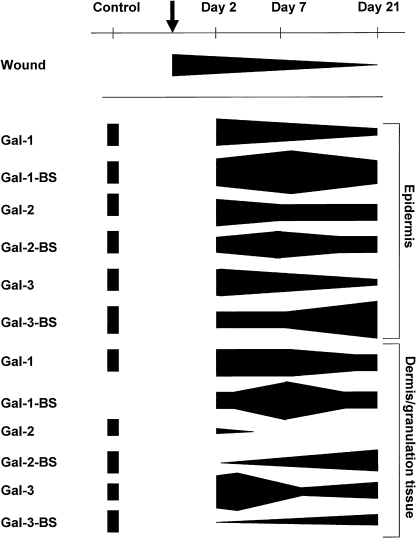
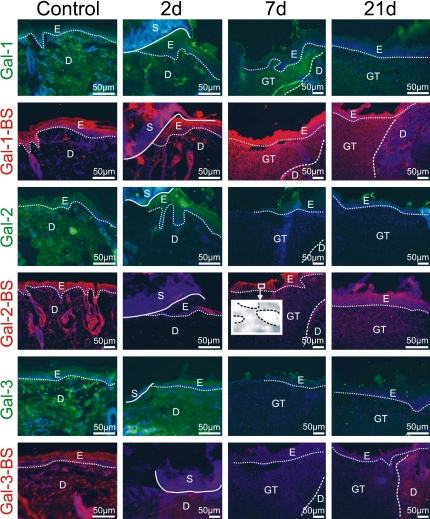
Galectins are a family of carbohydrate-binding proteins that modulate inflammation and immunity. This functional versatility prompted us to perform a histochemical study of their occurrence during wound healing using rat skin as an in vivo model. Wound healing is a dynamic process that exhibits three basic phases: inflammation, proliferation, and maturation. In this study antibodies against keratins-10 and -14, wide-spectrum cytokeratin, vimentin, and fibronectin, and non-cross-reactive antibodies to galectins-1, -2, and -3 were applied to frozen sections of skin specimens two days (inflammatory phase), seven days (proliferation phase), and twenty-one days (maturation phase) after wounding. The presence of binding sites for galectins-1, -2, -3, and -7 as a measure for assessing changes in reactivity was determined using labeled proteins as probes. Our study detected a series of alterations in galectin parameters during the different phases of wound healing. Presence of galectin-1, for example, increased during the early phase of healing, whereas galectin-3 rapidly decreased in newly formed granulation tissue. In addition, nuclear reactivity of epidermal cells for galectin-2 occurred seven days post-trauma. The dynamic regulation of galectins during re-epithelialization intimates a role of these proteins in skin wound healing, most notably for galectin-1 increasing during the early phases and galectin-3 then slightly increasing during later phases of healing. Such changes may identify a potential target for the development of novel drugs to aid in wound repair and patients' care.
半乳糖凝集素是一类能够调节炎症和免疫的糖结合蛋白。这种多功能性促使我们使用大鼠皮肤作为体内模型,对半乳糖凝集素在伤口愈合过程中的发生进行组织化学研究。伤口愈合是一个动态过程,表现出三个基本阶段:炎症、增殖和成熟。在这项研究中,我们使用了针对角蛋白-10 和 -14、广谱细胞角蛋白、波形蛋白和纤维连接蛋白的抗体,以及针对半乳糖凝集素-1、-2 和 -3 的非交叉反应性抗体,对创伤后两天(炎症期)、七天(增殖期)和二十一天(成熟期)的皮肤标本进行了冷冻切片。通过使用标记蛋白作为探针来确定半乳糖凝集素-1、-2、-3 和 -7 结合位点的存在,作为评估反应性变化的一种衡量标准。我们的研究在伤口愈合的不同阶段检测到一系列半乳糖参数的变化。例如,半乳糖凝集素-1 的存在在愈合的早期阶段增加,而半乳糖凝集素-3 在新形成的肉芽组织中迅速减少。此外,表皮细胞对半乳糖凝集素-2 的核反应发生在创伤后七天。半乳糖凝集素在再上皮化过程中的动态调节提示这些蛋白在皮肤伤口愈合中发挥作用,尤其是在早期阶段增加的半乳糖凝集素-1 和随后在愈合后期略有增加的半乳糖凝集素-3。这些变化可能为开发新型药物以帮助伤口修复和患者护理提供潜在的目标。