Key Laboratory of Biofuel, Qingdao Institute of Bioenergy and Bioprocess Technology, Chinese Academy of Sciences, Qingdao, 266101, China.
Microb Cell Fact. 2012 Apr 3;11:41. doi: 10.1186/1475-2859-11-41.
As an alternative for economic biodiesel production, the microbial production of extracellular fatty acid from renewable resources is receiving more concerns recently, since the separation of fatty acid from microorganism cells is normally involved in a series of energy-intensive steps. Many attempts have been made to construct fatty acid producing strains by targeting genes in the fatty acid biosynthetic pathway, while few studies focused on the cultivation process and the mass transfer kinetics.
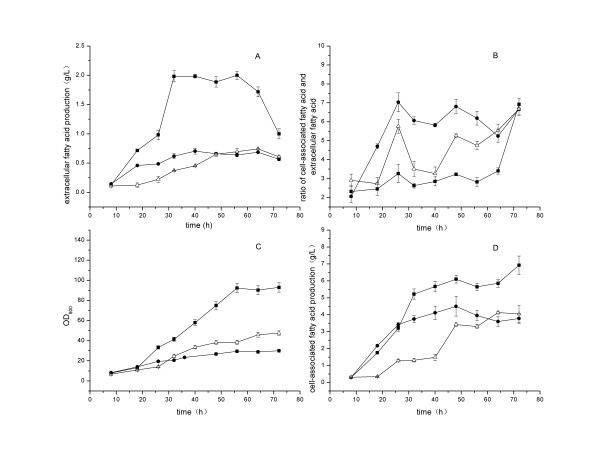
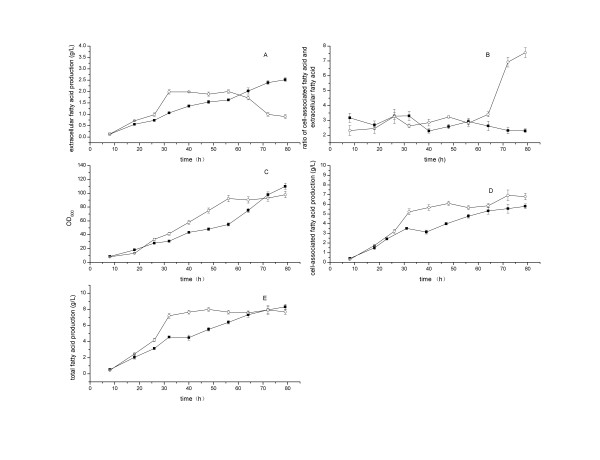
In this study, both strain improvements and cultivation process strategies were applied to increase extracellular fatty acid production by engineered Escherichia coli. Our results showed overexpressing 'TesA and the deletion of fadL in E. coli BL21 (DE3) improved extracellular fatty acid production, while deletion of fadD didn't strengthen the extracellular fatty acid production for an undetermined mechanism. Moreover, the cultivation process controls contributed greatly to extracellular fatty acid production with respect to titer, cell growth and productivity by adjusting the temperature, adding ampicillin and employing on-line extraction. Under optimal conditions, the E. coli strain (pACY-'tesA-ΔfadL) produced 4.8 g L⁻¹ extracellular fatty acid, with the specific productivity of 0.02 g h⁻¹ g⁻¹ dry cell mass, and the yield of 4.4% on glucose, while the ratios of cell-associated fatty acid versus extracellular fatty acid were kept below 0.5 after 15 h of cultivation. The fatty acids included C12:1, C12:0, C14:1, C14:0, C16:1, C16:0, C18:1, C18:0. The composition was dominated by C14 and C16 saturated and unsaturated fatty acids. Using the strain pACY-'tesA, similar results appeared under the same culture conditions and the titer was also much higher than that ever reported previously, which suggested that the supposedly superior strain did not necessarily perform best for the efficient production of desired product. The strain pACY-'tesA could also be chosen as the original strain for the next genetic manipulations.
The general strategy of metabolic engineering for the extracellular fatty acid production should be the cyclic optimization between cultivation performance and strain improvements. On the basis of our cultivation process optimization, strain improvements should be further carried out for the effective and cost-effective production process.
作为经济生物柴油生产的替代方法,微生物利用可再生资源从细胞外生产脂肪酸越来越受到关注,因为从微生物细胞中分离脂肪酸通常涉及一系列能源密集型步骤。许多尝试已经通过靶向脂肪酸生物合成途径中的基因来构建产脂肪酸的菌株,而很少有研究关注培养过程和传质动力学。
在这项研究中,通过工程大肠杆菌同时应用菌株改良和培养过程策略来提高细胞外脂肪酸的产量。我们的结果表明,在大肠杆菌 BL21(DE3)中过表达 'TesA 和缺失 fadL 可以提高细胞外脂肪酸的产量,而 fadD 的缺失对于一个未知的机制并没有加强细胞外脂肪酸的生产。此外,通过调节温度、添加氨苄青霉素和采用在线提取,培养过程控制对提高细胞外脂肪酸的产量、细胞生长和生产效率有很大贡献。在最佳条件下,大肠杆菌菌株(pACY-'tesA-ΔfadL)产生了 4.8 g/L 的细胞外脂肪酸,比产率为 4.4%,特异性生产率为 0.02 g h⁻¹ g⁻¹干细胞质量,而培养 15 小时后细胞相关脂肪酸与细胞外脂肪酸的比例保持在 0.5 以下。脂肪酸包括 C12:1、C12:0、C14:1、C14:0、C16:1、C16:0、C18:1、C18:0。组成以 C14 和 C16 饱和和不饱和脂肪酸为主。在相同的培养条件下,使用菌株 pACY-'tesA 也出现了类似的结果,并且产量也远高于以往报道的产量,这表明优势菌株不一定最适合高效生产所需产物。菌株 pACY-'tesA 也可以作为下一步遗传操作的原始菌株。
细胞外脂肪酸生产的代谢工程通用策略应该是在培养性能和菌株改良之间进行循环优化。在我们的培养过程优化的基础上,应进一步进行菌株改良,以实现有效和具有成本效益的生产过程。