Cytogenetics Laboratory, Department of Zoology, Banaras Hindu University, Varanasi, India.
PLoS One. 2012;7(5):e37113. doi: 10.1371/journal.pone.0037113. Epub 2012 May 14.
Ayurveda represents the traditional medicine system of India. Since mechanistic details of therapy in terms of current biology are not available in Ayurvedic literature, modern scientific studies are necessary to understand its major concepts and procedures. It is necessary to examine effects of the whole Ayurvedic formulations rather than their "active" components as is done in most current studies.
We tested two different categories of formulations, a Rasayana (Amalaki Rasayana or AR, an herbal derivative) and a Bhasma (Rasa-Sindoor or RS, an organo-metallic derivative of mercury), for effects on longevity, development, fecundity, stress-tolerance, and heterogeneous nuclear ribonucleoprotein (hnRNP) levels of Drosophila melanogaster using at least 200 larvae or flies for each assay.
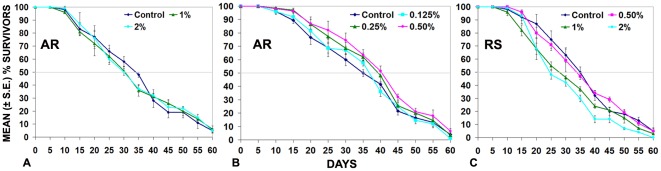
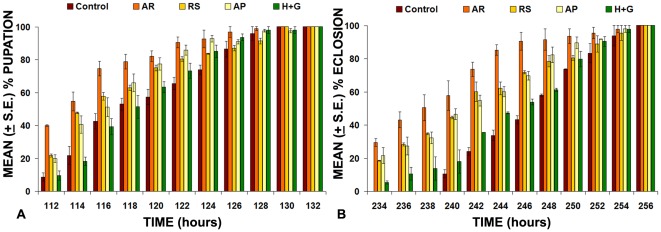
A 0.5% (weight/volume) supplement of AR or RS affected life-history and other physiological traits in distinct ways. While the size of salivary glands, hnRNP levels in larval tissues, and thermotolerance of larvae/adult flies improved significantly following feeding either of the two formulations, the median life span and starvation resistance improved only with AR. Feeding on AR or RS supplemented food improved fecundity differently. Feeding of larvae and adults with AR increased the fecundity while the same with RS had opposite effect. On the contrary, feeding larvae on normal food and adults on AR supplement had no effect on fecundity but a comparable regime of feeding on RS-supplemented food improved fecundity. RS feeding did not cause heavy metal toxicity.
The present study with two Ayurvedic formulations reveals formulation-specific effects on several parameters of the fly's life, which seem to generally agree with their recommended human usages in Ayurvedic practices. Thus, Drosophila, with its very rich genetic tools and well-worked-out developmental pathways promises to be a very good model for examining the cellular and molecular bases of the effects of different Ayurvedic formulations.
阿育吠陀代表印度的传统医学体系。由于阿育吠陀文献中没有当前生物学意义上的治疗机制细节,因此有必要进行现代科学研究以了解其主要概念和程序。有必要检查整个阿育吠陀制剂的效果,而不是像大多数当前研究那样检查其“活性”成分。
我们用至少 200 个幼虫或苍蝇测试了两种不同类别的制剂,即 Rasayana(Amalaki Rasayana 或 AR,一种草药衍生物)和 Bhasma(Rasa-Sindoor 或 RS,汞的有机金属衍生物),以研究其对寿命,发育,繁殖力,抗应激能力和异质性核核糖核蛋白(hnRNP)水平的影响。果蝇使用。
0.5%(重量/体积)的 AR 或 RS 补充剂以不同的方式影响了生命史和其他生理特征。尽管两种制剂喂养后,唾液腺的大小,幼虫组织中的 hnRNP 水平以及幼虫/成年果蝇的耐热性均显著提高,但仅 AR 喂养可提高中位寿命和抗饥饿能力。用 AR 或 RS 补充食物喂养对繁殖力的影响不同。用 AR 喂养幼虫和成虫会增加繁殖力,而用 RS 喂养则有相反的效果。相反,用正常食物喂养幼虫和成虫补充 AR 对繁殖力没有影响,但用 RS 补充食物喂养的类似方案可以提高繁殖力。 RS 喂养不会引起重金属毒性。
本研究用两种阿育吠陀制剂揭示了它们对果蝇生命的几个参数的特定制剂的影响,这似乎与它们在阿育吠陀实践中的推荐用途大致相符。因此,果蝇具有丰富的遗传工具和完善的发育途径,有望成为检查不同阿育吠陀制剂作用的细胞和分子基础的非常好的模型。