Institut Català de la Salut, Barcelona, Spain.
BMC Musculoskelet Disord. 2012 May 28;13:79. doi: 10.1186/1471-2474-13-79.
Knowledge on the epidemiology of non-hip fractures in Spain is limited and somewhat outdated. Using computerized primary care records from the SIDIAP database, we derived age and sex-specific fracture incidence rates for the region of Catalonia during the year 2009.
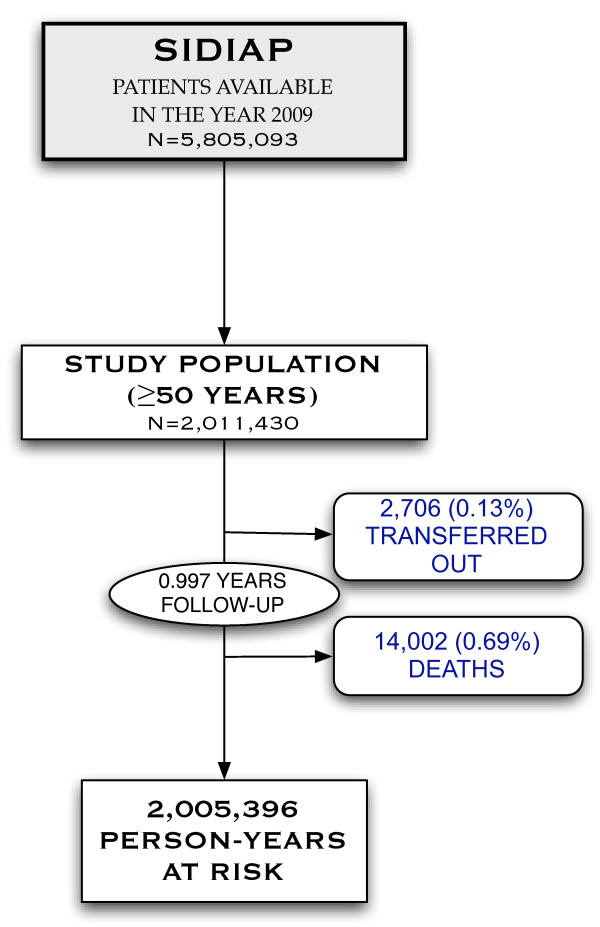
The SIDIAP database contains quality-checked clinical information from computerized medical records of a representative sample of >5,800,000 patients (80% of the population of Catalonia). We conducted a retrospective cohort study including all patients aged ≥50 years, and followed them from January 1 to December 31, 2009. Major osteoporotic fractures registered in SIDIAP were ascertained using ICD-10 codes and validated by comparing data to hospital admission and patient-reported fractures records. Incidence rates and 95% confidence intervals were calculated.
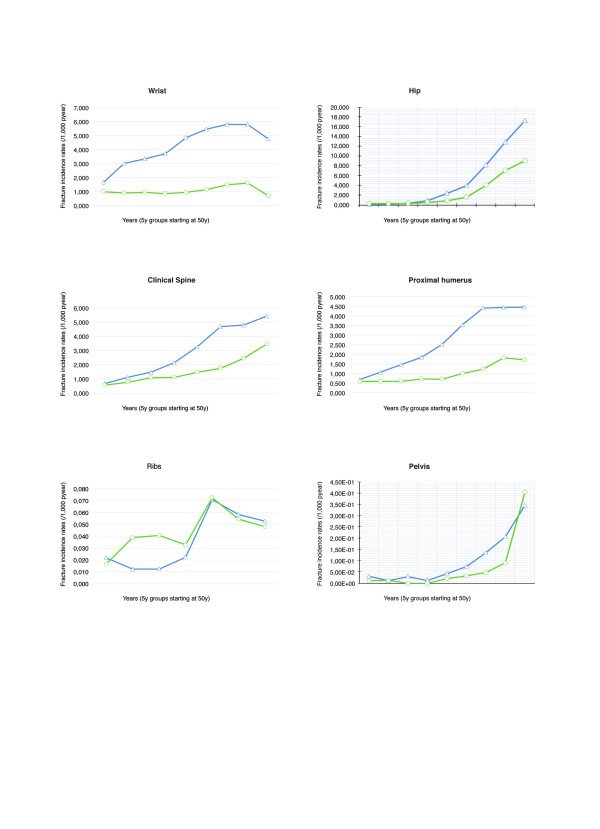
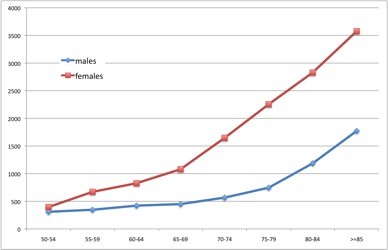
In total, 2,011,430 subjects were studied (54.6% women). Overall fracture rates were 10.91/1,000 person-years (py) [95%CI 10.89-10.92]: 15.18/1,000 py [15.15-15.21] in women and 5.78/1,000 py [5.76-5.79] in men. The most common fracture among women was wrist/forearm (3.86/1,000 py [3.74-3.98]), while among men it was clinical spine (1.25/1,000 py [1.18-1.33]). All fracture rates increased with age, but varying patterns were observed: while most of the fractures (hip, proximal humerus, clinical spine and pelvis) increased continuously with age, wrist and multiple rib fractures peaked at age 75-80 and then reached a plateau.
Our study provides local estimates of age, sex and site-specific fracture burden in primary health care, which will be helpful for health-care planning and delivery. A proportion of fractures are not reported in primary care records, leading to underestimation of fracture incidence rates in these data.
西班牙非髋部骨折的流行病学知识有限且有些陈旧。我们利用 SIDIAP 数据库的计算机化初级保健记录,得出了 2009 年加泰罗尼亚地区按年龄和性别划分的骨折发病率。
SIDIAP 数据库包含了来自超过 580 万患者(加泰罗尼亚地区 80%的人口)计算机化医疗记录的经过质量检查的临床信息。我们进行了一项回顾性队列研究,纳入了所有年龄≥50 岁的患者,并从 2009 年 1 月 1 日至 12 月 31 日对其进行随访。SIDIAP 中登记的主要骨质疏松性骨折使用 ICD-10 代码确定,并通过与医院入院和患者报告的骨折记录进行比较来验证。计算发病率和 95%置信区间。
共有 2011430 名患者纳入研究(54.6%为女性)。总体骨折发生率为 10.91/1000 人年(95%CI 10.89-10.92):女性为 15.18/1000 人年(15.15-15.21),男性为 5.78/1000 人年(5.76-5.79)。女性中最常见的骨折是腕/前臂(3.86/1000 人年[3.74-3.98]),而男性中最常见的骨折是临床脊柱(1.25/1000 人年[1.18-1.33])。所有骨折发生率均随年龄增长而增加,但存在不同模式:大多数骨折(髋部、近端肱骨、临床脊柱和骨盆)随年龄持续增加,而腕部和多处肋骨骨折在 75-80 岁时达到峰值,然后达到平台期。
我们的研究提供了初级保健中按年龄、性别和部位划分的骨折负担的当地估计值,这将有助于医疗保健规划和服务的提供。初级保健记录中并未报告一部分骨折,这导致这些数据中骨折发病率的低估。