Department of Preventive Medicine, Keck School of Medicine, University of Southern California, Alhambra, CA 91803, USA.
Am J Health Promot. 2012 Jul-Aug;26(6):371-80. doi: 10.4278/ajhp.100827-QUAN-290.
To examine whether residing in a community designed to promote physical activity moderates the relationship between parent perceptions of the neighborhood and general physical activity or active commuting to school in their children.
Cross-sectional.
San Bernardino County, California.
Three hundred sixty-five families (one parent and one child in grades four through eight). Eighty-five reside in a smart growth community designed to be more conducive to physical activity.
Parent perceptions assessed using the Neighborhood Environment Walkability Scale (NEWS). General child physical activity was measured using accelerometers, and active commuting was self-reported by children.
Two sets of regressions were performed: one for general physical activity, and one for active commuting. Separate models were run in the two sets for each of the 14 NEWS factors, while controlling for demographics.
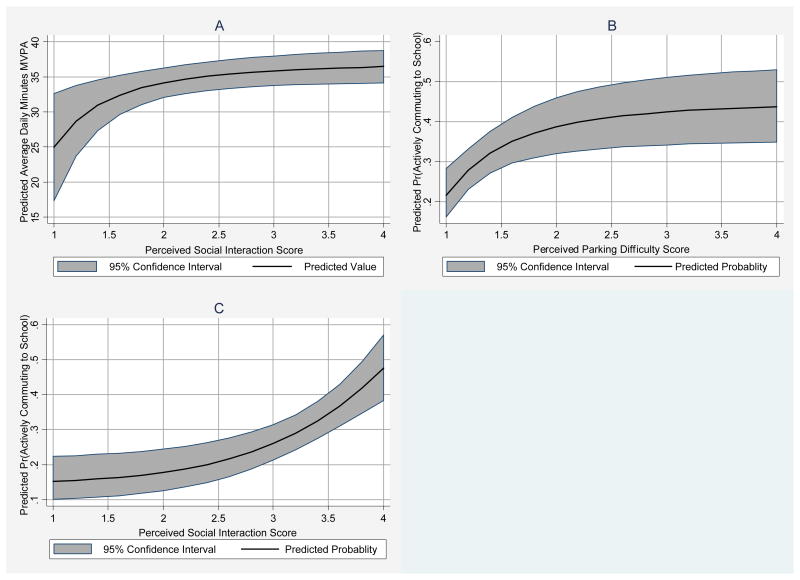
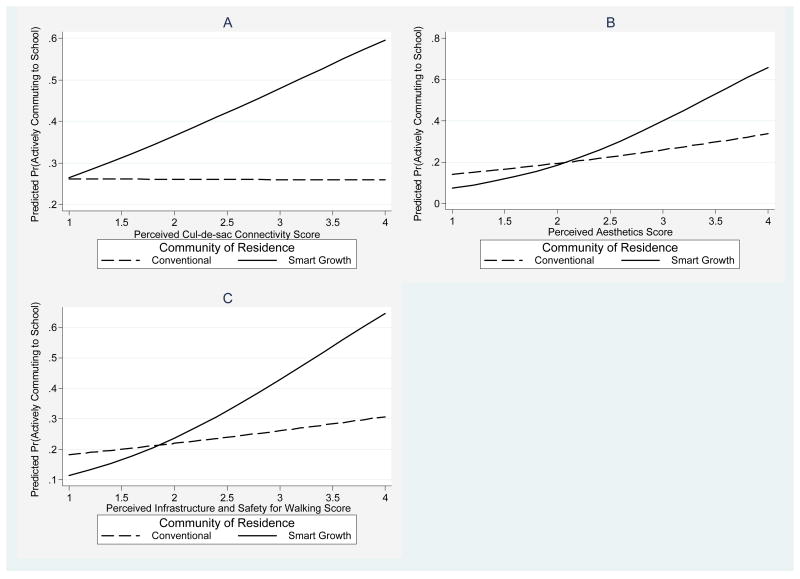
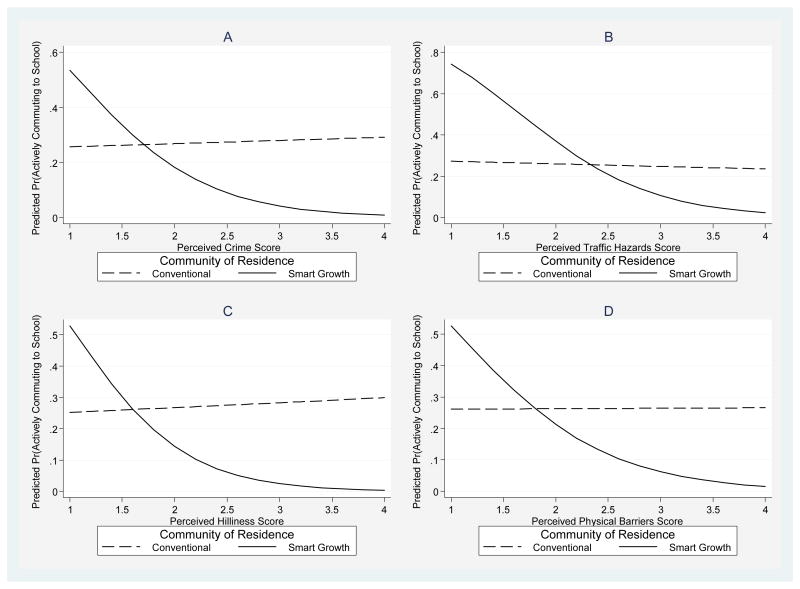
For general physical activity, walking infrastructure, lack of cul-de-sacs, and social interaction had significant main effect associations (p ≤ .05). No factors were moderated by community. The relationships between active commuting to school and perceived crime, traffic hazards, hilliness, physical barriers, cul-de-sac connectivity, aesthetics, and walking infrastructure were significant for those in the smart growth community only (p ≤ .05).
Living in an activity-friendly environment is associated with positive relationships between parent perceptions and active commuting behaviors in children. Future interventions should account for both the perceived neighborhood environment and available physical activity infrastructure.
研究居住在促进身体活动的社区是否能调节父母对邻里环境的看法与孩子的一般身体活动或主动上学交通方式之间的关系。
横断面研究。
加利福尼亚州圣贝纳迪诺县。
365 个家庭(四年级至八年级的一位家长和一位孩子)。其中 85 人居住在一个智能增长社区,旨在促进身体活动。
使用邻里环境步行性量表(NEWS)评估家长的看法。通过加速度计测量儿童的一般身体活动,由儿童自我报告主动上学交通方式。
进行了两组回归分析:一组用于一般身体活动,一组用于主动上学交通方式。在两组中,分别为 14 个 NEWS 因素中的每一个因素运行单独的模型,同时控制人口统计学因素。
对于一般身体活动,步行基础设施、没有死胡同和社会互动具有显著的主要关联(p ≤.05)。没有任何因素受到社区的调节。在智能增长社区中,与感知犯罪、交通危险、坡度、物理障碍、死胡同连通性、美学和步行基础设施相关的主动上学交通方式与感知犯罪、交通危险、坡度、物理障碍、死胡同连通性、美学和步行基础设施之间存在显著关系(p ≤.05)。
生活在一个适宜活动的环境中与父母对邻里环境的看法与孩子的积极主动上学交通方式之间存在正相关关系。未来的干预措施应同时考虑到感知邻里环境和可用的身体活动基础设施。