PharmaBiotech, Basel, Switzerland.
Med Princ Pract. 2013;22(3):209-19. doi: 10.1159/000341794. Epub 2012 Aug 16.
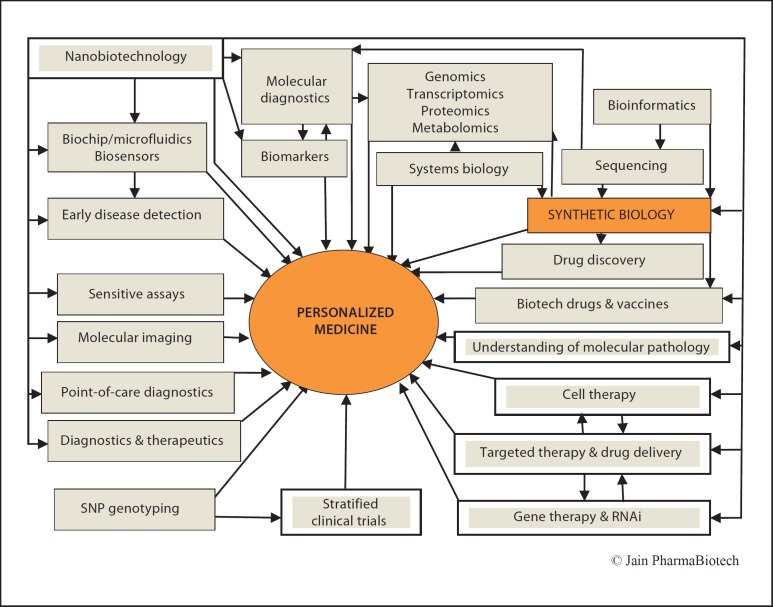
Synthetic biology, application of synthetic chemistry to biology, is a broad term that covers the engineering of biological systems with structures and functions not found in nature to process information, manipulate chemicals, produce energy, maintain cell environment and enhance human health. Synthetic biology devices contribute not only to improve our understanding of disease mechanisms, but also provide novel diagnostic tools. Methods based on synthetic biology enable the design of novel strategies for the treatment of cancer, immune diseases metabolic disorders and infectious diseases as well as the production of cheap drugs. The potential of synthetic genome, using an expanded genetic code that is designed for specific drug synthesis as well as delivery and activation of the drug in vivo by a pathological signal, was already pointed out during a lecture delivered at Kuwait University in 2005. Of two approaches to synthetic biology, top-down and bottom-up, the latter is more relevant to the development of personalized medicines as it provides more flexibility in constructing a partially synthetic cell from basic building blocks for a desired task.
合成生物学,即应用合成化学的方法来设计、构建具有特定功能的生物系统,是一个涵盖了信息处理、化学操控、能量产生、细胞环境维持以及人类健康增强等多个领域的广泛术语。合成生物学器件不仅有助于加深我们对疾病机制的理解,还为新型诊断工具的开发提供了可能。基于合成生物学的方法可以设计出治疗癌症、免疫疾病、代谢紊乱和传染病的新型策略,同时也可以生产廉价的药物。2005 年在科威特大学的一次演讲中,已经指出了利用扩展遗传密码的合成基因组的潜力,该遗传密码专为特定药物的合成以及通过病理信号在体内递药和激活药物而设计。在自上而下和自下而上这两种合成生物学方法中,后者与个性化药物的发展更为相关,因为它为从基本构建块构建部分合成细胞以实现预期任务提供了更大的灵活性。