Political Science Department, University of California, San Diego, La Jolla, California 92093, USA.
Nature. 2012 Sep 13;489(7415):295-8. doi: 10.1038/nature11421.
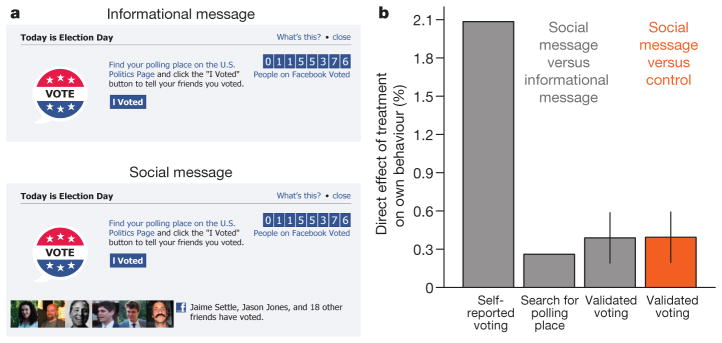
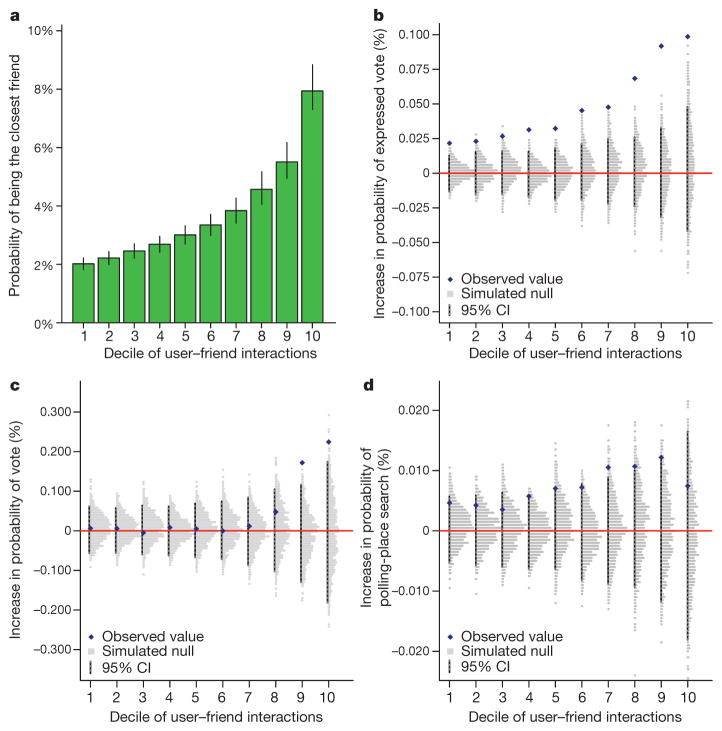
Human behaviour is thought to spread through face-to-face social networks, but it is difficult to identify social influence effects in observational studies, and it is unknown whether online social networks operate in the same way. Here we report results from a randomized controlled trial of political mobilization messages delivered to 61 million Facebook users during the 2010 US congressional elections. The results show that the messages directly influenced political self-expression, information seeking and real-world voting behaviour of millions of people. Furthermore, the messages not only influenced the users who received them but also the users' friends, and friends of friends. The effect of social transmission on real-world voting was greater than the direct effect of the messages themselves, and nearly all the transmission occurred between 'close friends' who were more likely to have a face-to-face relationship. These results suggest that strong ties are instrumental for spreading both online and real-world behaviour in human social networks.
人们认为,人类行为是通过面对面的社交网络传播的,但在观察性研究中很难识别社交影响效应,也不知道在线社交网络是否以同样的方式运作。在这里,我们报告了在 2010 年美国国会选举期间向 6100 万 Facebook 用户发送政治动员信息的随机对照试验结果。结果表明,这些信息直接影响了数百万人的政治自我表达、信息搜索和现实世界的投票行为。此外,这些信息不仅影响了收到信息的用户,还影响了他们的朋友以及朋友的朋友。社会传播对现实世界投票的影响大于信息本身的直接影响,而且几乎所有的传播都发生在“亲密朋友”之间,这些朋友更有可能存在面对面的关系。这些结果表明,在人类社交网络中,强关系对于传播在线和现实世界的行为都很重要。