Max Planck Institute for Evolutionary Anthropology, Leipzig, Germany.
PLoS One. 2012;7(10):e48433. doi: 10.1371/journal.pone.0048433. Epub 2012 Oct 31.
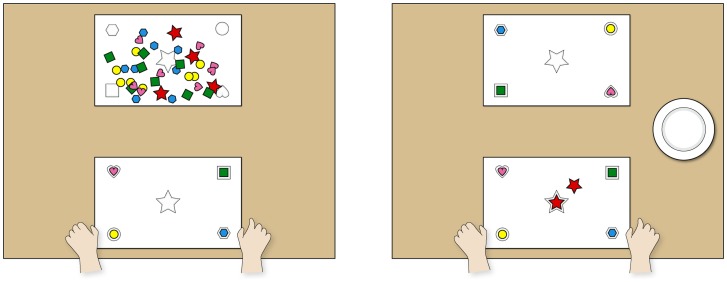
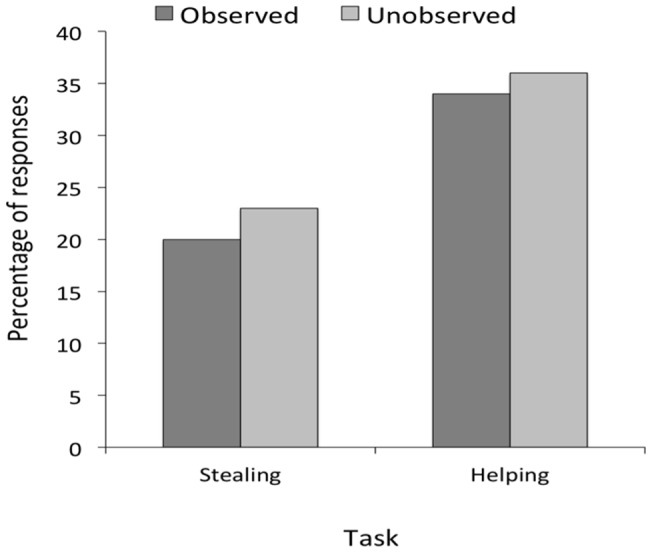
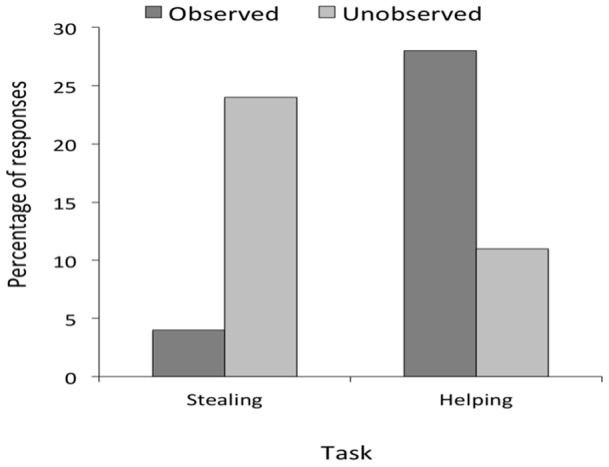
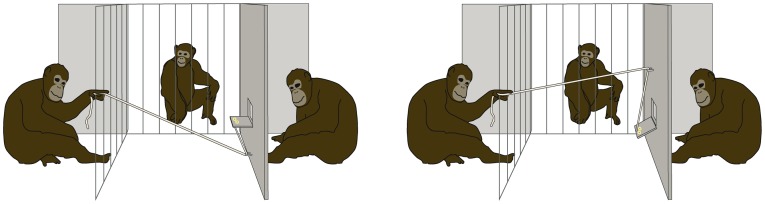
Virtually all theories of the evolution of cooperation require that cooperators find ways to interact with one another selectively, to the exclusion of cheaters. This means that individuals must make reputational judgments about others as cooperators, based on either direct or indirect evidence. Humans, and possibly other species, add another component to the process: they know that they are being judged by others, and so they adjust their behavior in order to affect those judgments - so-called impression management. Here, we show for the first time that already preschool children engage in such behavior. In an experimental study, 5-year-old human children share more and steal less when they are being watched by a peer than when they are alone. In contrast, chimpanzees behave the same whether they are being watched by a groupmate or not. This species difference suggests that humans' concern for their own self-reputation, and their tendency to manage the impression they are making on others, may be unique to humans among primates.
几乎所有关于合作进化的理论都要求合作者找到有选择地相互作用的方法,将骗子排除在外。这意味着个体必须根据直接或间接的证据,对他人作为合作者做出声誉判断。人类,可能还有其他物种,为这个过程增加了另一个组成部分:他们知道自己正在被他人评判,因此他们会调整自己的行为,以影响那些评判——所谓的印象管理。在这里,我们首次表明,甚至学龄前儿童也会有这种行为。在一项实验研究中,当 5 岁的人类儿童被同伴观察时,他们会比独处时分享更多,偷窃更少。相比之下,黑猩猩无论是否被同伴观察,行为都是一样的。这种物种差异表明,人类对自身声誉的关注,以及他们管理自己在他人眼中形象的倾向,可能是人类在灵长类动物中所独有的。