Department of Chemical and Biomolecular Engineering, University of California, Los Angeles, CA 90095, USA.
Microb Cell Fact. 2013 Jan 22;12:4. doi: 10.1186/1475-2859-12-4.
The modern society primarily relies on petroleum and natural gas for the production of fuels and chemicals. One of the major commodity chemicals 1,2-propanediol (1,2-PDO), which has an annual production of more than 0.5 million tons in the United States, is currently produced by chemical processes from petroleum derived propylene oxide, which is energy intensive and not sustainable. In this study, we sought to achieve photosynthetic production of 1,2-PDO from CO2 using a genetically engineered cyanobacterium Synechococcus elongatus PCC 7942. Compared to the previously reported biological 1,2-PDO production processes which used sugar or glycerol as the substrates, direct chemical production from CO2 in photosynthetic organisms recycles the atmospheric CO2 and will not compete with food crops for arable land.
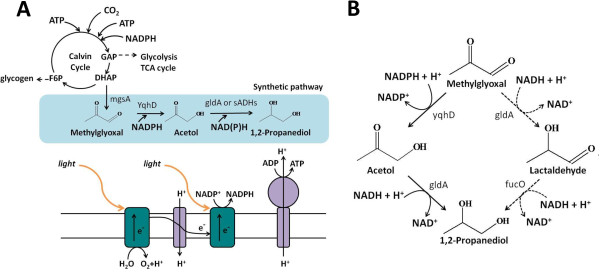
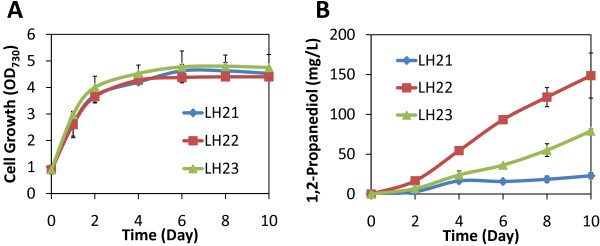
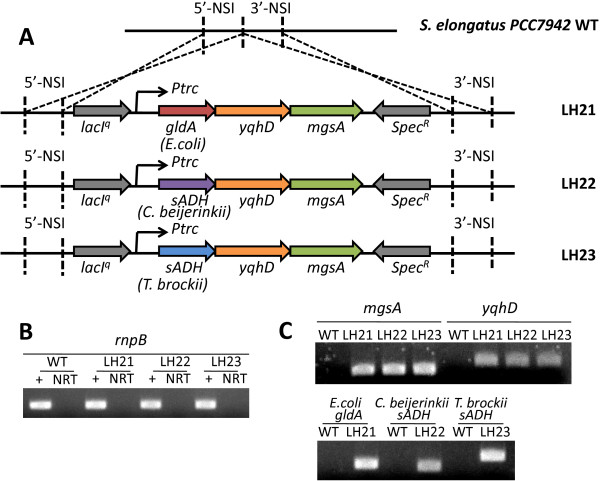
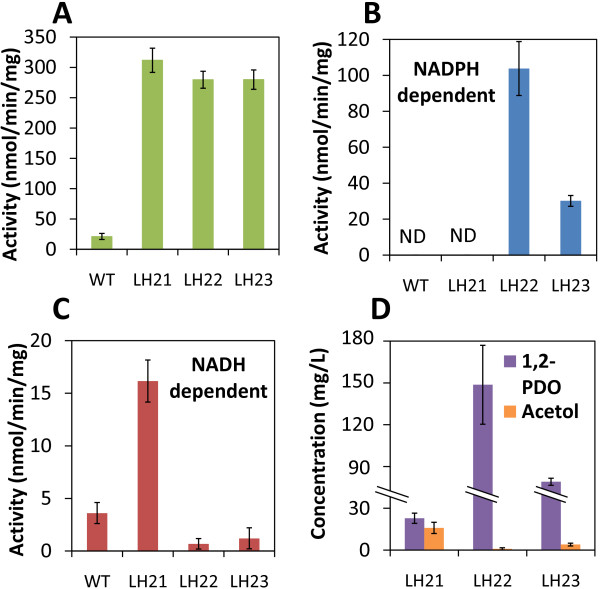
In this study, we reported photosynthetic production of 1,2-PDO from CO2 using a genetically engineered cyanobacterium Synechococcus elongatus PCC 7942. Introduction of the genes encoding methylglyoxal synthase (mgsA), glycerol dehydrogenase (gldA), and aldehyde reductase (yqhD) resulted in the production of ~22 mg/L 1,2-PDO from CO2. However, a comparable amount of the pathway intermediate acetol was also produced, especially during the stationary phase. The production of 1,2-PDO requires a robust input of reducing equivalents from cellular metabolism. To take advantage of cyanobacteria's NADPH pool, the synthetic pathway of 1,2-PDO was engineered to be NADPH-dependent by exploiting the NADPH-specific secondary alcohol dehydrogenases which have not been reported for 1,2-PDO production previously. This optimization strategy resulted in the production of ~150 mg/L 1,2-PDO and minimized the accumulation of the incomplete reduction product, acetol.
This work demonstrated that cyanobacteria can be engineered as a catalyst for the photosynthetic conversion of CO2 to 1,2-PDO. This work also characterized two NADPH-dependent sADHs for their catalytic capacity in 1,2-PDO formation, and suggested that they may be useful tools for renewable production of reduced chemicals in photosynthetic organisms.
现代社会主要依赖石油和天然气来生产燃料和化学品。一种主要的大宗商品化学品 1,2-丙二醇(1,2-PDO),其在美国的年产量超过 50 万吨,目前是通过石油衍生的环氧丙烷的化学工艺生产的,这种工艺不仅能源密集,而且不可持续。在这项研究中,我们试图利用基因工程化的蓝藻集胞藻 PCC 7942 从二氧化碳中实现 1,2-PDO 的光合作用生产。与之前报道的使用糖或甘油作为底物的生物 1,2-PDO 生产工艺相比,直接从光合生物中的二氧化碳进行化学生产可以回收大气中的二氧化碳,并且不会与粮食作物争夺耕地。
在这项研究中,我们报告了利用基因工程化的蓝藻集胞藻 PCC 7942 从二氧化碳中生产 1,2-PDO。引入编码甲基乙二醛合酶(mgsA)、甘油脱氢酶(gldA)和醛还原酶(yqhD)的基因导致从二氧化碳中生产出约 22mg/L 的 1,2-PDO。然而,也产生了相当数量的途径中间产物乙缩醛,特别是在静止期。1,2-PDO 的生产需要细胞代谢中大量的还原当量输入。为了利用蓝藻的 NADPH 池,1,2-PDO 的合成途径通过利用以前没有报道过用于 1,2-PDO 生产的 NADPH 特异性仲醇脱氢酶被设计为 NADPH 依赖性。这种优化策略导致生产出约 150mg/L 的 1,2-PDO,并且最小化了不完全还原产物乙缩醛的积累。
这项工作表明,蓝藻可以被工程化为一种将二氧化碳转化为 1,2-PDO 的光合作用催化剂。这项工作还对两种 NADPH 依赖性 sADH 进行了表征,以确定它们在 1,2-PDO 形成中的催化能力,并表明它们可能是在光合生物中可再生生产还原化学品的有用工具。