Department of Biology, San Francisco State University, San Francisco, California 94132, USA.
Sci Rep. 2013;3:1126. doi: 10.1038/srep01126. Epub 2013 Jan 24.
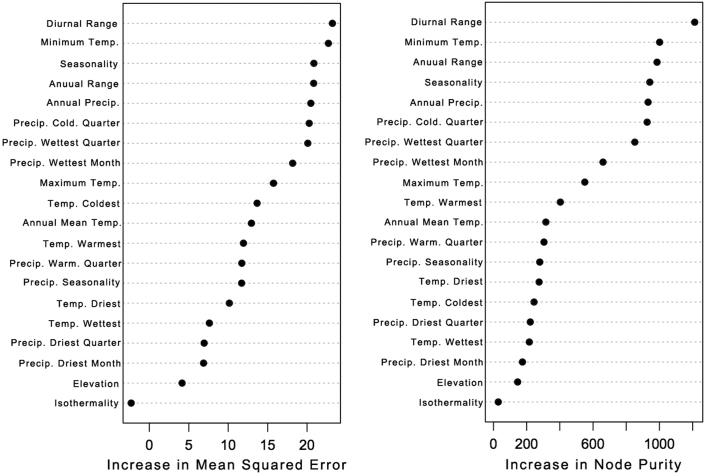
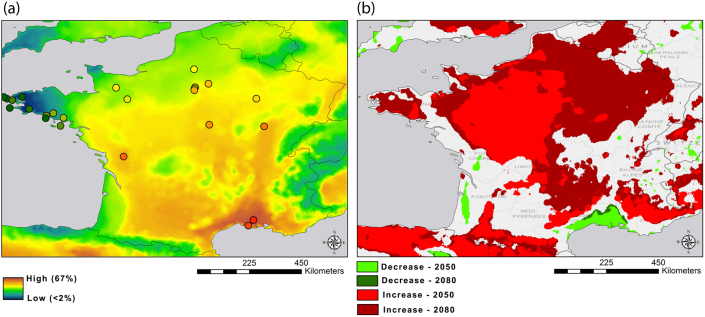
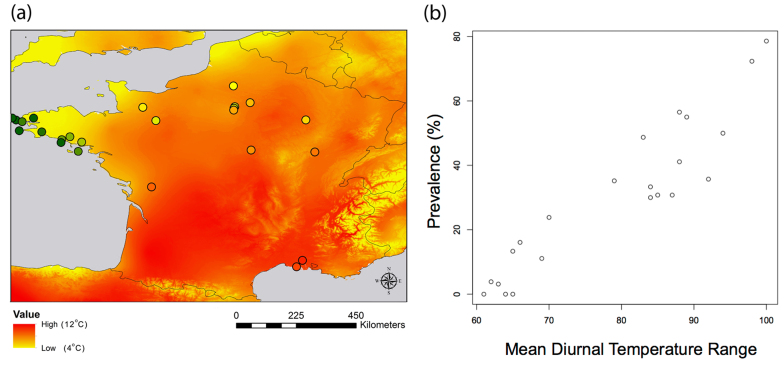
Vector-borne diseases are particularly responsive to changing environmental conditions. Diurnal temperature variation has been identified as a particularly important factor for the development of malaria parasites within vectors. Here, we conducted a survey across France, screening populations of the house sparrow (Passer domesticus) for malaria (Plasmodium relictum). We investigated whether variation in remotely-sensed environmental variables accounted for the spatial variation observed in prevalence and parasitemia. While prevalence was highly correlated to diurnal temperature range and other measures of temperature variation, environmental conditions could not predict spatial variation in parasitemia. Based on our empirical data, we mapped malaria distribution under climate change scenarios and predicted that Plasmodium occurrence will spread to regions in northern France, and that prevalence levels are likely to increase in locations where transmission already occurs. Our findings, based on remote sensing tools coupled with empirical data suggest that climatic change will significantly alter transmission of malaria parasites.
虫媒传染病对环境条件的变化特别敏感。昼夜温度变化已被确定为媒介内疟原虫发育的一个特别重要的因素。在这里,我们在法国各地进行了一项调查,对家麻雀(Passer domesticus)种群进行了疟疾(Plasmodium relictum)筛查。我们研究了远程感应环境变量的变化是否解释了流行率和寄生虫血症观察到的空间变化。虽然流行率与昼夜温度范围和其他温度变化的测量高度相关,但环境条件不能预测寄生虫血症的空间变化。根据我们的经验数据,我们在气候变化情景下绘制了疟疾的分布,并预测疟原虫的发生将传播到法国北部地区,并且在已经发生传播的地方,流行率水平可能会增加。我们的研究结果基于遥感工具和经验数据,表明气候变化将显著改变疟原虫的传播。