Department of Metabolic Medicine, Osaka University Graduate School of Medicine, Osaka, Japan.
Diabetes Care. 2013 May;36(5):1327-34. doi: 10.2337/dc12-1327. Epub 2013 Feb 12.
Although many studies have shown that carotid intima-media thickness (IMT) is associated with coronary artery disease (CAD), it remains inconclusive whether assessment of carotid IMT is useful as a screening test for asymptomatic but severe CAD in diabetic patients.
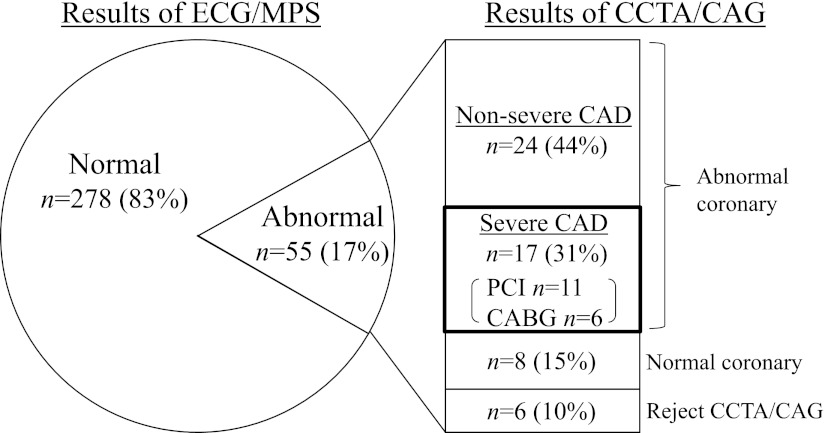
A total of 333 asymptomatic type 2 diabetic patients without history of CAD underwent exercise electrocardiogram or myocardial perfusion scintigraphy for detection of silent myocardial ischemia, and those whose test results were positive were subjected to coronary computed tomography angiography or coronary angiography. The ability of carotid IMT to identify severe CAD corresponding to treatment with revascularization was examined by receiver-operating characteristic (ROC) curve analyses.
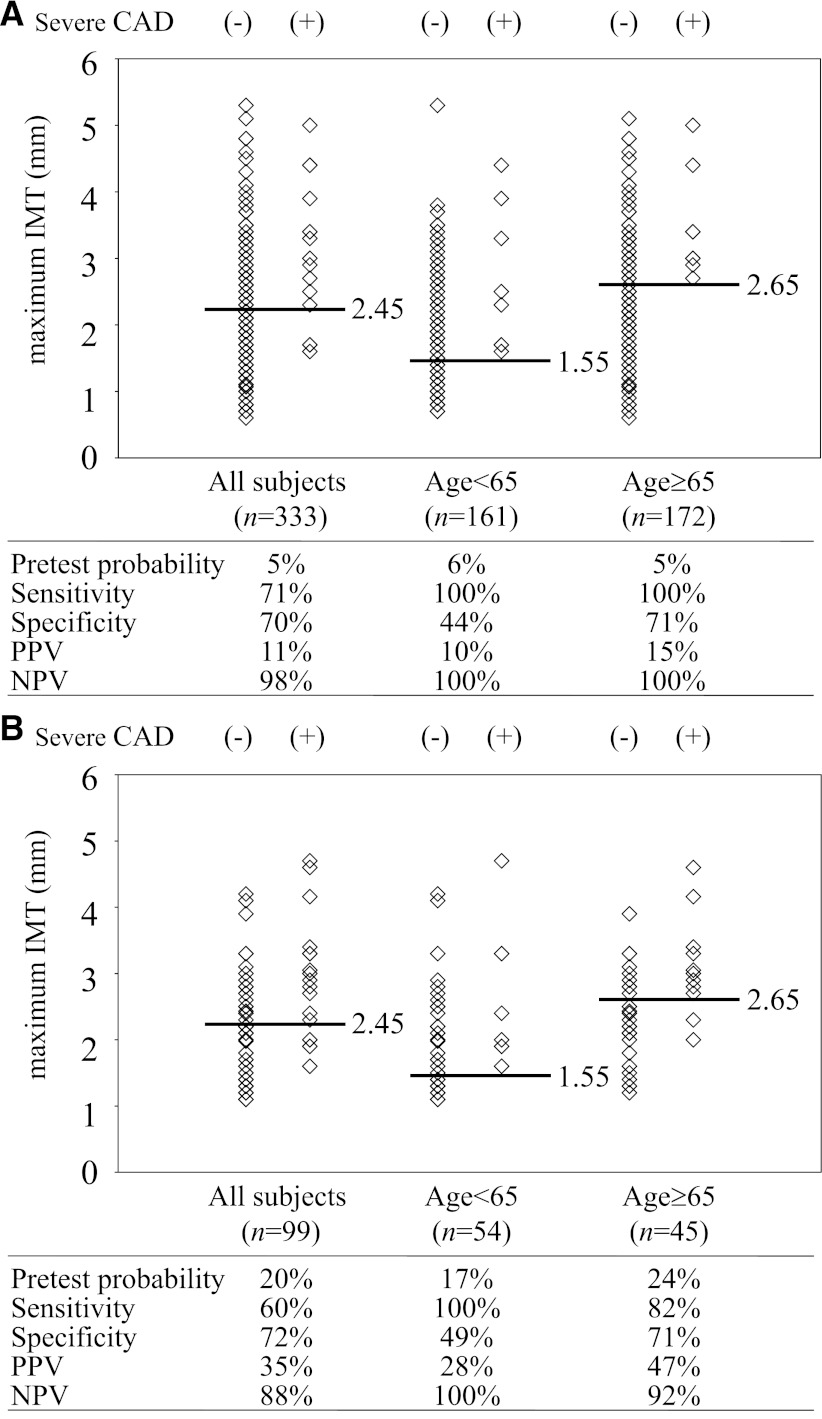
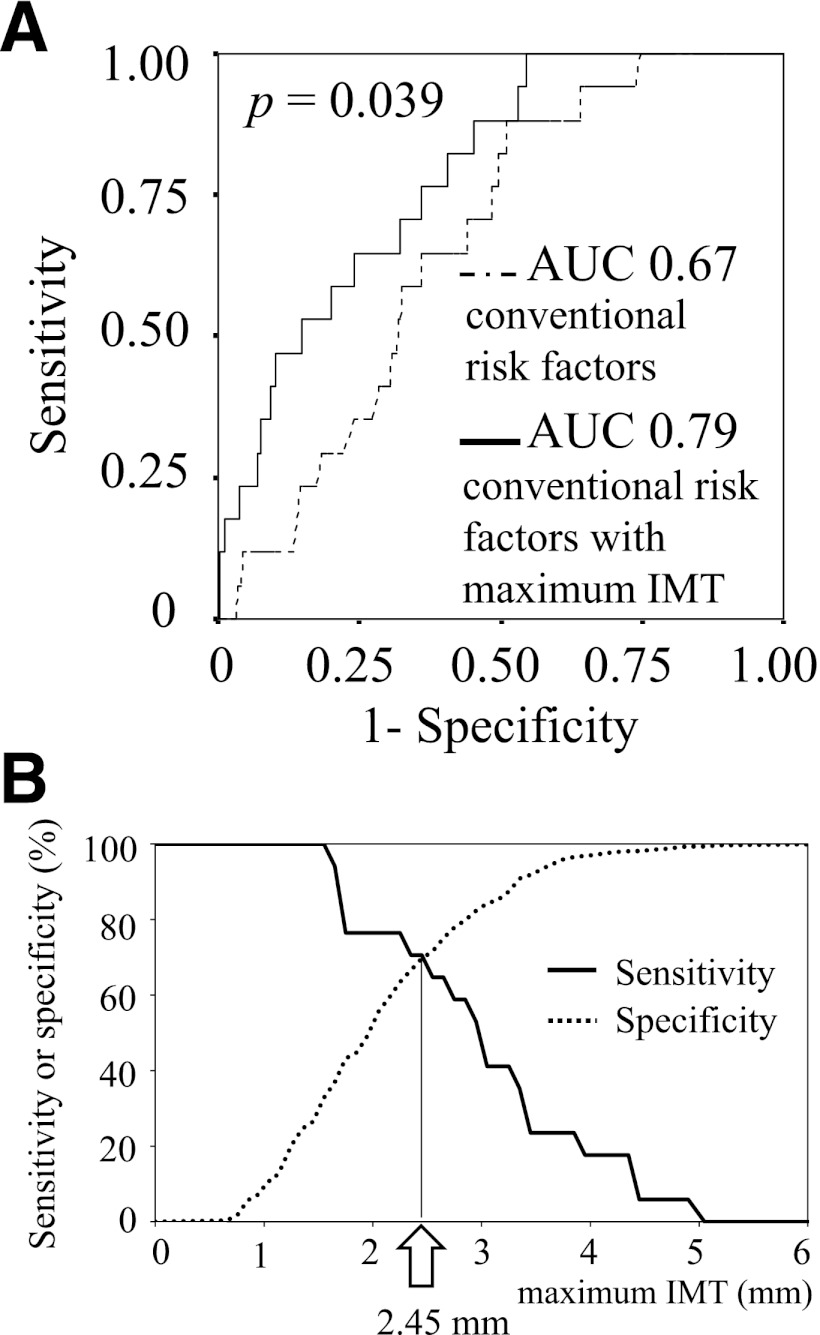
Among the 333 subjects, 17 were treated with revascularization. A multiple logistic regression analysis showed that maximum IMT was an independent predictor of severe CAD even after adjustment for conventional risk factors. ROC curve analyses revealed that the addition of maximum IMT to conventional risk factors significantly improved the prediction ability for severe CAD (from area under the curve, 0.67 to 0.79; P = 0.039). The greatest sensitivity and specificity were obtained when the cut-off value of maximum IMT was set at 2.45 mm (pretest probability, 5%; posttest probability, 11%; sensitivity, 71%). When we applied age-specific cut-off values, the sensitivity of screening further increased in both the nonelderly (pretest probability, 6%; posttest probability, 10%; sensitivity, 100%) and the elderly subjects (pretest probability, 5%; posttest probability, 15%; sensitivity, 100%).
Our study suggests that carotid maximum IMT is useful for screening asymptomatic type 2 diabetic patients with severe CAD equivalent to revascularization.
尽管许多研究表明颈动脉内膜-中层厚度(IMT)与冠状动脉疾病(CAD)有关,但评估颈动脉 IMT 是否可作为无症状但严重 CAD 糖尿病患者的筛查试验,其结果仍不确定。
共 333 例无症状 2 型糖尿病患者,无 CAD 病史,行运动心电图或心肌灌注闪烁显像以检测无症状性心肌缺血,对检查结果阳性者行冠状动脉计算机断层血管造影或冠状动脉造影。通过受试者工作特征(ROC)曲线分析,检查颈动脉 IMT 识别需要血运重建的严重 CAD 的能力。
在 333 例患者中,17 例接受了血运重建治疗。多因素逻辑回归分析显示,最大 IMT 是严重 CAD 的独立预测因子,即使在调整了常规危险因素后也是如此。ROC 曲线分析显示,最大 IMT 与常规危险因素联合应用可显著提高严重 CAD 的预测能力(曲线下面积从 0.67 提高至 0.79;P=0.039)。当最大 IMT 的截止值设定为 2.45mm 时,可获得最大的灵敏度和特异性(术前概率为 5%,术后概率为 11%,灵敏度为 71%)。当应用年龄特异性截止值时,在非老年(术前概率为 6%,术后概率为 10%,灵敏度为 100%)和老年患者(术前概率为 5%,术后概率为 15%,灵敏度为 100%)中,筛查的灵敏度进一步提高。
本研究表明,颈动脉最大 IMT 可用于筛查需要血运重建的无症状 2 型糖尿病严重 CAD 患者。