Academy of Physical Education and Sport, Department of Physiology, Gdańsk, Poland.
J Hum Kinet. 2011 Dec;30:65-73. doi: 10.2478/v10078-011-0074-1. Epub 2011 Dec 25.
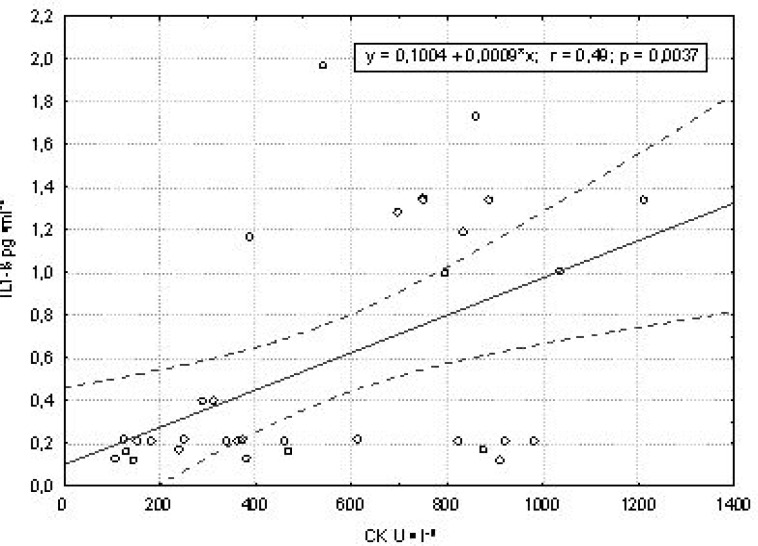
The main purpose of this study was to investigate how extreme physical strain influences cytokine response and oxidative stress markers by examining professional judo athletes during a typical 3-day judo training session (randori combat training). Creatine kinase (CK) activity, a marker of muscle damage, was considerably elevated immediately after randori training. Pro- (IL-1β and TNF-α) and anti-inflammatory (IL-6 and IL-10) cytokines were also increased. The strongest effect was seen in IL-1β concentration, which correlated with CK activity (r = 0.49, P < 0.05). All the observed cytokines returned to baseline (IL-1β) or even dropped below initial levels (TNF-α, IL-6 and IL-10) 12 h after completing the training. Lipid peroxides (LPO), a marker of reactive oxygen species, also decreased below their initial values. LPO levels correlated directly with IL-1β, TNF-α, IL-6 and IL-10. This study is the first to evaluate the effect of a 3-day judo training session on muscle damage by evaluating the release of pro- and anti-inflammatory cytokines and markers of oxidative stress. It is also the first to demonstrate significant changes in the blood cytokine profile that correlate with lipid peroxide levels and muscle damage.
本研究的主要目的是通过检查专业柔道运动员在典型的 3 天柔道训练(实战训练)期间,研究极端体力消耗如何影响细胞因子反应和氧化应激标志物。肌酸激酶(CK)活性作为肌肉损伤的标志物,在实战训练后立即显著升高。促炎(IL-1β 和 TNF-α)和抗炎(IL-6 和 IL-10)细胞因子也增加。IL-1β 浓度的变化最为显著,与 CK 活性呈正相关(r = 0.49,P < 0.05)。所有观察到的细胞因子在训练结束后 12 小时内恢复到基线(IL-1β)或甚至低于初始水平(TNF-α、IL-6 和 IL-10)。脂质过氧化物(LPO)作为活性氧的标志物,也低于初始值。LPO 水平与 IL-1β、TNF-α、IL-6 和 IL-10 呈直接相关。本研究首次通过评估促炎和抗炎细胞因子及氧化应激标志物的释放来评估 3 天柔道训练对肌肉损伤的影响。这也是首次证明与脂质过氧化物水平和肌肉损伤相关的血液细胞因子谱发生显著变化。